[Penalty] Shoot-outs—the first of which, in the World Cup in Brazil, could be on June 28th—demand qualities rarely needed by footballers. The match proper is a team game, but a penalty kick is a lone endeavour. It allows time for agonised thinking, not least on the long walk from the team’s huddle towards the goal. It looks simple, yet the stakes are agonisingly high. A shoot-out, in other words, is a test less of athleticism or skill than of nerve.
Some nations are more jittery than others. A shoot-out was first used as a World Cup tie-breaker in 1982, and a clear pattern is visible. The English are at the bottom, with six losses out of seven shoot-outs in World Cup or European Championship tournaments (see chart). The Dutch, with four losses out of five, are also fairly dire. Conversely, the Germans have won all their four World Cup shoot-outs (in Britain, the notion that the Germans are invincible at penalties is among the few still-respectable national stereotypes). The Czechs are even more proficient: they have never missed a single kick in a penalty shoot-out.
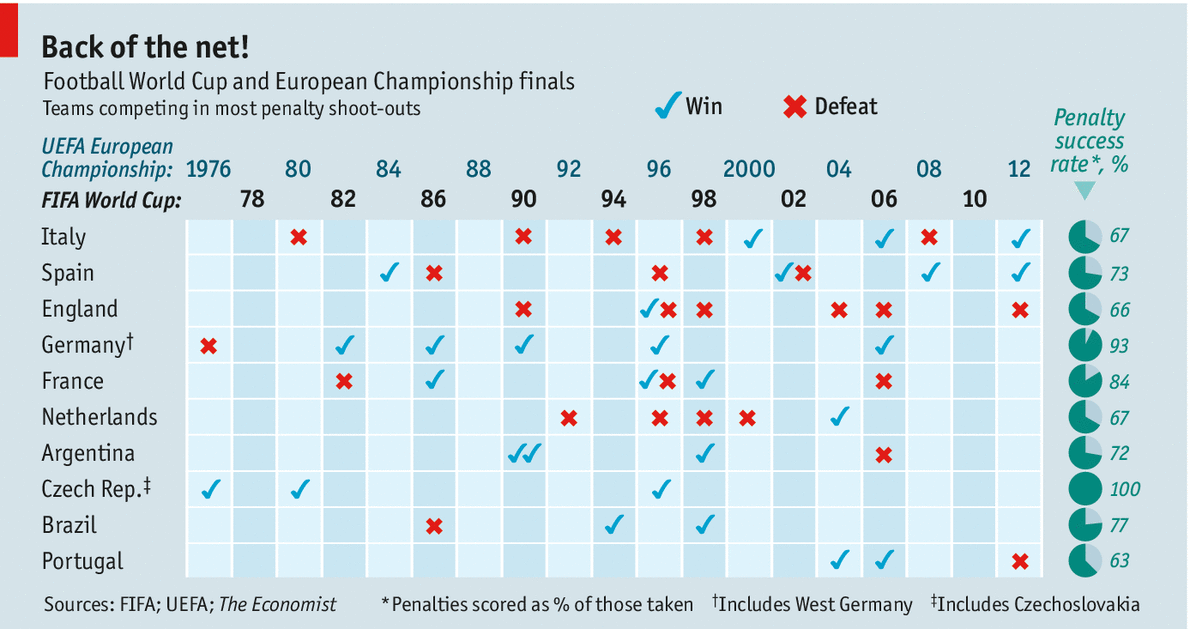
What explains the national teams’ varying records? One theory is that defeat is habit-forming. The record suggests that players are more likely to miss if they—or even their team—have failed at penalties before. They become fatalistic, attribute the outcome to chance and neglect to prepare properly. As T.S. Eliot might have put it, between the penalty spot and the net falls the shadow.
Another explanation focuses on national cultures. Jon Billsberry of Deakin University in Australia argues that “countries that are collectivist in nature tend to do much better in penalty shoot-outs than those that are individualistic.” Mindful of their public images and anticipating recrimination from a merciless media, English players often buckle: they “contrive completely new ways to miss”, Mr Billsberry notes, such as falling over or hitting the ball with a shin. Research by Geir Jordet of the Norwegian School of Sport Sciences supports this ego-based theory: star players, he finds, are more likely to miss than less feted ones.
Statistical analysis offers insights into winning habits as well. Players are far more likely to fluff a kick that could have prevented them losing the match (by levelling the score) than one that will secure victory. Mr Jordet has also detected an “emotional contagion” among penalty-takers: when a player celebrates a successful kick by raising his arms in triumph, he makes his teammates more likely to score too—and his opponents less likely. Greg Wood of Liverpool Hope University finds that effective players tend to kick according to a plan, without regard for the goalkeeper’s movement. Most of the time, the team that shoots first in the alternating contest ends up winning—because playing catch-up makes their opponents’ task extra stressful.
__________
More football nerdiness from the Economist at
this link: all 2,200 goals scored in World Cup finals, by minute of the match in which they were scored. If you hover over a goal the thing shows you all the goals scored in that game and the outcome.
I've only watched two games so far and really get the impression this year's cup isn't very popular. FIFA is widely hated, the Brazilians did well to show their unhappiness with the cost of the tournament there... and maybe people just have too much other stuff to think about. I'll make an effort for Germany-Ghana tomorrow night. Spain are out, as are England (barring some unlikely outcomes in Italy's next two games). Only Ivory Coast are still in with a shot of the African teams, and I don't really fancy any of the top-tier teams. I used to be a France supporter but not since their low-class fiasco in the 2010 cup under Raymond Domenech, of whom my lasting memory is that he refused to shake the SA coach's hand after France's loss in that game. Looks like I'll end up half-heartedly cheering for Mexico, but it is hard to care much this time.











 Everywhere else.