http://www.stewarthomesociety.org/sp/carlos.htm
CARLOS THE JACKAL
Stewart Home
Carlos the Jackal has been caged, the western media rejoices and in this celebratory fashion, the press has ushered in a new era of paranoia. The Venezuelan belongs to the old school who specialised in hi-jackings and assassinations. In his middle-age, Carlos is an anachronism and western spooks are now using this media icon to remind those who nominally employ them that their services are indispensable if the world is to be 'made safe for democracy'. It is highly convenient that, as the London Sunday Times so eloquently put it, 'no sooner had the world rejoiced at the capture of Ilich Ramirez Sanchez, the celebrity terrorist of the 1970s, than a new menace emerged: a nuclear market for backroom bomb makers.' In other words, at the very moment nineteen-seventies style 'revolutionary' mayhem is finally neutralised, the 'threat' of nuclear terrorism is to be exploited by the many journalists who work for the intelligence services to the mutual benefit of themselves and their paymasters.
Given this state of affairs, it's hardly surprising that the press has presented Carlos to its readers as being simultaneously villainous and comic, recasting his life as the tragic story of how a bumbling psychopath became known as the most dangerous man in the world. One of the more sordid aspects of the Jackal's arrest was its exploitation as an opportunity for under-the-line advertising of Johnny Walker whiskey. The media necessarily played a key role in these illicit promotions, with the fact that Carlos had a penchant for this brand of scotch being mentioned in many of the news reports about his capture. If the Jackal had been a 100 Pipers man, I might have a little more respect for him, but thanks in no small part to his consumption of Johnny Walker Red Label, Carlos comes across like a failed method actor angling for the lead role in a B movie about an ageing drug baron being edged out of business by younger and more vicious hoodlums. The Jackal possesses all the trappings of a sad old bastard, from the tendency to reminisce about his 'glory days' right the way through to a hernia and a girlfriend twenty years younger than himself.
While much of the media is busy portraying Carlos as evil, his small but vocal fan club within anarchist and left-wing circles persist in simplistically praising their hero's bold 'revolutionary' acts. Rather like the groupies who stalk the inmates of America's death row, innumerable Carlos freaks believe they are transgressing dominant values when all they are really doing is creating a mirror image of the world as it is. Topsy-turvy thinking of this type was long ago taken to its logical conclusion by an American neo-Nazi group called the Universal Order, who view Charles Manson as their 'Fuhrer'. However, there are more sophisticated responses to the activities of the Jackal and his associates. In its more populist guise, one of these can be summarised under the heading 'Terrorism Is Theatre', which is used as the title of the opening chapter of a book called The Carlos Complex by British journalists Christopher Dobson and Ronald Payne.
If, as Dobson and Payne suggest, 'terrorism' is 'planned for public effect, not for military targets' and has no real strategic aims, then rather than resembling 'theatre', its 'irrationality' is closer to the techniques employed by avant-garde movements such as Futurism, Dada and Fluxus. Indeed, the parallels are remarkable, not only is there the same focus on breaking down traditional narrative structures and instead emphasising individual and apparently isolated events, both 'Terror International' and the avant-garde consist of several tightly knit and overlapping groups operating under a variety of organisational names. Just as it is difficult to explain the activities of Carlos to the uninitiated without mentioning the Baader-Meinhof Gang or the Japanese Red Army, so when summarising the achievements of the Fluxus group, intelligent discussion requires reference to contemporary rivals and collaborators such as Auto-Destructive Art, Gutai, Actual, the Situationists and the Happenings movement. The supposition that there is a link between the avant-garde and the activities of urban guerrillas has become something of a cliche in the Anglo-American media over recent years. The more upmarket sections of the press have run endless features about 'art terrorism', which generally consist of little more than anecdotes about media pranks pulled by individuals working in what can loosely be described as the cultural tradition derived from Futurism and Dada.
It is therefore inevitable that fringe intellectuals will begin to consume the media spectacles orchestrated by the various groups associated with Carlos as works of performance art. Since the individuals being drawn into this discourse are well versed in the theoretical basis of avant-gardism, its course of development is utterly predictable. Carlos himself is suspect, over-exposure in the press and the recent 'capture' have completely eroded his mystique. The chief theorist of Fluxus, George Maciunas, drew a distinction between 'the monomorphic neo-haiku flux event' and 'the mixed media neo-baroque happening'; the career of the Jackal smacks suspiciously of the latter.
When divorced from its political context and viewed through the perspective of avant-garde aesthetics, the Lod airport massacre performed by the Japanese Red Army in May 1972 is without doubt the most sublime act of 'Terror International'. Three members of the JRA troupe who'd just arrived in Israel from Rome walked into the arrival lounge, removed submachine guns from their hand luggage and sprayed their fellow passengers with hot lead. Twenty-six people died and another eighty were wounded before two of the actors were killed and the third captured. Andre Breton had long ago insisted that the ultimate Surrealist act consisted of randomly firing a revolver into a crowd. The Lod airport 'happening' was simply the realisation of this dictum through the use of modern weaponry. However, it would be wrong to conclude from this that the JRA is not rooted in the past or that it entirely escaped the conventions of the particular culture from which it emerged. Like all avant-gardists, 'Terror International' established its 'modernity' through the double-bind of incorporating archaic elements into its activities. In the case of the JRA, the troupe's fame dates from the March 1970 hi-jack of a Japanese airliner using Samurai swords instead of more contemporary weapons such as guns. It is the tension established between this embrace of tradition and the use of genuine innovations which creates the illusion that the avant-garde is at the cutting edge of social change.
While all the groups clustered around Carlos and the PFLP were absorbed by the cult of violence, the JRA were particularly mystical in their disregard for life, believing that death during the course of their 'revolutionary' happenings would result in union with the three stars of Orion. The use by 'Terror International' of this combination of myth and violence is reminiscent of the theoretical outlook of Georges Sorel, the scourge of social decadence and prophet of the general strike, whose writings were a huge influence on Marinetti and the Futurist movement. This conjunction of perspectives serves to illustrate one of the many ways in which the activities of Carlos and his associates could be absorbed into the history and practice of performance art.
Equally, the words of Group Zero's Otto Piene can be interpreted as a call to arms: 'We, the artists, with serious concerns, have to face reality, wake up, move out of the art world and embrace the void'. Likewise, the influence of the Situationist International on the Angry Brigade, an English urban guerrilla group of the early seventies, is well documented and this troupe's use of terminology such as 'spectacle' in communiques enabled the police to identify them as 'anarchist' inspired. However, there are innumerable other ways of understanding the significance of 'terrorism', many of which produce results that are considerably more sublime than those obtained from pure aesthetics.
The Carlos 'legend' is still being milked by western propagandists, the Jackal's stint as a student at Patrice Lumumba University in Moscow being considered more than sufficient proof that he was a KGB agent. However, nothing in the world of spookery is straight forward and since his activities greatly benefited the CIA/MI6, it is just as likely that Carlos was working for the British and Americans. This scenario isn't nearly as bizarre as it may at first appear, thanks to the cell structure of para-military organisations, individuals joining groups of this type have no idea who is directing their actions.
Becoming an urban guerrilla has remarkable parallels with joining the Freemasons, it is a commitment made in blind faith, as the example of Italy demonstrates so well. While the majority of individuals who saw 'active service' with the Red Brigades genuinely adhered to left-wing ideals, their activities were ultimately directed by members of the security services and blended perfectly with right-wing atrocities such as the Bologna Station massacre, that had initially been blamed on communist elements. In Philip Willan's 1991 book Puppet Masters: The Political Use of Terrorism in Italy, the Red Brigades are described as having a three tier structure; the young fanatics, the Eastern Bloc agents and 'further in, in the most secret compartment, the infiltrators of the Interior Ministry and Western secret services'. The Red Brigades were, of course, part of the PFLP inner circle in Europe and while these and other groups claimed to be 'marxist revolutionaries', the fact that their activities were of such obvious benefit to the security services in both cold war camps, results in assertions of this type appearing suspicious.
Personally, I do not subscribe to conspiracy theories that suggest the destiny of the world is controlled by a cabal of thirteen men who meet in a darkened room. Obviously, various forces are competing for dominance within the world, and even the more successful of these ruling elites are riven by factionalism and rivalry. The success of the Anglo-American 'security' system established in the aftermath of the Second World War rested, at least partially, upon the fact that it remained unseen by the mass of those whose lives were circumscribed by it. While the role the British and Americans played in the establishment of the post-war intelligence services throughout Europe is most readily evident in Italy, their influence certainly wasn't confined to this single defeated Axis power. Likewise, there can be little doubt that this state of affairs gave London and particularly Washington, great power and political leverage across the whole of Western Europe.
In the latest issue of the maverick London based journal Perspectives, someone calling himself Peter Drew makes a number of observations about the security services and writes explicitly about a CIA inspired scheme code named Gladio which has received considerable coverage in the British 'quality' press in recent years. After repeating what was already widely known about the plan to use anti-communist far-right groups as a disownable guerrilla army against the cold war foe, Drew then says it 'is now believed that some of these, particularly in Germany, are being used to foment political and xenophobic violence and destabilise the USA's new enemy - a united Europe'. Drew also makes reference to the fact that Robin Ramsey, editor of the left-wing and generally reliable conspiracy journal Lobster, recently reprinted the one statement cut from an early eighties television programme on British intelligence. It was made by a former BOSS agent Gordon Winter and ran as follows: 'British intelligence has a saying that if there is a left-wing movement in Britain bigger than a football team our man is the captain or the vice captain, and if not, he is the referee and he can send any man off the field and call our man on at any time he likes.'
Now, if British intelligence is in the habit of providing leadership to 'subversive elements' within the United Kingdom, it would make sense for the CIA to control from above the activities of its foreign 'enemies'. I am not suggesting that control of Carlos and his Commando Boudia, or interlocking groups such as the JRA, was necessarily as direct as that exerted on the Italian Red Brigades. However, since it was the Anglo-American security establishment who reaped the major propaganda benefits from the media 'happenings' of 'Terror International', it would not be surprising to discover that they pulled at least some of the strings animating the PFLP puppet. It was in the spooks interest to perpetuate the cold war and they quickly created a minor cultural industry in the form of books and articles linking 'international terrorism' to Moscow. That they were well placed to maximise the propaganda potential of 'terrorism' is made readily evident by works such as Stephen Dorril's The Silent Conspiracy: Inside the Intelligence Services in the 1990s: 'Journalism has been a natural recruiting ground for the security services. John le Carre, who worked for M16 between 1960 and 1964, has made the astonishing statement that 'the British Secret Service controlled large sections of the press, just as they may do today'. In 1975, following Senate hearings on the CIA which had revealed the extent of agency recruitment of both American and British journalists, sources let it be known that half the foreign staff of a British daily were on the MI6 payroll. In the mid-eighties, the present author was given, by a senior Observer journalist, a list of five foreign affairs journalists on a Sunday newspaper who had acted as correspondents for the intelligent services. No doubt the practice continues to this day.' Certainly, as recently as this month, the British journalist Patrick Seale felt it necessary to issue a statement denying that he ran MI6's Beirut bureau when he was the Observer's Middle East correspondent.
However, intelligence influence in the publishing industry extents well beyond the employment of journalists to gather data and spread disinformation through the press. A Sunday Times feature of 19/9/93 by Nigel West entitled 'Literary Agents', revealed that a good many novelists, particularly those working in the thriller genre, were security service employees. This article appeared to be partially inspired by a more detailed account of the phenomena given in a 1987 book by Anthony Masters called Literary Agents: The Novelist as Spy. Many spy thrillers are little more than Anglo-American intelligence propaganda, and a pertinent example is the 1976 publication Carlos Terror International by Dennis Eisenberg and Eli Landau, promoted with the blurb: 'the novel that is closer to the truth than anyone dares to believe!' The book name checks urban guerrilla groups from across the world: 'As for West Germany, there have been indications that the Baader-Meinhof murder-gang are again gaining in strength'. The inevitable conclusion is the 'same we would reach if we had an interest in weakening the West and fostering anarchy - unite all these factors under one umbrella - an umbrella known as Terror International'.
However, whether or not it was directly controlled by the CIA, 'Terror International' was more than simply a vehicle for cold war propaganda which sought to justify increased surveillance and other repressive measures in the western 'democracies', while simultaneously helping to secure those all important increases in 'defence' and espionage budgets. The Jackal's greatest personal triumph was the raid on the OPEC headquarters in Vienna in December 1975. Once the building had been stormed, the hostages were divided into four categories; Friends, Enemies, Neutrals and Austrians. The 'Friends' were the Libyans, Algerians, Iraqis and Kuwaitis. The enemies were the officials representing Saudi Arabia, Iran, Abu Dhabi and Qatar. In this way, the activities of 'Terror International' were perfectly suited to protecting the interests of the Anglo-American establishment. The PFLP and their inner circle in Europe were a not unimportant factor in reinforcing those divisions that already existed between a number of middle eastern states. In this way, Carlos and his associates assisted in minimising the chances of OPEC functioning as an effective oil cartel.
I do not wish to suggest that the PFLP was simply an arm of the CIA. Certainly, many of the politically naive urban guerrillas who saw active service with 'Terror International' initially committed themselves to para-military tactics because they adhered to a political programme that was at complete variance with the aims and interests of the Anglo-American establishment. At certain times, these 'revolutionaries' may even have been able to act in accord with their 'marxist' principles. However, the clandestine nature of the organisations to which they belonged provided ample opportunity for manipulation by both Washington and Moscow. If 'Terror International' was a political football, it's logical to conclude that the Anglo-American establishment supplied the referee, because this side scored the vast majority of goals during the course of a long and toughly contested game. Since we now know that the CIA was able to exercise at least some control over the Red Brigades, there is a distinct possibility that they succeeded in directing the activities of the other urban guerrilla organisations co-ordinated by Carlos.
Dobson and Payne are therefore wrong to suggest that the activities of 'Terror International' had no real strategic aims. From the perspective of the Anglo-American establishment, they were a perfect covert compliment to official policy. In middle-age, Carlos isn't much use to anyone as an urban guerrilla. Now is a particularly convenient time to haul him before the courts and thereby demonstrate that the western 'democracies' are still vigilantly guarding themselves against the many 'enemies' who threaten their very existence. And the successful persecution of a spent force immediately after the Aldrich Ames spy-scandal can't do any harm. In their different ways, these two events provide justification for spiralling intelligence budgets in our increasingly insecure world.
To nobody's surprise, the Anglo-American establishment continues to perfect its own unique technology of repression, with vast amounts of money being poured into the development of frequency weapons and methods of electronic control. In the final analysis, it doesn't matter who Carlos worked for or what motivated his activities, he served the cause of reaction by playing the role of an urban guerrilla on a pitch marked out by the Anglo-American establishment and according to the rules they'd instituted for the 'strategy of tension' game. Little that is good is likely to emerge from the capture of the Jackal. The most we can hope for is the rehabilitation of that classic fashion item, the white trenchcoat, as worn by Carlos during the OPEC raid of December 1975. As a celebrity 'terrorist', the Jackal is the perfect hook on which to sell ideologies, whiskey and clothes.
First published by the German magazine Konkret, October 1994
Fascists are the Tools of the State
Moderators: Elvis, DrVolin, Jeff
-
American Dream
- Posts: 19946
- Joined: Sat Sep 15, 2007 4:56 pm
- Location: Planet Earth
Re: Fascists are the Tools of the State
"If you don't stand for something, you will fall for anything."
-Malcolm X
-Malcolm X
-
American Dream
- Posts: 19946
- Joined: Sat Sep 15, 2007 4:56 pm
- Location: Planet Earth
Re: Fascists are the Tools of the State
21 August 2014
(Pro-)Russian extremists in 2006 and 2014: the Dugin Connection
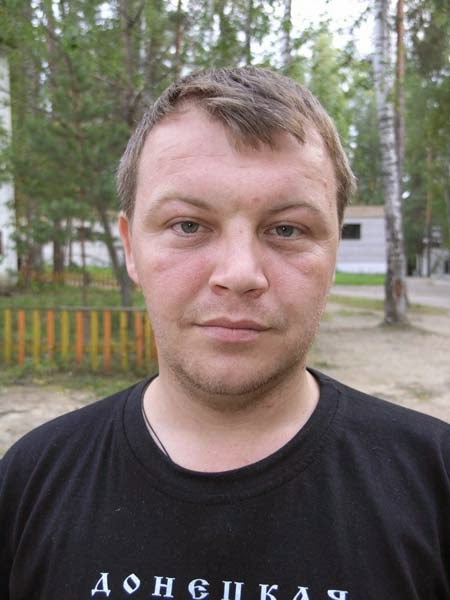
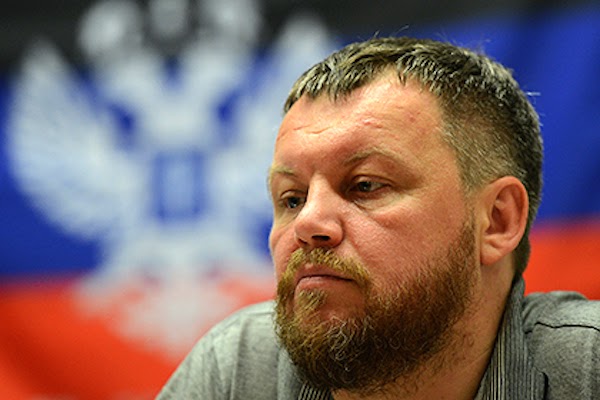
In August 2006, Russian fascist Aleksandr Dugin and his Eurasian Youth Union (Евразийский союз молодежи, ESM) organised a summer camp where ultranationalist activists were further indoctrinated and trained to fight against democratic movements in neighbouring independent states. Looking at the pictures from that camp, I have identified at least five people who, in 2014, were engaged in the terrorist activities of (pro-)Russian extremists in Eastern Ukraine.
Andrey Purgin in the ESM camp, 2006
Andrey Purgin, 2014
Andrey Purgin, first "Prime Minister" of the "Donetsk People's Republic". In 2006, he was a leader of the organisation "Donetsk Republic".
Read more »
-
American Dream
- Posts: 19946
- Joined: Sat Sep 15, 2007 4:56 pm
- Location: Planet Earth
Re: Fascists are the Tools of the State
The 1979 Greensboro Massacre
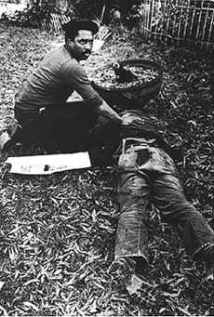
Late morning, November 3, 1979, at the corner of Carver and Everitt Streets in Greensboro, North Carolina, forty Ku Klux Klansmen and American Nazis handed each other shotguns and automatic weapons from the trunks of their cars and opened fire on black and white anti-Klan demonstrators and union organizers who had gathered at Morningside Homes, a black housing project.
Nelson Johnson at the body of Jim Waller
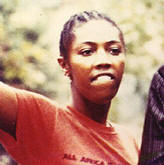
Sandi Smith, a nurse who’d been active in the black student movement and was at the time trying to unionize textile workers, was shot between the eyes.
Sandi Smith
The KKK and Nazi members shot at anyone who wasn’t hiding while four television news teams and one police officer recorded the action. They then got back into their cars and sped away after which the Greensboro police arrived and began arresting protestors.
Continues at: http://thenewliberator.wordpress.com/20 ... -massacre/
-
American Dream
- Posts: 19946
- Joined: Sat Sep 15, 2007 4:56 pm
- Location: Planet Earth
-
American Dream
- Posts: 19946
- Joined: Sat Sep 15, 2007 4:56 pm
- Location: Planet Earth
Re: Fascists are the Tools of the State
This aspect of the bloody massacre in Greensboro described above is extremely important:
http://threewayfight.blogspot.com/2014/ ... e-and.html
Thursday, May 08, 2014
Frazier Glenn Miller, Nazi violence, and the state
In the 1980s, Frazier Glenn Miller was one of the most prominent white supremacist leaders in the United States. Lately he's been in the news again -- sometimes identified as Miller, sometimes as Frazier Glenn Cross -- charged with shooting dead three people at two Jewish centers in the Kansas City metro area on April 13.
Miller’s story -- even the fact that he goes by two different last names -- dramatizes the profound shift in government security forces' relationship with the the U.S. far right over the past few decades. This issue has received little or no attention since Miller's April 13th arrest.
Miller is a Vietnam veteran and former Green Beret who was kicked out of the Army in 1979 for distributing racist propaganda. As a member of the National Socialist Party of America, Miller helped to organize a coalition of Klansmen and Nazis in North Carolina called the United Racist Front, which carried out the Greensboro massacre on November 3, 1979. That day, a caravan of URF men drove to an anti-Klan rally organized by the Communist Workers Party, unloaded their guns, and shot five people to death. URF members were twice acquitted for the massacre by all-white juries. Miller was present at the scene and later declared, "I am more proud of the 88 seconds I spent in Greensboro on November 3, 1979, than I am of the twenty years I spent in the U.S. Army" (Martin Durham, White Rage, p. 44). He was never indicted for his role in the killings.
The Greensboro massacre was a pivotal event for the U.S. far right in two ways. On one hand, it was a high water mark of far right violence carried out with the involvement or sponsorship of government security services. An agent of the Bureau of Alcohol, Tobacco, and Firearms was part of the URF and in later court testimony about the massacre "characterized his role as an undercover agent as one that gave people with a known propensity for illegal activity the ‘opportunity to violate the law.'" (This was under a Democratic administration, by the way.)
The URF also included a man who was an informant for both the FBI and the local police. As Joanne Wypijewski reported in a 2005 article for Mother Jones, "At the time of the killings, the police special agent in charge of the Klan informant was at the back of the [URF] caravan, having trailed it to the site. He did not intervene, or radio for help, or trip a siren, or pursue the killers as nine of their vehicles got away. Arrests occurred only because two police officers broke ranks and apprehended a van."
I've seen several news reports since Miller's recent arrest that note his involvement in the Greensboro killings, but none that mention the role of federal agencies. (For more on the federal security services' history of involvement with the paramilitary far right, see my 2012 post, "Liberal counterinsurgency versus the paramilitary right."
The Greensboro massacre was also pivotal because it broke the suspicion and animosity that for decades had kept Klansmen and Nazis at odds with each other. After this event, collaboration, cross-over, and interchange between the two branches of the far right became much more common. As a result, the movement's ideological center of gravity shifted from segregationism to fascism -- away from restoring the old racial order, to new dreams of creating a new whites-only homeland or overthrowing the U.S. government entirely.
Glenn Miller was in the thick of this change. A few months after Greensboro, he formed the Carolina (later Confederate) Knights of the Ku Klux Klan, which in 1985 changed its name to the White Patriot Party. The WPP advocated an independent Southern White Republic. Leonard Zeskind reports that its activists "typically wore camouflage uniforms, regularly engaged in paramilitary-style training, and some illegally acquired weapons from nearby military bases…. y 1986 Miller's White Patriot Party had over 1,000 members in North Carolina alone. Some reports indicated that 150 members had once been Special Forces soldiers."
http://threewayfight.blogspot.com/2014/ ... e-and.html
-
American Dream
- Posts: 19946
- Joined: Sat Sep 15, 2007 4:56 pm
- Location: Planet Earth
Re: Fascists are the Tools of the State
http://libcom.org/history/1924-kkk-iww- ... greenville
KKK and IWW wage drawn battle in Greenville, 1924

A 1924 article from the Portland Press Herald about conflict between the Industrial Workers of the World and the the Ku Klux Klan.
From the Portland Press Herald – Tuesday, February 5, 1924
KKK and IWW wage drawn battle in Greenville, 1924
A 1924 article from the Portland Press Herald about conflict between the Industrial Workers of the World and the the Ku Klux Klan.
From the Portland Press Herald – Tuesday, February 5, 1924
K.K.K. And I.W.W. Wage Drawn Battle in Greenville
175 Workers Patrol The Street After Clash Saturday Night
HOSTILITIES OPEN WHEN KLAN CLEANS OUT BOARDING HOUSE
Woodsmen Ordered Out But Refuse to Leave – Reinforcements Pouring in By the Hundreds
Greenville, Me., Feb. 4 — With the thermometer hovering around the zero mark, about 175 members of the Industrial Workers of the World walked the streets of the town tonight as a result of a clash with local members of the Ku Klux Klan Saturday night.
About 40 members of the Klan marched to a local boarding house known as the Lake House, in which several leaders of the I.W.W. were stopping and ordered them to leave town at once or they would use force and put them out.
The I.W.W. leaders called to Deputy Sheriff Davis S. Cowan for protection against violence. An officer was placed on guard at the boarding house Saturday night.
Sunday and today the I.W.W. delegates as they termed themselves, sent out a call to the lumber camps and today there has been a steady flow of I.W.W. members into this little Maine town. Tonight it was estimated that there were fully 175 I.W.W. members walking the streets.
Bob Pease of Bangor, leader of the I.W.W. organization in Maine arrived in town tonight and told the PRESS HERALD representative that he would establish headquarters for the I.W.W. in Greenville.
“We are going to stick,” asserted Pease. “and if the Klan starts anything, the I.W.W. will finish it. The slave drivers, the Great Northern Paper Company and Hollingsworth and Whitney people do not want us here, but we are too strong for them.”
“Why are they against you,” asked the PRESS HERALD representative.
“Because we want good wages, eight hours a day in the lumber camps and clean linen on our bunks,” replied Pease. “The day of the old logging camp and the lumberjacks is about over with.”
Pease claims that that the Ku Klux Klan in Greenville has been bought by the merchants and the lumber interests.
Refuse to Leave Town
It was understood tonight that the selectmen of the town ordered the I.W.W. members to leave town, but Pease and his men refused, saying they would walk the streets and would build bonfires to keep from freezing.
The I.W.W. members were denied admission to any of the local boarding houses and the Y.M.C.A. boarding houses according to Pease.
Sheriff Roscoe Macomber from Dover-Foxcroft was here today and placed two of his deputies in charge tonight with instructions to arrest anybody starting trouble.
Klan Organizing
It was said tonight that the Klan members are organizing and the K.K.K.’s leaders have not given up the idea of forcing the I.W.W. men to get out of town. Deputy Sheriff Cowan said late tonight that I.W.W. members from surrounding lumber camps were steadily coming into town and that he expected that several hundred would be here before another twenty-four hours had passed.
Pease, the I.W.W. head, said late tonight that he intended to open a branch of his organization in Kingfield, but that headquarters would be established here for the present. He said many of the men in his organization were French Catholics.
-
American Dream
- Posts: 19946
- Joined: Sat Sep 15, 2007 4:56 pm
- Location: Planet Earth
Re: Fascists are the Tools of the State
Black Legion regalia included this high powered rifle and a leather-bladed bludgeon used to beat their victims.
The murder that brought down the Black Legion
August 5, 1997
Charles Poole, an organizer for the Works Progress Administration, was murdered by the Black Legion after they accused him of beating his wife.
The gang that killed Poole was part of the Black Legion, and the triggerman was Dayton Dean, an employee of the Detroit Public Lighting Department and, by all accounts, a man who simply lived for violence. As such, Dean fit the profile of the Black Legion, whose propensity for violence, as one contemporary observed, made the Ku Klux Klan look like a cream puff.
The Black Legion was founded in the mid-1920s as the Black Guards, a security force for the officers of the Ohio Ku Klux Klan. A Michigan regiment was established in 1931, with Arthur Lupp of Highland Park as its major general. Organized along military lines, the Michigan Legion had five brigades, 16 regiments, 64 batallions, and 256 companies. Although its members boasted that there were one million legionaires in Michigan, it probably had only between 20,000 and 30,000 members in the state in the 1930s, one third of whom lived in Detroit.
The legion had various fronts to cover its activities, such as the Wayne County Rifle and Pistol Club, whose members frequented a downtown Detroit sporting goods store with a backroom firing range. It also had a political front as well, the Wolverine Republican Club. The legion's political objectives were broad and, at the same time, narrowly specific. As one of its promotional pieces stated, "we will fight political Romanism [the Catholic Church], Judaism, Communism, and all 'isms' which our forefathers came to this country to avoid."
Some legionaires, more inclined toward outright violence for the sake of violence, went further in their plots to rid America of those they called undesirables than fearmongering and night riding. It was alleged, for instance, that Major General Lupp had explored ways to inject typhoid germs into milk and cheese delivered to specific undesirable neighborhoods in Detroit. The fact that Lupp was an inspector for the Detroit Department of Public Health lent some credence to this story, in the minds of many who heard it.
Poole's widow, Rebecca, and their 16-month-old daughter, Mary Lou.
Labor and civil rights lawyer Maurice Sugar, who believed he was targeted for death by the legion, claimed that his investigations had uncovered a plot by the legion to release cyanide gas in synagogues during Hanukkah in 1935, although no official investigation supported the allegations. There was clear evidence, however, that Sugar's 1935 campaigns for a seat on Detroit Recorder's Court and on the city's Common Council were targeted by legionaires for a series of dirty tricks and outright sabotage.
Some politicians supported the legion's efforts to preserve the American System against foreign influence and often spoke before the Wolverine Republican Club, whose members circulated petitions and conducted get-out-the-vote campaigns for their favorite candidates. Too often, however, the legion's political activities tended to violent acts of retaliation against those candidates running against a legion favorite.
Running through the literature and rhetoric of the Black Legion was the fear of an international Communist takeover of the United States. Legionaires were ordered by their superiors to be prepared to take over federal government buildings with arms at what they called "zero hour," the date and time that communists would rise up throughout the United States and launch their attack on the country. In truth, however, the legion was led by unsophisticated men, "petty men," as one researcher has noted, who were most interested in the "pettiness of personal reform."
Thus, the legion saw as its enemies not only blacks, Jews, and Catholics, but also welfare workers and recipients and labor union organizers. Homer Martin, the first president of the United Automobile Workers union, believed beyond any question that legionaires had infiltrated his union for the express purpose of providing inside information to the automobile manufacturers and that many black knights were members of the "Dawn Patrol," the private security force that guarded many Detroit auto plants.
The legion also provided a job service for its members. Many joined the organization during the economically unsettled 1930s with the understanding that legionaires would look out for their own in terms of jobs and promotions. It was alleged that the Packard and Hudson automobile plants were controlled by the legion and that members would enjoy in those shops 'special privileges' as a result. It is worth noting, in this regard, that later investigations of the legion revealed that none of its known members were unemployed and that many of them had positions in the public services.
By and large, the typical Black Legionaire was a lower-class, Anglo-Saxon male, poorly educated with few industrial skills, and were Southerners transplanted to the Detroit area during the heyday of the city's industrial growth during the 1920s. Why did they join? They believed that the American System was being undermined and their obligation was to counteract that trend
They were also frustrated by the uncertainty generated by the economic problems of the 1930s and they felt alienated in a large metropolitan area and within a huge industrial complex. In general, they were beset by the feeling that, although their ancestral roots in America stretched back to the nation's earliest years, they were being left behind; they believed foreigners were competing for jobs they considered their own, that Jews and Catholics were supplanting Protestants among the nation's influential political and economic leaders, and that racial integration was leading America to social anarchy.
In the Black Legion, members found a sense of security and a sense of superiority. For those of a more violent bent, the group quenched their thirst for adventure and, in some cases, personal injury and murder. Most especially, the legion provided easy answers to the complex questions that plagued Americans during the dark days of the Great Depression. As its oath of allegiance proclaimed, "the native-born white people of America are menaced on every hand from above and below. If America is in the melting pot, the white people of America are neither the aristocratic scum on top nor the dregs of society on the bottom which is composed of anarchists and Communists and all cults and creeds believing in social equality. ... We regard as enemies to ourselves and our country all aliens, Negroes, Jews and cults and creeds believing in racial equality or owing allegiance to any foreign potentates. These we will fight without fear or favor as long as one foe of American liberty is left alive."
Michigan's Black Legion had its roots in the Ohio Ku Klux Klan, right.


From The Detroit News: http://web.archive.org/web/201210110901 ... php?id=151
-
American Dream
- Posts: 19946
- Joined: Sat Sep 15, 2007 4:56 pm
- Location: Planet Earth
Re: Fascists are the Tools of the State
http://isreview.org/issue/85/it-cant-happen-here
The Silver Shirts
Minneapolis, Minnesota, from the turn of the nineteenth century until the mid-1930s was ruled by a ruthless business oligarchy known as the Citizens Alliance (CA). It successfully and boastfully kept the city free of any unions that could challenge their near complete domination of economic and political life. The first crack in the CA armor came with the election of Floyd Olson, the Farmer-Labor Party candidate, as governor in 1930. The popular Olson personified the shifting political landscape of Minnesota produced by the Great Depression. Reform was in the air, and the CA could feel power slipping from their hands. Olson also broke the unspoken ban on having Jews play important roles in the highest levels of state government. Teamsters Local 574, however, finally broke the CA’s stranglehold on Minneapolis through a series of militant, extremely well-organized strikes that rocked the trucking industry in the late spring and summer of 1934. Within a few short years, Minneapolis went from being the open shop capital of the United States to being one of its best-known union towns. Teamsters Local 574 (later known as Local 544) was led by a group of talented and experienced revolutionary socialists—who were first members of the Communist League of America and then the SWP—that included Swedish immigrant Carl Skoglund, a young Farrell Dobbs, and the Dunne brothers, Vincent, Miles, and Grant.5 The Dunne brothers especially elicited a visceral hatred from the bosses who literally growled at the mention of their names.6
The Minneapolis trucking strikes were a major event in the emergence of the militant industrial union movement of the 1930s and 1940s, and led to the organization of hundreds of thousands of truck drivers and warehouse workers. The success of the Minneapolis teamsters put wind in the sails of the entire labor movement across Minnesota and the Upper Midwest, a region still referred to at the time as the Northwest. Union organizers came from all over the country to learn their organizing techniques and strategies, including a young Jimmy Hoffa from Detroit. The CA and its supporters found themselves on the losing end of the battle for several years following the 1934 strikes. They rechristened themselves the Associated Industries (AI) in December 1936 and made several failed efforts to hem in the militant teamsters and their radical leaders but nothing worked. The Farmer-Labor Party also continued to dominate state politics even after the death of Olson in 1936 from stomach cancer. Olson’s elected successor, Elmer Benson, embraced even more left-wing policies and continued Olson’s policy of having Jews play a prominent role in state government and the Farmer-Labor Party. With the onset of the “Roosevelt Recession,” many of Minneapolis’s employers thought the ground had finally shifted in their favor, and some of them were quite willing to flirt with the fascist Silver Shirts to achieve their goals.7
Modeling his organization after Hitler’s brown-shirted street fighters, William Dudley Pelley founded the Silver Legion of America, popularly known as the Silver Shirts, the day after Hitler was appointed chancellor of Germany on January 30, 1933. Pelley was, in many ways, a typical American religious crackpot, but he became a violent anti-Semite and Nazi, inspired by the success of German Nazism. Pelley, himself, did not look like a menacing street fighter. With his graying hair, goatee, and pince-nez glasses, he looked like the aging choral director of a small Midwestern college. On formal occasions Pelley and his followers donned the official uniform of the Silver Shirts: navy blue trousers and black shoes. The distinctive silver shirt was emblazoned with a large scarlet “L” over the heart that added a slight varsity touch to the fascist-inspired uniform that stood for “Love, Loyalty and Liberty.”8
Pelley, while in uniform, tried to strike the image of an old-fashioned cavalry officer. Soon after he founded the Silver Shirts in 1933 from his Asheville, North Carolina, headquarters, the organization grew significantly and peaked at a membership of around 15,000. From his headquarters Pelley edited Liberation, the Silver Shirts’ national newspaper, and issued orders to his supporters across the country. The Silver Shirts drew support largely from struggling and retired middle-class businessmen and skilled workers in the Midwest and West Coast whose lives had been thrown into turmoil by the Great Depression. They came from overwhelmingly white Anglo-Saxon, German, northern European, and Protestant ancestry. There was also a large overlap in some areas between the Silver Shirts and the traditional far Right racist organizations like the Ku Klux Klan.9
The Silver Shirts’ menacing activities early on became the subject of congressional investigations. “Arms Plot Is Laid to San Diego Nazis” was the headline of the New York Times on August 8, 1934. Two marines, Virgil Hayes and Edward T. Grey, infiltrated the Silver Shirts at the behest of Marine Corps intelligence and revealed the “arms plot” to congressional investigators. Hayes testified before a congressional subcommittee in Los Angeles that the Silver Shirts had offered him money to purchase weapons stolen from military arsenals. When asked by the subcommittee investigator what the purpose of the Silver Shirts was, Hayes responded, “To change the government, William Dudley Pelley, the national organizer told me. . .. He also planned to deport the Jews.” The investigator then asked him if they advocated violence to take control of the government. Hayes answered, “Yes, I was commissioned as an instructor in military tactics with the Silver Shirts. I taught them the use of small arms and street fighting.”10
Grey testified about a Silver Shirt plan to capture San Diego City Hall by force:
It was planned for early in May [1934], when the Communists were to stage a May Day celebration. The Silver Shirts were ready, too. The 200 armed, trained Silver Shirts had orders to converge on the city from the outskirts. They counted on the Communists going in before them and taking the city by storm. Then, in the confusion, the Silver Shirts were to overthrow the Communists, their avowed enemies.11
The Silver Shirt “coup” failed because, according to Grey, the May Day demonstration was called off. How serious this plot was we will probably never know, yet the testimonies of the two marine infiltrators reveal an organization eager to obtain weapons, training, and the opportunity to seize power. There was no doubt that they were a dangerous organization to be on guard against. Pelley’s ambitions after 1934, however, were sidelined by the militant struggles of US workers, and the enactment of a series of historic social reforms by the Roosevelt administration that were embraced by a huge section of the population, including people that Pelley hoped to win to fascism. The Silver Shirts’ membership slumped, after peaking in 1934, while Pelley became ensnared in a legal case after allegations of stock fraud. Liberation was even forced to declare bankruptcy.12
Starting in 1936, Pelley attempted to revive his organizing efforts. He founded the Christian Party, which he hoped would funnel large numbers of men into the Silver Shirts, and ran for president.13 Pelley’s campaign battle cry was “Down with the Reds and out with the Jews.” The campaign was a flop in terms of votes but it gave Pelley a somewhat more legitimate platform from which to espouse his political views. It was in that same year that the Silver Shirts, according Minnesota historian Laura Weber, “first actively attempted to recruit members in the Twin Cities.” They found fertile ground. Minneapolis had a long history of anti-Semitism. “Its peak,” Weber argues, “occurred during the Great Depression.”14 A young, eager reporter, Arnold Sevareid, who would many years later become a fixture of CBS News as Eric Sevareid, penned the first major exposé of the Silver Shirts in Minnesota. Sevareid wrote in his autobiography Not So Wild a Dream:
Fresh from the theoretical battles of the classrooms, I was acutely concerned with the developing struggle in the country. When a couple of Communist acquaintances came to me with the information that a semisecret Fascist group, the Silver Shirt, were organizing widely in Minneapolis, I went to work.15
He went undercover for the Minneapolis Journal. Sevareid was a tall, lanky young man of Norwegian descent. He fit right in with the Silver Shirt crowd. Born in 1912 in Velva, North Dakota, his parents moved to Minneapolis when he was a teenager. He attended the University of Minnesota during a time of campus political ferment. He was an open admirer of Governor Olson and was radicalized by the 1934 teamster strikes. His series in the Minneapolis Journal was the first major exposé of the anti-Semitic fascist activity in the state and was something of a bombshell. “Anti-Semitism is the outstanding feature of the Silvershirts,” Sevareid wrote. He spent many “hair-raising evenings in the parlors of middle class citizens who worshipped a man named William Dudley Pelley, devoted to driving out the Jew from America.” They claimed a membership of 6,000 in the state. “They sang the praises of Adolf Hitler and longed for the day when Pelley should come to power as the Hitler of the United States.”16
“It was an unbelievably weird experience,” he recounted a decade later.17 At first Sevareid’s editor refused to believe him until he was able to gain admittance to a Silver Shirt meeting. His editor returned to the office and demanded: “Get me a drink, quick! God, I feel I’ve been through the fantastic nightmare of my life.” Sevareid “took them seriously, as a cadre of fascism, and we proposed to expose them in a series of articles.” Somehow it was leaked to a group of “liberal rabbis and wealthy Jews” that the Journal was about to publish Sevareid’s series, and the group asked the Journal to “withhold the story” fearing it would “abet a virulent form of anti-Semitism.” Their attitude, Sevareid thought, could be summed up as, “It would be better to ignore the madmen and pretend they didn’t exist.” Despite the opposition, his editor published the stories, “not as I wanted written, as a cry of alarm, but as a semi-humorous exposé of ridiculous crackpots who were befuddling otherwise upright citizens.”18 Nevertheless, after the first article appeared in print, the Minneapolis Journal sold several thousand extra copies above its regular distribution.19
What Sevareid wasn’t prepared for was the unrelenting hostility that he received from the good Christian, middle-class readers of theJournal. “I was threatened by telephone and letter every day to such a point that my family was alarmed for my safety and my brothers wanted to sleep, armed in my apartment.” He got no relief at work, “Odd characters, fuming and bridling, would march to my desk in the city room, and demand to know whether I was a Christian or a Bolshevik.” Self-righteous “lifelong subscribers” to the Journal would harass him on the phone, and when they didn’t get the response they desired, they called Sevareid’s publisher to complain about him and the Silver Shirts series. He was even denounced as a “Red” and “a foolish cub reporter” by the pastor of the biggest Baptist church in Minneapolis while he sat in the audience with his wife. Even his wife wasn’t very supportive. She turned to him and said, “After all, darling, you are a cub reporter, really.” Sevareid thought he was something of hero for the undercover reporting that he did, instead he was made to feel like an “ass.”20 It also demonstrated that a large pool of potential recruits existed for the Silver Shirts.
Political anti-Semitism
“A more violent threat to the Teamsters’ union was organizing secret councils in Minneapolis during the summer of 1938,” according to historian William Millikan. Millikan has written the only comprehensive history of the Minneapolis bosses’ four-decade war against organized labor. “The fascist Silver Shirts had returned to Minneapolis.”21 The Silver Shirt efforts benefitted greatly from an emerging split in the ranks of the Farmer-Labor Party (FLP). The sitting Minnesota governor Elmer Benson, who had been elected governor by the largest margin up until that point in the state’s history in 1936, was being challenged for the FLP nomination by longtime rival, Hjalmar Peterson. Peterson “obliquely” used anti-Semitism to attack Benson, according to Minnesota historian Hyman Berman, whose staff included a number of Jews appointed by Olson. Benson won the FLP nomination but what Peterson had begun was picked up on and, later, brazenly used in the fall election. The person who organized this was Ray P. Chase, “who was no lunatic-fringe anti-Semite, but was in the mainstream of Old Guard Minnesota Republicanism.”22 Chase’s “Research Bureau” was financed by some of the biggest names in Minnesota business including Jay C. Hormel of Hormel meatpacking fame and George K. Belden, president of AI.23The stated goal of Chase’s bureau was “to block the efforts of the present Governor and his communistic Jewish advisors to perpetuate themselves in power, [and] to block efforts to initiate and promote the Soviet plan of the Social Ownership of Key Industries.”24
Pelley sent his top lieutenant Roy Zachary, officially designated by him a “Field Marshal” of the Silver Shirts, to Minneapolis. It was part of a three-and-a-half month, twenty-two state recruitment drive that he had methodically planned.25 Zachary, however, came to Minneapolis with a dark cloud hanging over his head. He was, at the time, under investigation by the Secret Service for allegedly threatening the life of President Franklin Roosevelt at a May rally of the Silver Shirts in Chicago. “If no one else will volunteer to assassinate Roosevelt, I’ll do it myself,” he allegedly bellowed to a Silver Shirt audience in May. Zachary was dogged by these “false charges,” as he called them.26 When he spoke in Tacoma, Washington, shortly after his Chicago stop, he complained that the CIO’sTimber Worker newspaper, “with a large circulation in the Northwest, published an account of my speech and repeated the false charge that I had threatened to assassinate the President.”27 When he spoke on July 18 in Spokane, Washington, Zachary was annoyed that “people attending our meeting in Redmens’ Hall had to pass through a street mob of several hundred Jews, communists and other radicals—sponsored by the League for Peace and Democracy—milling around the hall entrance with banners, blocking traffic, and otherwise demonstrating their determination to deny patriotic American citizens the right of free speech and peaceable assembly.”28Zachary pressed on. He was determined to demonstrate to “the Silvershirts and other decent Americans throughout the nation. . .that our meetings and our program are being conducted as scheduled and in spite of opposition on the part of Jews and communists.”29
Hundreds of invitations were sent out by T.G. Wooster, state organizer of the Silver Shirts, to Minnesota businessmen and professionals calling on them to attend Zachary’s meeting in Minneapolis. Pelley wanted to recruit 3,000 to 5,000 new members to the Silver Shirts. This ambitious goal was to be done through a series of rallies at some of Minneapolis’s best-known venues as well as through private meetings.30 Pelley himself was expected to come to Minneapolis. The first two meetings were held on July 29 and August 2 at the Royal Arcanum Hall in Minneapolis. They were private meetings by invitation only. The invitation, in part, said:
You are hereby cordially invited to attend another meeting of patriotic, Christian citizens who believe there is a very urgent need for united action on behalf of our Government.
The Committee is pleased to announce that they were able to again secure the speaker [Roy Zachary] you heard on May 12th, who will return to our city for a one-night address, loaded with many new topics and additional information on relative alien forces that are seeking to undermine our government. . ..
Due to the growing interest in the movement it would be impossible to contact everyone in person as was done on the previous occasions. You are, therefore, requested to present this letter to the doorkeeper with an admittance fee of twenty-five cents. . ..
Any of your Christian, patriotic friends who desire to attend may accompany you and be admitted through this invitation.31
Among the many businessman and prominent political officials invited were Jay C. Hormel, George Belden, and Roy F. Dunn, the state secretary of the Republican Party. Zachary’s contact list also included such old right-wing warhorses as James F. Gould, the head of the American Committee of Minneapolis in 1919, an organization that dedicated itself to eradicating radicalism in Minnesota in the post–World War I era.32 If there is an obvious overlap between supporters of Chase’s Research Bureau and the mailing list of the local Silver Shirts, it doesn’t appear to be an accident. Chase carried on “a long time correspondence with William Dudley Pelley of the Silver Shirts. . .asking and receiving information regarding organizations and individuals.”33 His list of contacts also included A. C. Hubbard, president of the Mutual Truck Owners and Drivers Association, a company union affiliated with the AI, called Associated Independent Union (AIU).
The first meeting—on Friday night, July 29, at the Ark Temple—was the largest, drawing more than 350 people, including such “respectable people” as Dr. George Drake, a member of the Minneapolis School Board, and George K. Belden.34 Drake and Belden’s presence at a nasty fascist rally set off alarm bells for anyone concerned about the deteriorating political situation in the country and across the globe. (A more notorious example of an open show of fascist sympathy occurred the following day in Dearborn, Michigan, when the German government presented Henry Ford with the Grand Cross of the German Eagle, making him the first foreigner to receive such a medal from Hitler’s government.)35 According to the Minneapolis Labor Review, the official organ of the Minneapolis Central Labor Union Council, Roy Zachary called for “Vigilante bands to raid the headquarters of Drivers 544, declaring that the time for the ballot was passed and the only way to deal with the unions was to raid their headquarters and destroy them.”36
The Silver Shirts were declaring open war on Teamsters Local 544.37 Newspaper reporters and photographers were barred from the secret, invitation-only meeting but word had leaked out that the Silver Shirts were meeting in the city, and they gathered outside the Ark Temple. As their rally came to an end, the dispersing audience had their pictures taken outside the hall. “The threat of having their pictures taken,” according to the reporter for the American Jewish World, the weekly newspaper for the Twin Cities Jewish community, “is believed to be the reason for the small attendance of 65 at the next Tuesday meeting in the basement of the Royal Arcanum.”38 If this is true, it reveals something of the soft support for the Silver Shirts. Conspicuously, however, George Belden was once again in attendance. Roy Zachary violently attacked what he called the “Communist racketeers of the Teamsters’ Local 544.” Zachary claimed to the August 4 meeting that the Silver Shirts were “infiltrating” Minneapolis labor unions, including Local 544. Leaflets were handed out at both rallies inviting attendees to join the AIU’s Mutual Truck Owners and Drivers Association Local No. 1, whose primary target was Teamsters Local 544.39 At the end of both rallies, Silver Shirt guards attacked photographers. The American Jewish World reported that the photographers got the best of the Silver Shirts, especially after the second rally when “a fight followed during which a cameraman fell on his attackers with a blow to the chin.

-
American Dream
- Posts: 19946
- Joined: Sat Sep 15, 2007 4:56 pm
- Location: Planet Earth
Re: Fascists are the Tools of the State
excerpted from the book
The Iran-Contra Connection
Secret Teams and Covert Operations in the Reagan Era
by Jonathan Marshall, Peter Dale Scott , Jane Hunter
South End Press, 1987
The Iran-Contra Connection
Secret Teams and Covert Operations in the Reagan Era
by Jonathan Marshall, Peter Dale Scott , Jane Hunter
South End Press, 1987
The Strategy of Tension: CAL, P-2, Drugs, and the Mafia
Reports linking WACL to drugs became particularly flagrant in the period 1976-80, as the rift between WACL and Carter's CIA widened, and as a new Argentine-dominated affiliate of WACL in Latin America (the Confederacion Anticomunista Latina, or CAL) plotted to extirpate radical Roman Catholic priests and prelates fostering liberation theology.
A high-point or low-point of the CAL plotting was reached in 1980, when Argentine officers, bankrolled by the lords of Bolivia's cocaine traffic, installed the Bolivian drug dictatorship of Luis Garcia Meza. Two of the Argentine officers involved turned out to be wanted Italian terrorists, Stefano delle Chiaie and Pierluigi Pagliai; together with the veteran Nazi fugitive and drug trafficker Klaus Barbie, the neo-fascists seized the radio station as a signal to launch the coup.
Barbie and delle Chiaie were both deeply involved in the CAL project to identify and exterminate leftists and radical priests. Through this project delle Chiaie had advised d'Aubuisson by 1979; and at the September 1980 meeting of CAL in Argentina, delle Chiaie and d'Aubuisson met and arranged for weapons and money to be sent to d'Aubuisson in El Salvador.
That 1980 CAL Conference was presided over by Argentine General Suarez Mason, today a fugitive wanted on charges arising from the Argentine junta's death squads. In attendance were Bolivia's dictator, Garcia Meza, wanted by U.S. drug authorities for his involvement in cocaine trafficking, and Argentine President Videla, today serving a life sentence for his policies of mass murder and torture. A featured speaker at the conference was Mario Sandoval Alarcon, who had brought his protege d'Aubuisson and arranged for him to be put in touch with delle Chiaie.
What was being brokered at the September 1980 CAL Conference was nothing less than an "Argentine solution" of death squad dictatorships from Buenos Aires to Guatemala City. The inspiration and direction of this scheme was however not just Argentine, but truly international, involving the Italo-Argentine secret Masonic Lodge P-2 (of which General Suarez Mason was a member), and possibly through them the financial manipulations by insiders of the Milan Banco Ambrosiano and Vatican Bank.
P-2 has come under considerable scrutiny in Italy, where it began, because of its on-going involvement in intelligence-tolerated coup attempts, bank manipulations, and terrorist bombings. All of this has contributed to a right-wing "strategy of tension," a tactic of developing a popular case for right-wing order, by fomenting violence and disruption, and blaming this when possible on the left. Stefano delle Chiaie was perhaps the master activist for P-2's strategy of tension, assisted by a group of French intelligence veterans working out of Portugal as the so-called press agency Aginter-Presse. The Aginter group had their own connections to WACL in Latin America before delle Chiaie did, especially to the Mexican chapter (the so-called "Tecos") and to Sandoval's WACL chapter in Guatemala.
According to the Italian Parliamentary Report on P-2:
P-2 contributed to the strategy of tension, that was pursued by right-wing extremist groups in Italy during those years when the purpose was to destabilize Italian politics, creating a situation that such groups might be able to exploit in their own interest to bring about an authoritarian solution to Italy's problems.
Del'e Chiaie was a principal organizer for three of the most famous of these incidents, the 1969 bomb in the crowded Piazza Fontana of Milan (16 deaths, 90 injuries), the 1970 coup attempt of Prince Valerio Borghese (a CIA client since 1945), and the Bologna station bombing of August 2, 1980 (85 deaths, 200 injuries). In December 1985 magistrates in Bologna issued 16 arrest warrants, including at least three to P-2 members, accusing members of the Italian intelligence service SISMI of first planning and then covering up the Bologna bombing. One of these 16 was P-2's leader Licio Gelli, who had spent most of the post-war years in Argentina.
A small group of anarchists, penetrated by delle Chiaie's man Mario Merlino, were blamed at first for the Piazza Fontana bombing, even though Sismi knew within six days that delle Chiaie was responsible, and Merlino had planted the bomb.
After 1974, when the right-wing "strategists of tension" lost critical support with the ending of the Greek, Portuguese, and Spanish dictatorships, they appear to have looked increasingly for new friendly governments in Latin America. Delle Chiaie began to work for Chile's service DINA in 1975, the first contacts having been made through Aginter by Michael Townley, who would later murder Letelier with the help of CORU Cubans for DINA. (Delle Chiaie is said to have come from South America to Miami in 1982, with a Turkish leader of the fascist Grey Wolves who was a friend of the Pope's assassin Mehmet Agca.)
The P-2's support for Latin American terror seems to have been in part a matter of internal Roman Catholic politics: an attempt by one faction to use right-wing death squads to eliminate the Church's liberation theologians and moderate Christian Democrats. Both the contras and Mario Sandoval Alarcon were part of the anti-liberationist campaign: the contra radio maintained a steady propaganda campaign against the Maryknoll Sisters in Nicaragua; Lau of the contras murdered Archbishop Romero of El Salvador; and Lau's patron Sandoval, at the 11th WACL Conference in 1978, denounced the "intense Marxist penetration...acting within the highest echelons of the Catholic hierarchy." During the two years after the CAL adopted the Banzer Plan in 1978, "at least twenty-eight bishops, priests, and lay persons were killed in Latin America; most of their murders were attributed to government security forces or rightist death squads. That number multiplied after 1980 as civil war spread through Guatemala and El Salvador." We have already seen how Reagan's termination of the Carter "human rights" policies was followed by the decimation of the Guatemalan Christian Democrats.
The CAL/P-2 connection was and remains a drug connection as well. The terrorist delle Chiaie has been accused of ties to some of the French Connection heroin merchants who had relocated to Italy; while CAL Chairman Suarez Mason, according to the Italian magazine Panorama, became "one of Latin America's chief drug traffickers."
This Latin American WACL drug connection appears to have been originally put together by former Argentine Interior Minister Jose Lopez Rega, a P-2 member and Gelli intimate who was responsible for restoring Peron to power in 1973 and arranging for European experts in "dirty war" tactics to launch death squad tactics against the terrorist left. Lopez-Rega was later said to have been directly involved with other P-2 members in the Argentine-Paraguayan cocaine traffic, and to have used French members of the Ricord drug network as terrorists for his underground AAA (Alianza Argentina Anticomunista). Ex-CIA Cuban exile terrorists involved in the drug traffic also worked with the AAA, as well as for Somoza.
Paraguayan Intelligence Chief Pastor Coronel, a CAL participant and death squad co-ordinator, was also a smuggling partner of the Corsican drug kingpin in Latin America, Auguste Ricord, whose network trafficked with the Gambino Mafia family in New York. Michele Sindona, the author of the Ambrosiano-Vatican Bank connection to P-2, had his own connections to the Gambino family, which surfaced when in 1979 he used them to stage his own "abduction" to avoid a New York court appearance. According to Penny Lernoux, "the P-2 crowd obtained money from the kidnappings of well-to-do businessmen in Europe and from the drug traffic in South America. Sindona's bank laundered money from the notorious [Italian] Mafia kidnappers of Anonima Sequestri, who worked with ... Ordine Nuovo." Significantly, Mario Sandoval Alarcon has also been accused of resorting to the kidnapping of rich coffee-growers in Guatemala to get financing for his political faction. Since the fall of the Argentine junta and Suarez Mason in 1982-83, the AAA, abetted by delle Chiaie, has also taken to bank robberies and kidnapping.
-
American Dream
- Posts: 19946
- Joined: Sat Sep 15, 2007 4:56 pm
- Location: Planet Earth
Re: Fascists are the Tools of the State
http://anti-racistcanada.blogspot.com/2 ... ut-in.html
16 October 2014
Elisa Hategan's Race Traitor: Now Out In Paperback
Those who did not have a KOBO or Kindle and were not able to purchase Elisa Hategan's Race Traitor or those who would rather own a physical copy of the book now have the opportunity to purchase the paperback edition of the book:
Race Traitor: The Story of Canadian Intelligence's Biggest Cover-Up by Elisa Hategan
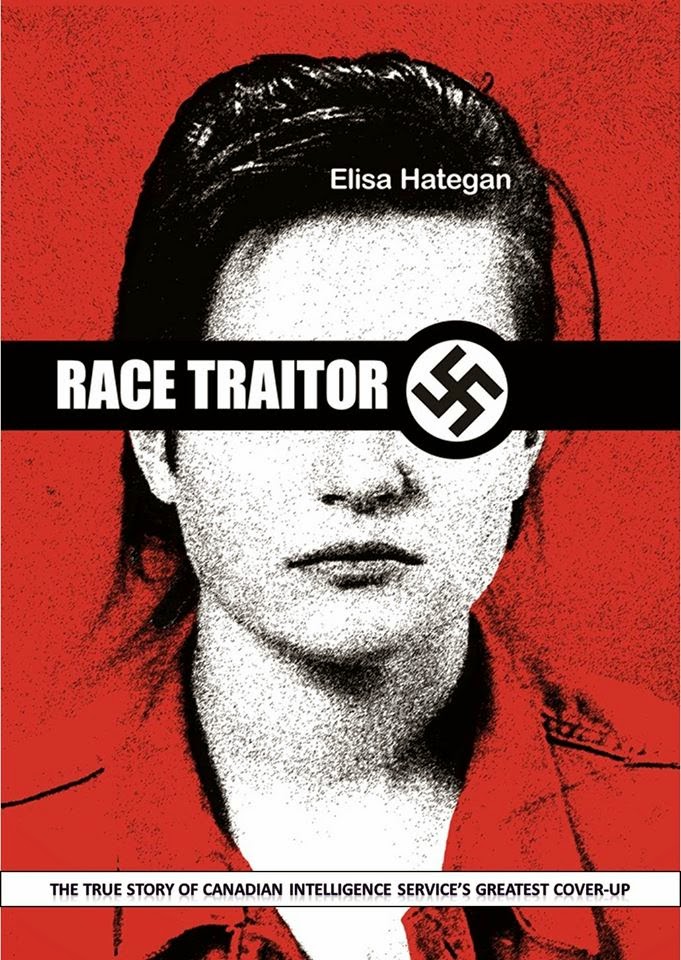
We wrote about the book in March when Ms. Hategan first published the digital editions for KOBO and Kindle. All the members of the Collective have read it and very highly recommend it to anyone who wants to learn about the history of the racist movement in Canada during the early 1990s, however more importantly the books is incredibly relevant in an era where the governments in ostensibly free and democratic nations have been caught spying on their own citizens. While set in the 90s, Race Traitor perhaps has as much to tell us about our future as it does the past.
16 October 2014
Elisa Hategan's Race Traitor: Now Out In Paperback
Those who did not have a KOBO or Kindle and were not able to purchase Elisa Hategan's Race Traitor or those who would rather own a physical copy of the book now have the opportunity to purchase the paperback edition of the book:
Race Traitor: The Story of Canadian Intelligence's Biggest Cover-Up by Elisa Hategan
We wrote about the book in March when Ms. Hategan first published the digital editions for KOBO and Kindle. All the members of the Collective have read it and very highly recommend it to anyone who wants to learn about the history of the racist movement in Canada during the early 1990s, however more importantly the books is incredibly relevant in an era where the governments in ostensibly free and democratic nations have been caught spying on their own citizens. While set in the 90s, Race Traitor perhaps has as much to tell us about our future as it does the past.
American Dream » Sun Mar 30, 2014 9:21 pm wrote:
http://anti-racistcanada.blogspot.com/2 ... -race.html
We'll provide the blurb from Amazon (links added by ARC):
We noticed that Ms. Hategan kindly also provided a page of resources which includes our "History of Violence" time line. For that we have to thank Ms. Hategan for the plug.Set in 1990s Toronto, RACE TRAITOR is the visceral true story of a teenage girl who becomes entangled in Canada’s most powerful white supremacist group, the Heritage Front – a domestic terrorist group later revealed to have been created and funded with the assistance of Canada’s spy agency, Canadian Security and Intelligence Service (CSIS).
To sixteen-year old runaway Elisse, the new friends she encounters in the secretive Heritage Front are the family she’s never had. They feed her when she’s hungry, watch her back, and Wolfgang Droege, one of the group’s charismatic leaders, introduces her to a trusted friend, notorious Holocaust denier Ernst Zundel, who provides her with shelter and work.
In less than a year, Elisse evolves into an extremist groomed for a leadership role in the far-right movement. Her loyalty earns her the attention and tutelage of Grant Bristow, co-founder of the Heritage Front, who is training a secret faction of skinheads and neo-Nazis in information-gathering and terror tactics targeting political opponents. Rapidly drawn into their web of hatred, Elisse witnesses an escalating campaign of terror from which there seems no way out.
Forced to confront her sexual orientation and secret heritage, Elisse realizes that she must fight back. But when she attempts to shut down the vicious organization that had brainwashed her and terrorized innocent Canadians, she learns that a darker force is behind the façade of the Heritage Front: Canada’s own spy agency, backed by the government that was supposed to protect her.
At only eighteen, Elisse’s testimony will lead to the criminal convictions of prominent white supremacists including Wolfgang Droege. Within months, Grant Bristow would be exposed as an undercover CSIS agent. Although Operation Governor never led to the arrest of a single Canadian racist, Bristow will be placed into the Witness Protection Program and given a package worth hundreds of thousands of taxpayer dollars, while the teenage girl who had named him as a criminal will be denied police protection and forced to go on the run for her life.
While a discussion of the history of the Heritage Front, from our point of view, is important in and of itself, Ms. Hategan notes that the story remains topical even today. In some way Race Traitor is less about the Heritage Front than it is a cautionary tale about government surveillance and the loss of civil liberties. While the Heritage Front might have existed without the help of CSIS, it seems clear that it became far more dangerous as a result of their involvement through their paid informant.
-
American Dream
- Posts: 19946
- Joined: Sat Sep 15, 2007 4:56 pm
- Location: Planet Earth
Re: Fascists are the Tools of the State
http://viewpointmag.com/2014/09/11/the- ... derground/
The Deep State: Germany, Immigration, and the National Socialist Underground
Wildcat September 11, 2014
Nearly three years ago, in November 2011, news of a double suicide after a failed bank robbery developed into one of the biggest scandals in postwar German history.1 Even now, it remains unresolved. For thirteen years the two dead men, Uwe Mundlos and Uwe Böhnhardt, had lived underground, together with a woman, Beate Zschäpe. The three were part of the National-Sozialistischer Untergrund (NSU), a fascist terror organization which is supposed to have murdered nine migrant small entrepreneurs in various German towns and a female police officer, and to have been responsible for three bomb attacks and around fifteen bank hold-ups. Although the NSU did not issue a public declaration, the connection between the nine murders committed between 2000 and 2006 as obvious: the same weapon was used each time, a Ceska gun.
At the time they were called “doner murders” (as in doner kebab) and the police called their special investigation team “Bosphorus.”2 Nearly all the police departments working on the murders focused mainly on the victims and their alleged involvement in “organized crime,” the drug trade, etc. Not only was it eventually revealed that the murderers were organized Nazis, but that the killers had been supported by some branches of the state apparatus and the search for the murderers had been systematically obstructed. As one famous public television news presenter said: “One fact is established: the perpetrators could have been stopped and the murders could have been prevented.” She also voiced “the outrageous suspicion that perhaps they were not supposed to be stopped.” The final report of the parliamentary investigation committee of the Thuringia state parliament, published in August 2014, stated a “suspicion of targeted sabotage or conscious obstruction” of the police search. The Verfassungsschutz (VS, the German domestic secret service) had “at least in an indirect fashion protected the culprits from being arrested.”
Since the supposed double suicide on the November 4, 2011, the intelligence services, the interior ministries of the federal and central state, and the BKA collaborated to cover tracks, just as they had collaborated before to keep the existence of the NSU from becoming publicly known. One day before the connection between the NSU and the last bank robbery was publicly announced, a consultation in the chancellery took place. Since then, the investigation has been systematically obstructed by the destruction of files, lies, and the refusal to surrender evidence. In the current criminal case against the alleged sole survivor of the NSU (Beate Zschäpe) and five supporters at the higher regional court in Munich, the public prosecutor wants it to be believed that the series of terror acts were the work of three people (“the Trio”) and a small circle of sympathizers. “The investigations have found no indication of the participation of local third parties in the attacks or any of organizational integration with other groups.” But it is clear that the NSU was much larger and had a network all over Germany. And it is highly unlikely that the two dead men were the only perpetrators.
Research on the NSU has shown that the VS had the organized fascists under surveillance the whole time, without passing its information on to the police. It had many Confidential Informants (CIs)3 in leading positions in the fascist structures – or rather, the CIs even built up large parts of these structures. It is very unlikely that the secret services acted without consultation with the government – but it is certain that we will never find any written order. Sometimes public prosecutors and leading police officials were included in the cover-up. For example, the current President – at the time Vice-President – of the Landeskriminalamt (LKA) or Criminal Police Offices of Thuringia ordered his police in 2003 to “go out there, but don’t find anything!” after receiving a tip about Böhnhardt’s whereabouts.
Obviously the German state apparatus has erected a (new?) parallel structure that operates in accordance with government policies and out of the reach of parliamentary or legal control. The National-Sozialistischer Untergrund was a flagship project of this “deep state,” supporting the new policy towards migrants that started in 1998 at the instigation of Otto Schily, then Interior Minister. Since the NSU became known to the public, this apparatus has even been financially and operationally strengthened.
The NSU complex gives us a glimpse of the way the German state functions, and can therefore sharpen our criticism of the capitalist state. This is of international relevance for two reasons. First, many countries, such as Hungary, the Czech Republic, Morocco, and Russia, have recently seen mobilization, pogroms, and violence against migrants. In a weaker form this has also happened in Germany, and as usual one can see a pattern: the government stirs up hatred, fascists take action (there have been at least five arson attacks in the first half of 2014). Second, many states are preparing militarily for mass strikes and social unrest. In accordance with an operational scheme that has shaped interior policies in many Western countries since the Second World War, state institutions make use of paramilitary fascist structures. A recent example is the relation between the Greek security apparatus and the fascist Golden Dawn.4
The Background: The State Lays the Ground for Racism
In October 1982 the new German Chancellor Helmut Kohl told Margaret Thatcher in a confidential conversation that he wanted to reduce the number of Turks in Germany by half within four years. They were “impossible to assimilate in their present number.” A few months before this conversation his predecessor Schmidt blared: “I won’t let any more Turks cross the border.” In October 1983, the government passed a repatriation grant. In the following years, the Christian Democrats (CDU) began a debate about the alleged rampant abuse of the asylum law. Although hate was stirred against “gypsies,” “negroes,” and others, in its core this racism was always aimed against “the Turks,” the largest group of immigrants. Kohl made this clear in his conversation with Thatcher: “Germany does not have a problem with the Portuguese, the Italians, not even the Southeast Asians, because all these communities are well integrated. But the Turks, they come from a very different culture.”5
Already in the second half of the 1980s, this government policy was accompanied by Nazi attacks on foreigners. After German reunification this process culminated in the racist pogroms of Rostock-Lichtenhagen in August 1992.6 Less than four months later, the SPD (Social Democratic Party of Germany) and the CDU (Christian Democratic Union of Germany) agreed to abolish the right of asylum almost completely.
The state racism was bloody, but it was not quantitatively successful in deporting large numbers or discouraging immigration. At the beginning of Kohl’s Chancellery there were 4.6 million foreigners in Germany; when it ended in 1998 there were 7.3 million. Consequently, interior policy focused on “police penetration” of “parallel societies” after the Rostock pogroms and especially under the Schröder government. Interior minister Kanther and his successor Schily imposed the definition of immigration as “criminally organized” throughout Europe. This policy, too, was primarily directed not against “newcomers” but against the “Turks” who already live here. Small businesses owned by migrants are generally suspected of involvement in organized crime. Even before 9/11, the financial transactions and phone calls of whole communities were screened and analyzed on suspicion of organized crime and trafficking. In particular, the investigations targeted small businesses frequented by large numbers of people: coffee shops, internet cafes, kiosks, and so forth. From these places migrants can transfer money to another country without the involvement of banks, using the Hawala system.7 “Police penetration” reached its climax with the search for the Ceska killers: the “BOA Bosphorus” organized the largest dragnet among migrant communities in the history of Germany: massive surveillance of phone calls, mobile phones, money transfers, hotel bookings, rental car use, etc.
The Nazis
Although the global economic crisis of the early 1990s reached Germany a bit later than elsewhere because of the “reunification boom,” it was relatively more severe. Unemployment doubled, “floodgates opened wide” in the factories. The unions supported the crisis policy of employers with new collective agreements to ensure “job security” and company agreements implementing “working time accounts” over a full year. The workers were left alone in their defensive struggles, even though some were quite militant and creative. The (radical) Left was preoccupied with the struggle against fascism and racism. They no longer analysed racism as a governmental policy, but as a “popular passion.” Anyone who tries to fight against ethnic racism in all its shades but omits the dimension of social racism remains toothless at best: in the worst case s/he becomes an agent of state racism.8 Jacques Rancière described it this way: “The racism we have today is a cold racism, an intellectual construction. It is primarily a creation of the state… [It is] a logic of the state and not a popular passion. And this state logic is primarily supported not by, who knows what, backward social groups, but by a substantial part of the intellectual elite.” Rancière concludes that the “‘Leftist’ critique” has adopted the “same conceit” as the right wing (“racism is a popular passion” which the state has to fight with increasingly tougher laws). They “build the legitimacy of a new form of racism: state racism and ‘Leftist’ intellectual racism.”9 After that shift, there was a strong tendency for antifascist activities to focus on the socially deprived and their primitive racism, and the state became increasingly attractive as an ally. From the mid-90s onward, it funded most of these anti-racist initiatives. All these changes were completed by the self-disarming of most of the radical Left, which started adopting the aim of “strengthening civil society” at the same time as it removed all references to class struggle.
The most important NSU members were born in the mid-1970s in East Germany and were politically socialized in the “asylum debate” in the early 90s. It was a phase of massive de-industrialization and high unemployment in the East of Germany. The young Nazis learned that they could use violence against migrants and leftist youth without being prosecuted by the state. They realized that they could change society through militant action.
In West Germany a new youth culture grew in the ’80s as well: right-wing skinheads. The skinhead scene in the East and in the West was held together by alcohol, excessive violence, concerts, and the distribution of illegal videos and CDs. This music business allowed them to set up their own financing. Still, a large part of their money was organized through petty crime. From the beginning, many Nazis were involved in prostitution, and arms and drug trafficking. Later they became heavily involved with biker gangs and security firms, which are booming due to the the privatization of state functions.
In the mid-90s various militant groups and other groups from the rightwing music scene united under the banner of the Blood & Honour network (B&H).10 Soon after the German Nazi scene organized internationally, making contacts worldwide and building an infrastructure that stretched from CD production to arms dealing and shooting ranges. At that time the police could no longer countenance Nazi violence, and the Nazis had to hide their actions. In that context, the B&H/Combat 18 concept of clandestine struggle and small, independent terrorist groups (“leaderless resistance”) helped them reorganize.
In the former East German state of Thuringia, the Nazi scene was built up by “Freie Kameradschaften,”11 the Thüringer Heimatschutz (THS),12 Blood & Honour, and the Ku Klux Klan. This is the environment that gave birth to the National-Sozialistischer Untergrund. The “Kameradschaft Jena” consisted of Ralf Wohlleben, Holger Gerlach, André Kapke, Böhnhardt, Mundlos, and Zschäpe. From 1995 onwards they were filed as “rightwing extremists” in the VS Information System. Organized in the THS, they practised the use of explosives and firearms, and committed their first attacks. The other members of the “Kameradschaft Jena” remained active in the scene after the Trio went underground in 1998. And they supported their comrades: Holger Gerlach gave them his driver’s licence, passport, and birth certificate, and he rented motorhomes for them. Kapke and Wohlleben organized weapons and passports. Those two organized the largest right-wing rock festival in Germany and maintained international contacts. In 1998 Wohlleben became a member of the NPD, the largest neo-Nazi party at the time. Over time he became its deputy chairman in Thuringia. With the help of this network, Böhnhart, Mundlos and Zschäpe could move underground and commit their attacks, probably with local support.
The Informants System
The German State is directly involved in organized fascist structures. But the direct and extensive involvement in the Thüringer Heimatschutz and the National-Sozialistischer Untergrund stands out. In and around these groups the VS positioned more than two dozen Confidential Informants, or CIs. These CIs were not used to catch violent Nazis like the Trio, instead they organized the militant Nazi scene in Germany, developing it ideologically and militarily. The VS recruited mostly very young fascists and made them into leaders of the scene. In an internal document of 1997, the Bundeskriminalamt (Federal Criminal Police Office, or the BKA) called these CIs “incendiaries” in the Nazi scene.13 It saw “the danger that the CIs egged each other on to bigger actions” and found it questionable “whether some actions would have happened without the innovative activities of the CIs.” There are many statements by former CIs descriving how they discussed their political actions with their handlers. In some of those cases the handlers prevented their CIs from leaving the scene or told them to appear more aggressive. For the German intelligence agencies, maintaining CIs is more important than law enforcement. They protected them from the police in multiple cases so that they could operate undisturbed. In the mid-90s there was a brief debate about this problem, because it became known that CIs of the German intelligence agencies fought and killed as mercenaries in the Yugoslavian civil war.
In 1996 the Federal Interior Ministry began Operation Rennsteig: the Bundesamt für Verfassungschutz (BfV, federal domestic secret service), Militärischer Abschirmdienst (MAD, German military intelligence agency), and local VS agencies of Thuringia and Bavaria coordinated their intelligence activities relating to the THS and the NSU, at least until 2003. They discussed the recruitment of informants but also how they could achieve discursive hegemony within “civil society.” Operation Rennsteig marks a turning point in German interior policy, which really took hold when Otto Schily, a former ’60s student radical and defense lawyer of the Red Army Faction, became interior minister in 1998. There was an unseen extension of the security apparatus and an adjustment of the focus of the intelligence agencies. To adapt themselves to the new international constellation (Yugoslavian wars, the first attack on the World Trade Center in 1993), they centralized the German intelligence structure and unified the handling of the Nazi scene. In this process they also expanded intelligence activities within the Nazi scene. All this happened at the same time as the shift in “foreigners policy” from the attempt at “reduction” under Kohl to the “fight against parallel societies in our midst” under Schily.
Everyone involved in Operation Rennsteig knew that it was an explosive and not entirely legal operation. Most of the files concerning recruitment and handling were incomplete, some CIs were not even registered. Between November 12, 2011 and the summer of 2012, 310 case files were destroyed in the BfV alone. They tried to destroy everything connected with Operation Rennsteig, CI “Tarif,” and other important CIs around the NSU. Again, the commands were coming from the top of the hierarchy. A few days after the first destruction of files, the Federal Interior Ministry gave the order to continue the destruction. Not only did they destroy physical files, they also manipulated computer files and deleted the phone data of CIs in contact with the NSU.
Who Was in Control?
When more and more high-level CIs in the NSU’s immediate environment were exposed, they began to tell the fairy tale of “CIs out of control.” This was just the secret service’s next smokescreen, after such cover stories as “we didn’t know anything” and “we were badly coordinated” collapsed when Operation Rennsteig became publicly known. It is a lie, but many on the Left believe it because it fits into their picture that “the Nazis can do what they want with the state.” It is therefore worth taking a closer look at this point.
Who are CIs? The services usually try to recruit people with problems: prison, debts, and personal crises. These people then receive an allowance that can amount to a normal monthly income for important CIs. CIs get support for their political actions and warnings before a house search. On the other hand, there is a lot of control: surveillance of all telephones, tracking of movements, sometimes direct shadowing. In order to crosscheck the reports, the VS runs more CIs than it would otherwise need. Time and again there are meetings of Nazi cadres with four or five CIs sitting around the table. There were several CIs within the NSU structure who did not know about each other. The great majority of them did what the VS wanted them to do — passing on information, betraying everything and everyone, while also directly supporting armed struggle by providing passports, logistics, propaganda and weapons.
Some examples of CIs in the NSU structure:
Tino Brandt, the chief of the THS, was the best paid CI of the Thuringia VS from 1994 to 2001; he helped the Trio go underground, and afterward provided passports and money.
Thomas Starke (LKA CI in Berlin from 2000 to 2011) organized weapons and the Trio’s first hideout, and he delivered explosives before they went underground. He gave clues as to where they could be found in 2002, but these were “not investigated.”
Thomas Richter was CI “Corelli” for the BfV from 1994 to 2012; after this became public he was kept hidden by the agency and was found dead in April 2014. He had “immediate contact” with Mundlos as early as 1995, and was the link between the NSU and the KKK and co-founder of the anti-antifa.
Andreas Rachhausen – “GP Alex” – brought back the getaway car the three had used for going underground in January 1998, when Rachhausen was already a CI.
Ralf Marschner was CI “Primus” for the BfV from 1992 until about 2001. He rented motorhomes through his building company at exactly the time when two of the murders occurred.
Carsten Szczepanski tried to build up a German branch of the KKK in the early 1990s, while monitored by the VS. Between 1993 and 2000, he was imprisoned for a brutal attempted murder. In prison he co-edited the Nazi magazine “Weißer Wolf” (White Wolf), which propagated the concept of leaderless resistance and sent greetings “to the NSU” even then. He became a CI in prison. For his work he received many prison privileges (besides lots of money). He supplied much information, for example that Jan Werner had organized the Trio’s weapons. Immediately after his release he tried to set up a terror cell like Combat 18. When his cover blew in 2000, the VS got him a new identity and sent him abroad.
Michael von Dolsperg, (formerly See), a member of Combat 18, close to the THS. From 1995 to 2001 he was a BfV CI with the code name “Tarif.” He was rewarded with at least 66,000 D-Mark. After 1994 he was editor of the magazine “Sonnebanner,” which proposed “going underground” and “forming independent cells.” We know that some of its articles were discussed by Mundlos, Böhnhardt, Zschäpe and their close contacts. Dolsperg produced a total of 19 issues. In an interview he claimed that “the BfV got all issues in advance.”14 This is not the only case where the VS partly financed and “fine-tuned” the contents of a Nazi magazine. In Thuringia, the VS was consulted for anti-antifascist leaflets and did the proofreading.15 In 1998 Kapke asked Dolsperg if he could provide housing for the Trio in hiding. Dolpsberg refused after his handler advised him to do so.
Parallel to the story about “CIs out of control,” the intelligence agencies created another one: “too much chaos in the intelligence apparatus.” To support this legend they put on display all the internal conflicts between the various law enforcement and intelligence agencies, cases of “conflicting authorities” and the competition between different agencies. One highpoint was the scandal around Roewer, the former President of the local VS agency in Thuringia.16 All this show of confusion was used to make the NSU a pretext for the enhancement of the security apparatus.
1998: The So-called Disappearance of the Underground
In January 1998, the LKA found pipe bombs and explosives in a garage rented by Zschäpe in Jena. The VS had known about these explosives all along. Nonetheless, Böhnhardt was able to leave undisturbed in his car during the raid. It took days until the police issued a warrant for the Trio because all those responsible were on sick leave, on vacation, or otherwise unavailable. Obviously they wanted the Trio to go underground. Already in November 2011, the famous German feuilletonist Nils Minkmar described the nature of the “underground” as follows: “They didn’t have to hide very deep, it was more like snorkeling in a bathtub: They used to have a social life in Zwickau, kept in contact with a wide circle of supporters and attended demonstrations, concerts and other events. Many did know where the three were hiding. And if the right wing scene in Germany has a problem, it is certainly not that it is extremely sealed off, but that it is heavily interspersed with CIs.” In fact, today we know that the three operated in an environment that was structured and monitored by the VS; most of their main supporters were CIs. After searching the garage, the police even found two address lists belonging to Mundlos containing 50 names, including at least five CIs.17 The lists displayed the national network of the NSU, with contacts in Chemnitz, Jena, Halle, Rostock, Nuremberg, Straubing, Regensburg, Ludwigsburg. Officially, the police never analyzed the lists or used them for investigation purposes!
2000: The Extremism Doctrine and the Beginning of the Murders
Two and a half years later, on September 9, 2000, the Ceska murders began with the death of Enver Simsek. In early summer the BfV had informed the interior ministry that “a few groups” were trying to get the “structure and the equipment” to “attack certain targets.” These groups were especially active in the states of Berlin and Brandenburg, Saxony, Saxony-Anhalt and Lower Saxony. The BfV also kept an eye on the Trio — after they went underground they were closely watched by the unit for right-wing terrorism (!). Nevertheless the BfV claimed that these small Nazi groups had “no political concept for armed struggle,” although they actively propagated such concepts by supporting newspapers such as the “Sonnenbanner.” Federal Interior Minister Schily used this information to make a press statement in which he warned of the “danger of Antifa actions radicalizing individual right-wing extremists. These militant right-wing extremists or small groups could decide to retaliate.”
The strategy was to build up fascist structures and to blame the radical left for their existence in the public discourse, employing the extremism doctrine.18 The film Youth Extremism in the Heart of Germany, made by the Thuringian VS in May 2000, is a clear example. At the beginning it states that fascist and antifascist “scenes need each other, they cannot live without each other” and that “violence as a means to an end is accepted in the left-wing scene.” It describes the fascists with the usual clichés: unemployed, uneducated, disorganized, committing crimes when drunk. Roewer, the president of the VS, explains the high number of right offenses “solely with the fact that scrawling swastikas, roaring Sieg Heil … are offenses in Germany … because of that the statistics appear very high with over 1,000 crimes per year, but nearly all are propaganda offences.” The THS is mentioned positively, Kapke and Tino Brandt are allowed to speak: “the Anti-Antifa Ostthüringen was formed in response to violence from the left, to bring those perpetrators to light,” and “We are representatives of the National Democratic Party of Germany in Jena … We are fundamentally opposed to violence.”
2003-2005: The Manhunt is Discontinued; Bomb Attack in Cologne
In 2003 four immigrants from Turkey had already been killed. Evidence piled up that the murders could have a right-wing extremist background. In March 2003 the Italian secret service gave the VS evidence of a network of European Nazis that prepared murders of immigrants. The FBI had analysed the murders and regarded “hatred of Turks” as a motive for the murders. In Baden-Württemberg CI “Erbse” revealed that there was a Nazi group called NSU and one member was called “Mundlos:” the handler was advised to destroy this information. It was decided to let the Trio disappear.
In June 2004, a nail bomb exploded in the Keupstraße in Cologne. The attack resembled other right-wing attacks, for example the London nail bombings by the Nazi David Copeland five years earlier. But the Federal Interior Minister Schily announced two days later: “The findings of our law enforcement agencies do not indicate a terrorist background, but a criminal one.” He definitely knew better!
The shops and restaurants in the Keupstraße are almost exclusively run by immigrants. Many of these shops are very successful; some businesspeople even joined in an initiative to become active in local politics with their own demands. The attack ended these attempts. The uncertainty as to who was behind the attack and the crackdown by the police on the victims directly after created great distrust in the Keupstraße, which is still felt to this day.
The Keupstraße bombing and its aftermath exemplify the structural interaction of state institutions with the fascist terror: first the attack terrorizes the immigrants, then they are harassed by the police and the media. This harassment makes the intentions of the NSU a reality: “foreign profiteers” and “foreign mafias” were marked and cut off from the German “Volkskörper” (“German people’s body”).
2006-2007: Murders of Migrants Stop, Police Officer Kiesewetter is Murdered
In April 2006 two people were killed within three days: kiosk owner Mehmet Kubasik in Dortmund and Halit Yozgat in his internet café in Kassel. The body count of the Ceska murders went up to nine. The victims’ relatives organized joint demonstrations in Kassel and Dortmund, shouting the slogan “No tenth victim!” After the demonstrations the series of murders stopped.
The murder in Kassel showed clearly that the VS wanted to sabotage all investigations – and that this was a decision from the top of the hierarchy: at the time of the murder the Hessian VS officer Andreas Temme was present in Yozgat’s internet café. Temme was known as a gun fanatic and collected fascist literature. He was the only person present at the murder scene and did not come forward to the police. At that time he was the handler of a fascist CI with whom he had a long phone call an hour before the murder. The police saw Temme as a suspect for the entire Ceska series. Nevertheless, the Hessian VS refused to give the police any information; otherwise someone “would just have to put a dead body near a CIs or a handler” to “paralyze the whole VS.” The dispute between the police and the VS was taken up to the Hessian interior minister Bouffier, who stopped the investigations after consultation with the BfV.
Just over a year later, on April 25, 2007, the police officer Michèle Kiesewetter was shot in her police car. Her colleague Martin Arnold, sitting next to her, survived a headshot. After four and a half years the investigations still had not gotten anywhere. After the NSU became publicly known, politicians and the public prosecutor insisted obstinately that Kiesewetter had been murdered by chance and that Böhnhardt and Mundlos had been the sole perpetrators. But that story does not add up!19 In the case of Kiesewetter, the poor performance of the investigation teams cannot be explained by “racism.” The murder victim was part of the police. Why the need for a cover-up?
After the murder in Heilbronn, it became quiet around the NSU. Four and a half years later, suddenly there were two bank robberies that were attributed to the NSU. After the second of these failed, Böhnhard and Mundlos allegedly committed suicide and the NSU became a matter of public knowledge.
Germany’s “Security Structure” and the Nazis
One has to make use of the far right, no matter how reactionary they are… Afterwards it is always possible to get rid of them elegantly… One must not be squeamish with auxiliary forces.
– Franz Joseph Strauß 20
Since at least the disclosures starting in Italy in the second half of 1990, it has been known that NATO keeps armed fascist troops as a reserve intervention force. Only states with such a “stay-behind” structure could become NATO members after the Second World War. In case of a Soviet occupation this reserve was supposed to fight as a guerrilla force behind the front (hence the name stay-behind). But it also had to prevent Communist Party election victories and other forms of radical social change. In West Germany the stay-behind troops were called Technischer Dienst (technical services) and were built up by Nazi war criminals such as Klaus Barbie under US leadership. This became publicly known for the first time in 1952.21
According to a German government report of December 1990, in which the existence of stay-behind structures was admitted, “preparations for the defence of the state” were made in cooperation with the Bundesnachrichtendienst (BND, German foreign intelligence agency) from 1956 onwards. Heinz Lembke was part of these structures. He delivered weapons to the Wehrsportgruppe Hoffmann22 in the ’70s. Lembke’s huge arsenal was discovered incidentally by forestry workers in 1981. The night after Lembke agreed to disclose who had pulled the strings, he was found hanged in his cell.
The stay-behind structures obviously changed their character in the 70s and 80s (in Italy they were called Gladio and took part in something they must have understood as a civil war from 1969 to 1989.) In the 1990s they changed their direction again: now Islamism was the main enemy – it was perhaps at this point that new personnel were recruited. The thread connecting them: fascist groups as reserve intervention forces.
Christian Menhorn’s testimony at the penultimate session of the BUA23 is typical of the secret services’ self-confidence. Menhorn was responsible for the THS at the time. He appeared as the best-informed VS analyst. He gave the BUA members the impression that he knew a lot more about the Nazi scene than they did and reprimanded them repeatedly. The questions put to him centered on why the VS prevented any mention of the Trio in a joint internal paper by the VS and BKA. Menhorn said that the VS, in opposition to the BKA, knew that the Trio was “irrelevant.” That was after the first murders had already happened. When he was asked for the reasons for this fatal denial, his immediate reply was very brief but still revealed what the VS did at that time: “We adjusted our information.”24
Menhorn, Richard Kaldrack (alias; Marschner’s handler), Thomas Richter, Mirko Hesse, Martin Thein (Dolsperg’s handler) and Gordian Meyer-Plath, Scepanski’s handler and head of the Saxony VS, are all part of a new generation, born in 1966 or later, who came straight from school or university and started working for the VS. They all stand for the extremism doctrine; some of them have used it for an academic career. Thein for example has published books on Ultras and “fan culture” with leftwing publishers. It is very unlikely that those agents/handlers, who were very young at the time, could have taken important decisions (not stopping the Trio, giving them arms, keeping information from the police … ) without consultation with the hierarchy. They were instructed by old hands like Norbert Wießner, Peter Nocken and Lothar Lingen (alias), who won their wings fighting the Red Army Faction. Lingen set up a department in the BfV exclusively for “right terror” at the beginning of the 90s. He could be called the highest-ranking agent/handler: it was he who coordinated the destruction of files after the existence of the NSU became public knowledge.
Behind them there was a strategic level of a very few high officials whose careers swung between the interior ministry, the chancellery and the top levels of the services (e.g. Hanning and Fritsche).
Intelligence, Nazis, and the War
Since the mid-90s Germany has almost always been at war. The biggest missions were those in Yugoslavia since 1995 and in Afghanistan since 2002. The role of intelligence became far more important, playing a greater role in securing German territory, holding down the domestic opposition to the war, and monitoring the Bundeswehr (German army) soldiers. To these ends it uses intelligence operations against opponents of the war, it infiltrates Islamist groups, and it cooperates with neo-fascist soldiers and mercenaries.
Many German and Austrian Nazis fought in the Yugoslavian civil wars, especially on the Croatian side. This involvement was organized by contacts in the “Freien Kameradschaften” and was known to the German government all along. At the same time, the German government ignored the embargo and sent military instructors to Croatia. August Hanning (see below) told the BUA that they were fighting against the Islamists since the mid-90s – and could not be bothered with the Nazis. They were focused on the “presence of al-Qaeda terrorist groups” and not on the extreme right-wing terrorists in Bosnia. What this statement obscures, of course, is that they had previously had strongly supported the Islamist militias, when these were not yet called “al-Qaeda.”
These wars were quite lucrative for some Nazis. Normally they got no pay but they were allowed to loot. They took part in “ethnic cleansing.” The regular Croatian army and the professional mercenaries25 conquered a town and marked the houses of “Serbs.” Then the Nazis were allowed to plunder and murder. After their return to Germany some Nazis could build up companies (and get leading positions in the NPD and other organizations).
The Bundeswehr has been called an “expeditionary force” since 2006. It became an all-volunteer military in July 2011 and can also be used inside Germany. So far, Germany has had little direct experience of the “privatization of warfare,” but the Bundeswehr is actively trying to eliminate this “shortcoming,” seeking to create its own private shadow armies with the support of the Federal Employment Agency. (This agency finances the training and “certification of safety personnel for international assignments”).
Operational Cores and Control from Above
You can see that the structure that led the NSU is still intact by looking at the systematic action to destroy important files. The heads of the agencies were immediately operationally active. On a strategic level they set the course for the further upgrade of the law enforcement agencies with targeted public relations work. In total five presidents of VS agencies were forced to resign. These resignations were intended “to provide breathing space for the Minister of the Interior,” as one of these directors put it. But above all the resignations were supposed to allow the the operational work to continue undisturbed. The “deep state” – this dense web of intelligence agencies, military, and police that supports government actions and implements its regulations with extra-legal means, “freelance” employees and “auxiliary forces” – must not become visible.
August Hanning is certainly one of the strategic coordinators of this structure. From 1986 to 1990 he was Security Officer in the embassy in East Berlin, among other things responsible for prisoner ransom. In 1990 he moved to the German chancellery and in 1998 he became president of the BND. Under his leadership the BND assisted in abductions and torture by the CIA. Among other things, Hanning argued against the return of Guantanamo prisoner Murat Kurnaz, although he knew of his innocence.26 He became secretary of state in the interior ministry late in 2005. During his examination before the BUA he said in relation to the NSU complex that “the security structure of Germany has proved itself.”
Another important figure is Klaus-Dieter Fritsche (CSU). Since the beginning of this year he has been federal government commissioner for the federal intelligence services, a newly created post. He is at the height of his career now. In 2009 he succeeded Hanning as Interior Ministry Secretary of State: in this capacity he was known as “Germany’s most powerful official” and “the secret interior minister.” Previously he was intelligence coordinator at the federal chancellery and before that, from 1996 to 2005, he was vice-president of the BfV with responsibility for the management of CIs like Corelli, Tarif and Primus. At the BUA he expressed the self-image of the “deep state” clearly: “secrets that could affect the government’s ability to act if revealed, must not be revealed… the interests of the state are more important than a parliamentary investigation.”
This “deep state” has a long tradition in Germany: it survived both 1933 and 1945. In 1933 the Nazis could smash the (Communist) opposition quickly, because the political police had previously created files about them which they immediately made available to the Nazi government. After 1945 the secret services, police agencies, and the administrative apparatus continued with essentially the same personnel. The BND, the VS and the stay-behind structures were made up of old Nazis. But today this complex runs across party lines. In the case of the NSU, both CDU and SPD Interior Ministers of the states played a role. BKA chief Ziercke is member of the SPD, while the public prosecutor is from the FDP [Free Democratic Party, a liberal party]. In Thuringia, interior ministers openly fought antifascist activities in cooperation with the VS whether they were from the SPD or the CDU, and so on.
The VS was an important tool in the domestic policy of all previous governments. In the mid-50s it helped to ban the Communist Party; in the 60s it worked with intelligence operations and agent-provocateurs against the youth movement. At the beginning of the 70s it helped the Brandt government to implement “professional bans”: 3.5 million applicants for civil service were audited, 11,000 applicants were banned from work as civil servants. There were unofficial disciplinary procedures and dismissals, too.
These structures survived the collapse of the Eastern Bloc: the security services were even able to use them to expand their sphere of influence. This was reinforced by 9/11: During the war on terror intelligence agencies worldwide had a massive boost, similar to that of the Cold War. The United States enhanced its security apparatus with the Patriot Acts to ensure “homeland security.” In Germany, the Joint Counter-Terrorism Centre was founded in 2004 to coordinate BKA, BND, VS and the LKAs. The BKA Act of 2009 provides the BKA with means “to respond to threats of international terrorism,” which were previously only available to the police authorities of the states (computer and network surveillance, dragnets, use of undercover investigators, audio and video surveillance of housing and telecommunications). In addition, the BKA can now investigate without concrete suspicion on its own initiative, without the approval of an prosecutor.
The development of the scandals surrounding the NSU and the surveillance of the NSA and its western partners (which include the German agencies) has made clear that the power of the ‘deep state’ in Germany is stronger than was expected. It was never touched and has survived all scandals. Across party lines, parliamentary investigation is conducted with special consideration for raison d’état. This ensures that the deep state is not affected and that police and intelligence agencies continue to be empowered, provided with additional rights and encouraged to cooperate more closely. Because of this, the Bundestag investigation committee arrived at the non-factual conclusions that there is “no evidence to show that any authority was involved in the crimes (of the NSU) in any manner, or supported or approved them” and that there was no evidence “that before November 4, 2011 any authority had knowledge” of the NSU or its deeds or “helped it to escape the grasp of the investigating authorities.”27
This raison d’état also includes the PdL (Partei die Linke – Left Party), which participated “constructively” in the BUA and supported its final report. The PdL is the left-wing opposition party in Germany. It was formed in 2007 through a merger of the successor of the SED (state party of former East Germany) and the Left opposition in the SPD. It is increasingly supported by sections of the radical left. So far, the VS had spied on the PdL. As part of the final declaration of the BUA the PdL has been assured that it will be no longer monitored by the secret services.
The Nazi scene is hardly affected: the unmasking of the NSU has not weakened it, instead many are encouraged to pursue their goals at gunpoint. They are arming themselves. In 2012, there were 350 cases of gun use registered. That was a peak, but in 2013, the use of firearms by Nazis increased further. Refugee shelters are attacked much more frequently again.
There is no reason to believe that we could take action against the brown plague via the state. At the trial in Munich, the public prosecutor is doing a political job, trying to deal with the case according to the ruling doctrine.
A weakness of large parts of the “left” opposition and the radical Left becomes apparent: after the pogroms of the early ’90s many abandoned the working class as a revolutionary force. They could therefore only turn to “civil society” and thus ultimately the state as an ally against the Nazis. This ally supported fascist structures and helped to establish them, while at the same time it gave the left-wing opposition the opportunity to turn itself into a force supportive of the state. This fact paralyses many Antifa and other leftwing groups. Instead of naming the state’s role in the NSU complex, they focus on the investigation committees and the trial, they lose themselves in the details which are produced there. There were no significant movements on the streets when the NSU became public. All this allows the state apparatus to minimize the NSU – but many people still feel the horror.
NSU timeline:
1993/1994 Foundation of the “Kameradschaft Jena”
1996 Foundation of the Thüringer Heimatschutz (THS)
1996-1998 Small actions with dummy bombs and deactivated bombs
1/26/1998 Raid on the garage of Zschäpe; the Trio (Zschäpe, Mundlos, Böhnhardt) goes underground
1998-2011 Numerous bank robberies
07/27/2000 Bomb attack on eastern European, mostly Jewish migrants in Düsseldorf
09/09/2000 Murder of Enver Şimşek in Nürnberg
01/19/2001 Bomb attack in the Probsteigasse in Cologne
6/13/2001 Murder of Abdurrahim Özüdoğru in Nürnberg
6/27/2001 Murder of Süleyman Taşköprü in Hamburg
8/29/2001 Murder of Habil Kılıç in Munich
2/25/2004 Murder of Mehmet Turgut in Rostock
06/09/2004 Bomb attack on the Keupstraße in Cologne
06/09/2005 Murder of İsmail Yaşar in Nürnberg
6/15/2005 Murder of Theodoros Boulgarides in Munich
04/04/2006 Murder of Mehmet Kubaşık in Dortmund
04/06/2006 Murder of Halit Yozgat in Kassel
4/25/2007 Murder of the police officer Michèle Kiesewetter
11/04/2011 The NSU becomes publicly known
List of Abbreviations
VS = German domestic secret service
BfV = Federal office of the domestic secret service
MAD = German military intelligence agency
BND = German foreign intelligence agency
BUA = Parliamentary investigation committee
NSU = National Socialist Underground
B&H = Blood & Honour
Trio = Böhnhardt, Mundlos, Zschäpe
BAW = German public prosecutor
BOA = Special investigation team
LKA = The “Criminal Police Offices” of Germany’s 16 federal states (Länder). Each incorporates a ‘state security’ division.
BKA = Federal equivalent of the LKA, with reponsibility for “national security,” “counter-terrorism,” etc.
THS = Thüringer Heimatschutz (Thuringia Homeland Protection): coordinating network of the neo-Nazi Freie Kameradschaften groups in Thuringia, eastern Germany. See also footnotes 9 and 10.
What follows is based on four articles previously published in Wildcat. These in turn were based on the research of antifascist groups, on newspaper articles, on the reports from parliamentary investigation committees and on books. We use a lot of names of German Nazis, German towns, German cops and politicians. Most do not have any meaning outside of Germany. But we hope that in the “Age of Google” they can help you if you want to check the facts or go deeper. ↩
We will refer to some of the German security agencies. There are three intelligence agencies in Germany. The Bundesnachrichtendienst (BND; Federal Intelligence Service) is the foreign intelligence agency of Germany, directly subordinated to the Chancellor’s Office. The Militärischer Abschirmdienst (Military Counterintelligence Service, MAD) is a federal intelligence agency and is responsible for military counterintelligence. The third agency, Germany’s domestic intelligence service, is called “Verfassungsschutz” and has a federated structure. Aside from the federal “Bundesamt für Verfassungsschutz”(BfV; Federal Office for the Protection of the Constitution) there are also 16 so called Landesämter für Verfassungsschutz (LfV; State Authorities for the Protection of the Constitution) – one for each state – which are independent of the BfV. They are tasked with intelligence-gathering on threats against the state order and with counter-intelligence. ↩
In the language of the German police and intelligence, confidential informants are called “V-Leute” or “V-Männer.” The V stands for Vertrauen, which means confidence. ↩
Wildcat has published an article about the Golden Dawn in Greece, “Fascists in Greece: From the streets into parliament and back.” ↩
Claus Hecking, “Britische Geheimprotokolle: Kohl wollte offenbar jeden zweiten Türken loswerden,” Spiegel Online, August 1, 2013. ↩
There were many racist pogroms in Germany at the beginning of the 90s. The first peak was in September 1991 in Hoyerswerda, a town in northeastern Saxony. On four nights there were attacks against a hostel mainly used by Mozambican contract workers. The second peak was the pogroms in Rostock-Lichtenhagen in Mecklenburg-Vorpommern: Between August 22 and 24, 1992, violent xenophobic riots took place; these were the worst mob attacks against migrants in postwar Germany. There were also arson attacks against Turkish houses in which eight people died.There are two Wildcat articles in English about these pogroms and their consequences, “Rostock, or: How the New Germany is being governed,” from Wildcat 60, 1992; and “Critique of autonomous anti-fascism,” from Wildcat 57, 1991. ↩
The Hawala system is an informal value-transfer system based on a huge network of money brokers. This network makes it possible to send money to an acquaintance in a cheap and confidential way. There are no promissory instruments exchanged between the hawala brokers: the system is solely based on trust between the brokers. ↩
By social racism we mean racism against people from lower social strata, people who don’t integrate well in society, people living from benefits, etc. Étienne Balibar uses a similar concept in Étienne Balibar and Immanuel Wallerstein, Race, Nation, Class: Ambiguous Identities (London: Verso, 1991). ↩
All quotes from a lecture by Jacques Rancière in 2010, printed in German translation in ak 555, November 19, 2010. The English translation is available at: http://wrongarithmetic.wordpress.com/20 ... re-racism/ ↩
Blood & Honour is a neo-Nazi music promotion network and political group founded in the United Kingdom in 1987. Combat 18 was founded in 1992 as its militant arm. ↩
In the early 90s the militant neo-Nazi scene began to organize in groups called Freie Kameradschaften (free associations, free camaraderie). These have no formal membership and no centralized national structure, but keep in close contact. Over 150 such Kameradschaften exist in Germany. ↩
The Thüringer Heimatschutz (THS) was a coordinating network of the Freie Kameradschaften in Thuringia with up to 170 members. Its head Tino Brandt was a paid CI for VS in Thuringia. ↩
Von Baumgärtner, Maik; Röbel, Sven; Stark, Holger, “Innere Sicherheit: Der Brandstifter-Effekt,” Der Spiegel 45, November 5, 2012; “Der »Brandstifter-Effekt« des Verfassungsschutzes,” Antifaschistisches Infoblatt, March 8, 2014. ↩
Der Spiegel, September 2014. ↩
“Der Thüringer NSU-Untersuchungsausschuss,” Antifaschistisches Infoblatt 101 / 4.2013, 28.01.2014. ↩
From 1994 to 2000 Helmut Roewer was president of the Thuringia Verfassungsschutz. He is famous for his excessive leadership of the VS, involving prostitutes and spiked helmets. In summer 2000 he had to resign because it came to light that he financed important militant Nazis not only with help of the ‘normal’ VS structures but also with a system of front companies. Exactly who got the money remains unclear. Roewer himself said some time ago that the Thuringia Verfassungsschutz funded the neo-Nazi scene with 1.5 million DM. Today Roewer publishes with the right wing Ares-Verlag. ↩
Von Maik Baumgärtner, Hubert Gude und Sven Röbel, “Ermittlungspanne: Fahnder werteten NSU-“Garagenliste” nicht richtig aus,” Spiegel Online, February 14, 2014; Wolf Wetzel, “Die Garagenliste – die Gold Card des Nationalsozialistischen Untergrundes/NSU,” Eyes Wide Shut, November 16, 2011. ↩
The “extremism doctrine” is the state doctrine in the Federal Republic of Germany, which says that the democracy of the Weimar republic (1918-1933) was destroyed by the violent extremism of the right and the left. The term was coined in the 1970s by the VS. Before the 1970s it was called “radicalism,” but had to be changed because in the 60s “radical” became a positive term. ↩
Why would Böhnhardt and Mundlos go all the way to Heilbronn to kill at random a police officer who was also from Thuringia? A police officer whose immediate superior was a member of the KKK? Kiesewetter’s uncle is a police officer involved in fascist structures himself; he said to the police in 2007 that the murder of his niece was connected to the Ceska murders. The police officers investigating Heilbronn concluded from eyewitness accounts that there were six perpetrators and made composite sketches, but those were not used in the investigation, etc. ↩
Franz Josef Strauß was a German politician. He was the chairman of the CSU (independent party in Bavaria, but in an electoral union with the CDU), a member of the federal cabinet in various positions and for a long time minister-president of Bavaria. During his political career Strauss was a controversial figure, a law-and-order politician, well connected to the intelligence agencies and often leaning to the far right. He was involvement in several large-scale scandals. ↩
See Daniele Ganser, Nato’s Secret Armies: Operation Gladio and Terrorism in Western Europe (Cass: New York, 2004). ↩
The Wehrsportgruppe Hoffmann was one of the largest paramilitary groups in Germany. It was founded by Karl-Heinz Hoffmann in 1973 and prohibited in 1980. Part of the group subsequently went to Lebanon to receive military training. In September 1980 a bomb exploded at the Oktoberfest in Munich, killing 13 people. The alleged individual perpetrator Gundolf Köhler, who died in the explosion, was a member of the Wehrsportgruppe Hoffmann. ↩
Before that, the BUA had not paid attention to the BfV. The delegates had not even known about its department for right-wing terrorism. ↩
Hajo Funke, Abbruch der Untersuchung auf halber Strecke. Das vorzeitige Ende der öffentlichen Ermittlung des NSU Untersuchungsausschusses des Bundestags. ↩
U.S. companies heavily involved in the conquest of Krajna. ↩
Murat Kurnaz is a Turkish citizen and resident of Germany. He was arrested was arrested in Pakistan late in 2001 then imprisoned at Guantanamo Bay for five years. From 2002 onwards the USA was ready to return Kurnaz to Germany, but the German government declined that offer. According to the German government Kurnaz had lost his residency permit because he had left Germany for more than 6 months without notice. Kurnaz couldn’t return to Germany until a court ruled that he still had his residency permit because in Guantanamo he was unable to apply for an extension of his “leave to remain.” ↩
From the final report of the parliamentary investigation committee. Available at: http://dipbt.bundestag.de/dip21/btd/17/146/1714600.pdf. ↩
Wildcatreports on class struggles all over the world, focusing on the experiences and discussions of the workers themselves. Originally founded as Karlsruher Stadtzeitung in the late 1970s, Wildcat is not a party organization; it is a group of people from different cities mostly in Germany that aims to engage in, support, and advance everyday struggles in factories, offices, hospitals, and neighborhoods. Some of their work has been translated into English, and can be accessed on their website.
The Deep State: Germany, Immigration, and the National Socialist Underground
Wildcat September 11, 2014
Nearly three years ago, in November 2011, news of a double suicide after a failed bank robbery developed into one of the biggest scandals in postwar German history.1 Even now, it remains unresolved. For thirteen years the two dead men, Uwe Mundlos and Uwe Böhnhardt, had lived underground, together with a woman, Beate Zschäpe. The three were part of the National-Sozialistischer Untergrund (NSU), a fascist terror organization which is supposed to have murdered nine migrant small entrepreneurs in various German towns and a female police officer, and to have been responsible for three bomb attacks and around fifteen bank hold-ups. Although the NSU did not issue a public declaration, the connection between the nine murders committed between 2000 and 2006 as obvious: the same weapon was used each time, a Ceska gun.
At the time they were called “doner murders” (as in doner kebab) and the police called their special investigation team “Bosphorus.”2 Nearly all the police departments working on the murders focused mainly on the victims and their alleged involvement in “organized crime,” the drug trade, etc. Not only was it eventually revealed that the murderers were organized Nazis, but that the killers had been supported by some branches of the state apparatus and the search for the murderers had been systematically obstructed. As one famous public television news presenter said: “One fact is established: the perpetrators could have been stopped and the murders could have been prevented.” She also voiced “the outrageous suspicion that perhaps they were not supposed to be stopped.” The final report of the parliamentary investigation committee of the Thuringia state parliament, published in August 2014, stated a “suspicion of targeted sabotage or conscious obstruction” of the police search. The Verfassungsschutz (VS, the German domestic secret service) had “at least in an indirect fashion protected the culprits from being arrested.”
Since the supposed double suicide on the November 4, 2011, the intelligence services, the interior ministries of the federal and central state, and the BKA collaborated to cover tracks, just as they had collaborated before to keep the existence of the NSU from becoming publicly known. One day before the connection between the NSU and the last bank robbery was publicly announced, a consultation in the chancellery took place. Since then, the investigation has been systematically obstructed by the destruction of files, lies, and the refusal to surrender evidence. In the current criminal case against the alleged sole survivor of the NSU (Beate Zschäpe) and five supporters at the higher regional court in Munich, the public prosecutor wants it to be believed that the series of terror acts were the work of three people (“the Trio”) and a small circle of sympathizers. “The investigations have found no indication of the participation of local third parties in the attacks or any of organizational integration with other groups.” But it is clear that the NSU was much larger and had a network all over Germany. And it is highly unlikely that the two dead men were the only perpetrators.
Research on the NSU has shown that the VS had the organized fascists under surveillance the whole time, without passing its information on to the police. It had many Confidential Informants (CIs)3 in leading positions in the fascist structures – or rather, the CIs even built up large parts of these structures. It is very unlikely that the secret services acted without consultation with the government – but it is certain that we will never find any written order. Sometimes public prosecutors and leading police officials were included in the cover-up. For example, the current President – at the time Vice-President – of the Landeskriminalamt (LKA) or Criminal Police Offices of Thuringia ordered his police in 2003 to “go out there, but don’t find anything!” after receiving a tip about Böhnhardt’s whereabouts.
Obviously the German state apparatus has erected a (new?) parallel structure that operates in accordance with government policies and out of the reach of parliamentary or legal control. The National-Sozialistischer Untergrund was a flagship project of this “deep state,” supporting the new policy towards migrants that started in 1998 at the instigation of Otto Schily, then Interior Minister. Since the NSU became known to the public, this apparatus has even been financially and operationally strengthened.
The NSU complex gives us a glimpse of the way the German state functions, and can therefore sharpen our criticism of the capitalist state. This is of international relevance for two reasons. First, many countries, such as Hungary, the Czech Republic, Morocco, and Russia, have recently seen mobilization, pogroms, and violence against migrants. In a weaker form this has also happened in Germany, and as usual one can see a pattern: the government stirs up hatred, fascists take action (there have been at least five arson attacks in the first half of 2014). Second, many states are preparing militarily for mass strikes and social unrest. In accordance with an operational scheme that has shaped interior policies in many Western countries since the Second World War, state institutions make use of paramilitary fascist structures. A recent example is the relation between the Greek security apparatus and the fascist Golden Dawn.4
The Background: The State Lays the Ground for Racism
In October 1982 the new German Chancellor Helmut Kohl told Margaret Thatcher in a confidential conversation that he wanted to reduce the number of Turks in Germany by half within four years. They were “impossible to assimilate in their present number.” A few months before this conversation his predecessor Schmidt blared: “I won’t let any more Turks cross the border.” In October 1983, the government passed a repatriation grant. In the following years, the Christian Democrats (CDU) began a debate about the alleged rampant abuse of the asylum law. Although hate was stirred against “gypsies,” “negroes,” and others, in its core this racism was always aimed against “the Turks,” the largest group of immigrants. Kohl made this clear in his conversation with Thatcher: “Germany does not have a problem with the Portuguese, the Italians, not even the Southeast Asians, because all these communities are well integrated. But the Turks, they come from a very different culture.”5
Already in the second half of the 1980s, this government policy was accompanied by Nazi attacks on foreigners. After German reunification this process culminated in the racist pogroms of Rostock-Lichtenhagen in August 1992.6 Less than four months later, the SPD (Social Democratic Party of Germany) and the CDU (Christian Democratic Union of Germany) agreed to abolish the right of asylum almost completely.
The state racism was bloody, but it was not quantitatively successful in deporting large numbers or discouraging immigration. At the beginning of Kohl’s Chancellery there were 4.6 million foreigners in Germany; when it ended in 1998 there were 7.3 million. Consequently, interior policy focused on “police penetration” of “parallel societies” after the Rostock pogroms and especially under the Schröder government. Interior minister Kanther and his successor Schily imposed the definition of immigration as “criminally organized” throughout Europe. This policy, too, was primarily directed not against “newcomers” but against the “Turks” who already live here. Small businesses owned by migrants are generally suspected of involvement in organized crime. Even before 9/11, the financial transactions and phone calls of whole communities were screened and analyzed on suspicion of organized crime and trafficking. In particular, the investigations targeted small businesses frequented by large numbers of people: coffee shops, internet cafes, kiosks, and so forth. From these places migrants can transfer money to another country without the involvement of banks, using the Hawala system.7 “Police penetration” reached its climax with the search for the Ceska killers: the “BOA Bosphorus” organized the largest dragnet among migrant communities in the history of Germany: massive surveillance of phone calls, mobile phones, money transfers, hotel bookings, rental car use, etc.
The Nazis
Although the global economic crisis of the early 1990s reached Germany a bit later than elsewhere because of the “reunification boom,” it was relatively more severe. Unemployment doubled, “floodgates opened wide” in the factories. The unions supported the crisis policy of employers with new collective agreements to ensure “job security” and company agreements implementing “working time accounts” over a full year. The workers were left alone in their defensive struggles, even though some were quite militant and creative. The (radical) Left was preoccupied with the struggle against fascism and racism. They no longer analysed racism as a governmental policy, but as a “popular passion.” Anyone who tries to fight against ethnic racism in all its shades but omits the dimension of social racism remains toothless at best: in the worst case s/he becomes an agent of state racism.8 Jacques Rancière described it this way: “The racism we have today is a cold racism, an intellectual construction. It is primarily a creation of the state… [It is] a logic of the state and not a popular passion. And this state logic is primarily supported not by, who knows what, backward social groups, but by a substantial part of the intellectual elite.” Rancière concludes that the “‘Leftist’ critique” has adopted the “same conceit” as the right wing (“racism is a popular passion” which the state has to fight with increasingly tougher laws). They “build the legitimacy of a new form of racism: state racism and ‘Leftist’ intellectual racism.”9 After that shift, there was a strong tendency for antifascist activities to focus on the socially deprived and their primitive racism, and the state became increasingly attractive as an ally. From the mid-90s onward, it funded most of these anti-racist initiatives. All these changes were completed by the self-disarming of most of the radical Left, which started adopting the aim of “strengthening civil society” at the same time as it removed all references to class struggle.
The most important NSU members were born in the mid-1970s in East Germany and were politically socialized in the “asylum debate” in the early 90s. It was a phase of massive de-industrialization and high unemployment in the East of Germany. The young Nazis learned that they could use violence against migrants and leftist youth without being prosecuted by the state. They realized that they could change society through militant action.
In West Germany a new youth culture grew in the ’80s as well: right-wing skinheads. The skinhead scene in the East and in the West was held together by alcohol, excessive violence, concerts, and the distribution of illegal videos and CDs. This music business allowed them to set up their own financing. Still, a large part of their money was organized through petty crime. From the beginning, many Nazis were involved in prostitution, and arms and drug trafficking. Later they became heavily involved with biker gangs and security firms, which are booming due to the the privatization of state functions.
In the mid-90s various militant groups and other groups from the rightwing music scene united under the banner of the Blood & Honour network (B&H).10 Soon after the German Nazi scene organized internationally, making contacts worldwide and building an infrastructure that stretched from CD production to arms dealing and shooting ranges. At that time the police could no longer countenance Nazi violence, and the Nazis had to hide their actions. In that context, the B&H/Combat 18 concept of clandestine struggle and small, independent terrorist groups (“leaderless resistance”) helped them reorganize.
In the former East German state of Thuringia, the Nazi scene was built up by “Freie Kameradschaften,”11 the Thüringer Heimatschutz (THS),12 Blood & Honour, and the Ku Klux Klan. This is the environment that gave birth to the National-Sozialistischer Untergrund. The “Kameradschaft Jena” consisted of Ralf Wohlleben, Holger Gerlach, André Kapke, Böhnhardt, Mundlos, and Zschäpe. From 1995 onwards they were filed as “rightwing extremists” in the VS Information System. Organized in the THS, they practised the use of explosives and firearms, and committed their first attacks. The other members of the “Kameradschaft Jena” remained active in the scene after the Trio went underground in 1998. And they supported their comrades: Holger Gerlach gave them his driver’s licence, passport, and birth certificate, and he rented motorhomes for them. Kapke and Wohlleben organized weapons and passports. Those two organized the largest right-wing rock festival in Germany and maintained international contacts. In 1998 Wohlleben became a member of the NPD, the largest neo-Nazi party at the time. Over time he became its deputy chairman in Thuringia. With the help of this network, Böhnhart, Mundlos and Zschäpe could move underground and commit their attacks, probably with local support.
The Informants System
The German State is directly involved in organized fascist structures. But the direct and extensive involvement in the Thüringer Heimatschutz and the National-Sozialistischer Untergrund stands out. In and around these groups the VS positioned more than two dozen Confidential Informants, or CIs. These CIs were not used to catch violent Nazis like the Trio, instead they organized the militant Nazi scene in Germany, developing it ideologically and militarily. The VS recruited mostly very young fascists and made them into leaders of the scene. In an internal document of 1997, the Bundeskriminalamt (Federal Criminal Police Office, or the BKA) called these CIs “incendiaries” in the Nazi scene.13 It saw “the danger that the CIs egged each other on to bigger actions” and found it questionable “whether some actions would have happened without the innovative activities of the CIs.” There are many statements by former CIs descriving how they discussed their political actions with their handlers. In some of those cases the handlers prevented their CIs from leaving the scene or told them to appear more aggressive. For the German intelligence agencies, maintaining CIs is more important than law enforcement. They protected them from the police in multiple cases so that they could operate undisturbed. In the mid-90s there was a brief debate about this problem, because it became known that CIs of the German intelligence agencies fought and killed as mercenaries in the Yugoslavian civil war.
In 1996 the Federal Interior Ministry began Operation Rennsteig: the Bundesamt für Verfassungschutz (BfV, federal domestic secret service), Militärischer Abschirmdienst (MAD, German military intelligence agency), and local VS agencies of Thuringia and Bavaria coordinated their intelligence activities relating to the THS and the NSU, at least until 2003. They discussed the recruitment of informants but also how they could achieve discursive hegemony within “civil society.” Operation Rennsteig marks a turning point in German interior policy, which really took hold when Otto Schily, a former ’60s student radical and defense lawyer of the Red Army Faction, became interior minister in 1998. There was an unseen extension of the security apparatus and an adjustment of the focus of the intelligence agencies. To adapt themselves to the new international constellation (Yugoslavian wars, the first attack on the World Trade Center in 1993), they centralized the German intelligence structure and unified the handling of the Nazi scene. In this process they also expanded intelligence activities within the Nazi scene. All this happened at the same time as the shift in “foreigners policy” from the attempt at “reduction” under Kohl to the “fight against parallel societies in our midst” under Schily.
Everyone involved in Operation Rennsteig knew that it was an explosive and not entirely legal operation. Most of the files concerning recruitment and handling were incomplete, some CIs were not even registered. Between November 12, 2011 and the summer of 2012, 310 case files were destroyed in the BfV alone. They tried to destroy everything connected with Operation Rennsteig, CI “Tarif,” and other important CIs around the NSU. Again, the commands were coming from the top of the hierarchy. A few days after the first destruction of files, the Federal Interior Ministry gave the order to continue the destruction. Not only did they destroy physical files, they also manipulated computer files and deleted the phone data of CIs in contact with the NSU.
Who Was in Control?
When more and more high-level CIs in the NSU’s immediate environment were exposed, they began to tell the fairy tale of “CIs out of control.” This was just the secret service’s next smokescreen, after such cover stories as “we didn’t know anything” and “we were badly coordinated” collapsed when Operation Rennsteig became publicly known. It is a lie, but many on the Left believe it because it fits into their picture that “the Nazis can do what they want with the state.” It is therefore worth taking a closer look at this point.
Who are CIs? The services usually try to recruit people with problems: prison, debts, and personal crises. These people then receive an allowance that can amount to a normal monthly income for important CIs. CIs get support for their political actions and warnings before a house search. On the other hand, there is a lot of control: surveillance of all telephones, tracking of movements, sometimes direct shadowing. In order to crosscheck the reports, the VS runs more CIs than it would otherwise need. Time and again there are meetings of Nazi cadres with four or five CIs sitting around the table. There were several CIs within the NSU structure who did not know about each other. The great majority of them did what the VS wanted them to do — passing on information, betraying everything and everyone, while also directly supporting armed struggle by providing passports, logistics, propaganda and weapons.
Some examples of CIs in the NSU structure:
Tino Brandt, the chief of the THS, was the best paid CI of the Thuringia VS from 1994 to 2001; he helped the Trio go underground, and afterward provided passports and money.
Thomas Starke (LKA CI in Berlin from 2000 to 2011) organized weapons and the Trio’s first hideout, and he delivered explosives before they went underground. He gave clues as to where they could be found in 2002, but these were “not investigated.”
Thomas Richter was CI “Corelli” for the BfV from 1994 to 2012; after this became public he was kept hidden by the agency and was found dead in April 2014. He had “immediate contact” with Mundlos as early as 1995, and was the link between the NSU and the KKK and co-founder of the anti-antifa.
Andreas Rachhausen – “GP Alex” – brought back the getaway car the three had used for going underground in January 1998, when Rachhausen was already a CI.
Ralf Marschner was CI “Primus” for the BfV from 1992 until about 2001. He rented motorhomes through his building company at exactly the time when two of the murders occurred.
Carsten Szczepanski tried to build up a German branch of the KKK in the early 1990s, while monitored by the VS. Between 1993 and 2000, he was imprisoned for a brutal attempted murder. In prison he co-edited the Nazi magazine “Weißer Wolf” (White Wolf), which propagated the concept of leaderless resistance and sent greetings “to the NSU” even then. He became a CI in prison. For his work he received many prison privileges (besides lots of money). He supplied much information, for example that Jan Werner had organized the Trio’s weapons. Immediately after his release he tried to set up a terror cell like Combat 18. When his cover blew in 2000, the VS got him a new identity and sent him abroad.
Michael von Dolsperg, (formerly See), a member of Combat 18, close to the THS. From 1995 to 2001 he was a BfV CI with the code name “Tarif.” He was rewarded with at least 66,000 D-Mark. After 1994 he was editor of the magazine “Sonnebanner,” which proposed “going underground” and “forming independent cells.” We know that some of its articles were discussed by Mundlos, Böhnhardt, Zschäpe and their close contacts. Dolsperg produced a total of 19 issues. In an interview he claimed that “the BfV got all issues in advance.”14 This is not the only case where the VS partly financed and “fine-tuned” the contents of a Nazi magazine. In Thuringia, the VS was consulted for anti-antifascist leaflets and did the proofreading.15 In 1998 Kapke asked Dolsperg if he could provide housing for the Trio in hiding. Dolpsberg refused after his handler advised him to do so.
Parallel to the story about “CIs out of control,” the intelligence agencies created another one: “too much chaos in the intelligence apparatus.” To support this legend they put on display all the internal conflicts between the various law enforcement and intelligence agencies, cases of “conflicting authorities” and the competition between different agencies. One highpoint was the scandal around Roewer, the former President of the local VS agency in Thuringia.16 All this show of confusion was used to make the NSU a pretext for the enhancement of the security apparatus.
1998: The So-called Disappearance of the Underground
In January 1998, the LKA found pipe bombs and explosives in a garage rented by Zschäpe in Jena. The VS had known about these explosives all along. Nonetheless, Böhnhardt was able to leave undisturbed in his car during the raid. It took days until the police issued a warrant for the Trio because all those responsible were on sick leave, on vacation, or otherwise unavailable. Obviously they wanted the Trio to go underground. Already in November 2011, the famous German feuilletonist Nils Minkmar described the nature of the “underground” as follows: “They didn’t have to hide very deep, it was more like snorkeling in a bathtub: They used to have a social life in Zwickau, kept in contact with a wide circle of supporters and attended demonstrations, concerts and other events. Many did know where the three were hiding. And if the right wing scene in Germany has a problem, it is certainly not that it is extremely sealed off, but that it is heavily interspersed with CIs.” In fact, today we know that the three operated in an environment that was structured and monitored by the VS; most of their main supporters were CIs. After searching the garage, the police even found two address lists belonging to Mundlos containing 50 names, including at least five CIs.17 The lists displayed the national network of the NSU, with contacts in Chemnitz, Jena, Halle, Rostock, Nuremberg, Straubing, Regensburg, Ludwigsburg. Officially, the police never analyzed the lists or used them for investigation purposes!
2000: The Extremism Doctrine and the Beginning of the Murders
Two and a half years later, on September 9, 2000, the Ceska murders began with the death of Enver Simsek. In early summer the BfV had informed the interior ministry that “a few groups” were trying to get the “structure and the equipment” to “attack certain targets.” These groups were especially active in the states of Berlin and Brandenburg, Saxony, Saxony-Anhalt and Lower Saxony. The BfV also kept an eye on the Trio — after they went underground they were closely watched by the unit for right-wing terrorism (!). Nevertheless the BfV claimed that these small Nazi groups had “no political concept for armed struggle,” although they actively propagated such concepts by supporting newspapers such as the “Sonnenbanner.” Federal Interior Minister Schily used this information to make a press statement in which he warned of the “danger of Antifa actions radicalizing individual right-wing extremists. These militant right-wing extremists or small groups could decide to retaliate.”
The strategy was to build up fascist structures and to blame the radical left for their existence in the public discourse, employing the extremism doctrine.18 The film Youth Extremism in the Heart of Germany, made by the Thuringian VS in May 2000, is a clear example. At the beginning it states that fascist and antifascist “scenes need each other, they cannot live without each other” and that “violence as a means to an end is accepted in the left-wing scene.” It describes the fascists with the usual clichés: unemployed, uneducated, disorganized, committing crimes when drunk. Roewer, the president of the VS, explains the high number of right offenses “solely with the fact that scrawling swastikas, roaring Sieg Heil … are offenses in Germany … because of that the statistics appear very high with over 1,000 crimes per year, but nearly all are propaganda offences.” The THS is mentioned positively, Kapke and Tino Brandt are allowed to speak: “the Anti-Antifa Ostthüringen was formed in response to violence from the left, to bring those perpetrators to light,” and “We are representatives of the National Democratic Party of Germany in Jena … We are fundamentally opposed to violence.”
2003-2005: The Manhunt is Discontinued; Bomb Attack in Cologne
In 2003 four immigrants from Turkey had already been killed. Evidence piled up that the murders could have a right-wing extremist background. In March 2003 the Italian secret service gave the VS evidence of a network of European Nazis that prepared murders of immigrants. The FBI had analysed the murders and regarded “hatred of Turks” as a motive for the murders. In Baden-Württemberg CI “Erbse” revealed that there was a Nazi group called NSU and one member was called “Mundlos:” the handler was advised to destroy this information. It was decided to let the Trio disappear.
In June 2004, a nail bomb exploded in the Keupstraße in Cologne. The attack resembled other right-wing attacks, for example the London nail bombings by the Nazi David Copeland five years earlier. But the Federal Interior Minister Schily announced two days later: “The findings of our law enforcement agencies do not indicate a terrorist background, but a criminal one.” He definitely knew better!
The shops and restaurants in the Keupstraße are almost exclusively run by immigrants. Many of these shops are very successful; some businesspeople even joined in an initiative to become active in local politics with their own demands. The attack ended these attempts. The uncertainty as to who was behind the attack and the crackdown by the police on the victims directly after created great distrust in the Keupstraße, which is still felt to this day.
The Keupstraße bombing and its aftermath exemplify the structural interaction of state institutions with the fascist terror: first the attack terrorizes the immigrants, then they are harassed by the police and the media. This harassment makes the intentions of the NSU a reality: “foreign profiteers” and “foreign mafias” were marked and cut off from the German “Volkskörper” (“German people’s body”).
2006-2007: Murders of Migrants Stop, Police Officer Kiesewetter is Murdered
In April 2006 two people were killed within three days: kiosk owner Mehmet Kubasik in Dortmund and Halit Yozgat in his internet café in Kassel. The body count of the Ceska murders went up to nine. The victims’ relatives organized joint demonstrations in Kassel and Dortmund, shouting the slogan “No tenth victim!” After the demonstrations the series of murders stopped.
The murder in Kassel showed clearly that the VS wanted to sabotage all investigations – and that this was a decision from the top of the hierarchy: at the time of the murder the Hessian VS officer Andreas Temme was present in Yozgat’s internet café. Temme was known as a gun fanatic and collected fascist literature. He was the only person present at the murder scene and did not come forward to the police. At that time he was the handler of a fascist CI with whom he had a long phone call an hour before the murder. The police saw Temme as a suspect for the entire Ceska series. Nevertheless, the Hessian VS refused to give the police any information; otherwise someone “would just have to put a dead body near a CIs or a handler” to “paralyze the whole VS.” The dispute between the police and the VS was taken up to the Hessian interior minister Bouffier, who stopped the investigations after consultation with the BfV.
Just over a year later, on April 25, 2007, the police officer Michèle Kiesewetter was shot in her police car. Her colleague Martin Arnold, sitting next to her, survived a headshot. After four and a half years the investigations still had not gotten anywhere. After the NSU became publicly known, politicians and the public prosecutor insisted obstinately that Kiesewetter had been murdered by chance and that Böhnhardt and Mundlos had been the sole perpetrators. But that story does not add up!19 In the case of Kiesewetter, the poor performance of the investigation teams cannot be explained by “racism.” The murder victim was part of the police. Why the need for a cover-up?
After the murder in Heilbronn, it became quiet around the NSU. Four and a half years later, suddenly there were two bank robberies that were attributed to the NSU. After the second of these failed, Böhnhard and Mundlos allegedly committed suicide and the NSU became a matter of public knowledge.
Germany’s “Security Structure” and the Nazis
One has to make use of the far right, no matter how reactionary they are… Afterwards it is always possible to get rid of them elegantly… One must not be squeamish with auxiliary forces.
– Franz Joseph Strauß 20
Since at least the disclosures starting in Italy in the second half of 1990, it has been known that NATO keeps armed fascist troops as a reserve intervention force. Only states with such a “stay-behind” structure could become NATO members after the Second World War. In case of a Soviet occupation this reserve was supposed to fight as a guerrilla force behind the front (hence the name stay-behind). But it also had to prevent Communist Party election victories and other forms of radical social change. In West Germany the stay-behind troops were called Technischer Dienst (technical services) and were built up by Nazi war criminals such as Klaus Barbie under US leadership. This became publicly known for the first time in 1952.21
According to a German government report of December 1990, in which the existence of stay-behind structures was admitted, “preparations for the defence of the state” were made in cooperation with the Bundesnachrichtendienst (BND, German foreign intelligence agency) from 1956 onwards. Heinz Lembke was part of these structures. He delivered weapons to the Wehrsportgruppe Hoffmann22 in the ’70s. Lembke’s huge arsenal was discovered incidentally by forestry workers in 1981. The night after Lembke agreed to disclose who had pulled the strings, he was found hanged in his cell.
The stay-behind structures obviously changed their character in the 70s and 80s (in Italy they were called Gladio and took part in something they must have understood as a civil war from 1969 to 1989.) In the 1990s they changed their direction again: now Islamism was the main enemy – it was perhaps at this point that new personnel were recruited. The thread connecting them: fascist groups as reserve intervention forces.
Christian Menhorn’s testimony at the penultimate session of the BUA23 is typical of the secret services’ self-confidence. Menhorn was responsible for the THS at the time. He appeared as the best-informed VS analyst. He gave the BUA members the impression that he knew a lot more about the Nazi scene than they did and reprimanded them repeatedly. The questions put to him centered on why the VS prevented any mention of the Trio in a joint internal paper by the VS and BKA. Menhorn said that the VS, in opposition to the BKA, knew that the Trio was “irrelevant.” That was after the first murders had already happened. When he was asked for the reasons for this fatal denial, his immediate reply was very brief but still revealed what the VS did at that time: “We adjusted our information.”24
Menhorn, Richard Kaldrack (alias; Marschner’s handler), Thomas Richter, Mirko Hesse, Martin Thein (Dolsperg’s handler) and Gordian Meyer-Plath, Scepanski’s handler and head of the Saxony VS, are all part of a new generation, born in 1966 or later, who came straight from school or university and started working for the VS. They all stand for the extremism doctrine; some of them have used it for an academic career. Thein for example has published books on Ultras and “fan culture” with leftwing publishers. It is very unlikely that those agents/handlers, who were very young at the time, could have taken important decisions (not stopping the Trio, giving them arms, keeping information from the police … ) without consultation with the hierarchy. They were instructed by old hands like Norbert Wießner, Peter Nocken and Lothar Lingen (alias), who won their wings fighting the Red Army Faction. Lingen set up a department in the BfV exclusively for “right terror” at the beginning of the 90s. He could be called the highest-ranking agent/handler: it was he who coordinated the destruction of files after the existence of the NSU became public knowledge.
Behind them there was a strategic level of a very few high officials whose careers swung between the interior ministry, the chancellery and the top levels of the services (e.g. Hanning and Fritsche).
Intelligence, Nazis, and the War
Since the mid-90s Germany has almost always been at war. The biggest missions were those in Yugoslavia since 1995 and in Afghanistan since 2002. The role of intelligence became far more important, playing a greater role in securing German territory, holding down the domestic opposition to the war, and monitoring the Bundeswehr (German army) soldiers. To these ends it uses intelligence operations against opponents of the war, it infiltrates Islamist groups, and it cooperates with neo-fascist soldiers and mercenaries.
Many German and Austrian Nazis fought in the Yugoslavian civil wars, especially on the Croatian side. This involvement was organized by contacts in the “Freien Kameradschaften” and was known to the German government all along. At the same time, the German government ignored the embargo and sent military instructors to Croatia. August Hanning (see below) told the BUA that they were fighting against the Islamists since the mid-90s – and could not be bothered with the Nazis. They were focused on the “presence of al-Qaeda terrorist groups” and not on the extreme right-wing terrorists in Bosnia. What this statement obscures, of course, is that they had previously had strongly supported the Islamist militias, when these were not yet called “al-Qaeda.”
These wars were quite lucrative for some Nazis. Normally they got no pay but they were allowed to loot. They took part in “ethnic cleansing.” The regular Croatian army and the professional mercenaries25 conquered a town and marked the houses of “Serbs.” Then the Nazis were allowed to plunder and murder. After their return to Germany some Nazis could build up companies (and get leading positions in the NPD and other organizations).
The Bundeswehr has been called an “expeditionary force” since 2006. It became an all-volunteer military in July 2011 and can also be used inside Germany. So far, Germany has had little direct experience of the “privatization of warfare,” but the Bundeswehr is actively trying to eliminate this “shortcoming,” seeking to create its own private shadow armies with the support of the Federal Employment Agency. (This agency finances the training and “certification of safety personnel for international assignments”).
Operational Cores and Control from Above
You can see that the structure that led the NSU is still intact by looking at the systematic action to destroy important files. The heads of the agencies were immediately operationally active. On a strategic level they set the course for the further upgrade of the law enforcement agencies with targeted public relations work. In total five presidents of VS agencies were forced to resign. These resignations were intended “to provide breathing space for the Minister of the Interior,” as one of these directors put it. But above all the resignations were supposed to allow the the operational work to continue undisturbed. The “deep state” – this dense web of intelligence agencies, military, and police that supports government actions and implements its regulations with extra-legal means, “freelance” employees and “auxiliary forces” – must not become visible.
August Hanning is certainly one of the strategic coordinators of this structure. From 1986 to 1990 he was Security Officer in the embassy in East Berlin, among other things responsible for prisoner ransom. In 1990 he moved to the German chancellery and in 1998 he became president of the BND. Under his leadership the BND assisted in abductions and torture by the CIA. Among other things, Hanning argued against the return of Guantanamo prisoner Murat Kurnaz, although he knew of his innocence.26 He became secretary of state in the interior ministry late in 2005. During his examination before the BUA he said in relation to the NSU complex that “the security structure of Germany has proved itself.”
Another important figure is Klaus-Dieter Fritsche (CSU). Since the beginning of this year he has been federal government commissioner for the federal intelligence services, a newly created post. He is at the height of his career now. In 2009 he succeeded Hanning as Interior Ministry Secretary of State: in this capacity he was known as “Germany’s most powerful official” and “the secret interior minister.” Previously he was intelligence coordinator at the federal chancellery and before that, from 1996 to 2005, he was vice-president of the BfV with responsibility for the management of CIs like Corelli, Tarif and Primus. At the BUA he expressed the self-image of the “deep state” clearly: “secrets that could affect the government’s ability to act if revealed, must not be revealed… the interests of the state are more important than a parliamentary investigation.”
This “deep state” has a long tradition in Germany: it survived both 1933 and 1945. In 1933 the Nazis could smash the (Communist) opposition quickly, because the political police had previously created files about them which they immediately made available to the Nazi government. After 1945 the secret services, police agencies, and the administrative apparatus continued with essentially the same personnel. The BND, the VS and the stay-behind structures were made up of old Nazis. But today this complex runs across party lines. In the case of the NSU, both CDU and SPD Interior Ministers of the states played a role. BKA chief Ziercke is member of the SPD, while the public prosecutor is from the FDP [Free Democratic Party, a liberal party]. In Thuringia, interior ministers openly fought antifascist activities in cooperation with the VS whether they were from the SPD or the CDU, and so on.
The VS was an important tool in the domestic policy of all previous governments. In the mid-50s it helped to ban the Communist Party; in the 60s it worked with intelligence operations and agent-provocateurs against the youth movement. At the beginning of the 70s it helped the Brandt government to implement “professional bans”: 3.5 million applicants for civil service were audited, 11,000 applicants were banned from work as civil servants. There were unofficial disciplinary procedures and dismissals, too.
These structures survived the collapse of the Eastern Bloc: the security services were even able to use them to expand their sphere of influence. This was reinforced by 9/11: During the war on terror intelligence agencies worldwide had a massive boost, similar to that of the Cold War. The United States enhanced its security apparatus with the Patriot Acts to ensure “homeland security.” In Germany, the Joint Counter-Terrorism Centre was founded in 2004 to coordinate BKA, BND, VS and the LKAs. The BKA Act of 2009 provides the BKA with means “to respond to threats of international terrorism,” which were previously only available to the police authorities of the states (computer and network surveillance, dragnets, use of undercover investigators, audio and video surveillance of housing and telecommunications). In addition, the BKA can now investigate without concrete suspicion on its own initiative, without the approval of an prosecutor.
The development of the scandals surrounding the NSU and the surveillance of the NSA and its western partners (which include the German agencies) has made clear that the power of the ‘deep state’ in Germany is stronger than was expected. It was never touched and has survived all scandals. Across party lines, parliamentary investigation is conducted with special consideration for raison d’état. This ensures that the deep state is not affected and that police and intelligence agencies continue to be empowered, provided with additional rights and encouraged to cooperate more closely. Because of this, the Bundestag investigation committee arrived at the non-factual conclusions that there is “no evidence to show that any authority was involved in the crimes (of the NSU) in any manner, or supported or approved them” and that there was no evidence “that before November 4, 2011 any authority had knowledge” of the NSU or its deeds or “helped it to escape the grasp of the investigating authorities.”27
This raison d’état also includes the PdL (Partei die Linke – Left Party), which participated “constructively” in the BUA and supported its final report. The PdL is the left-wing opposition party in Germany. It was formed in 2007 through a merger of the successor of the SED (state party of former East Germany) and the Left opposition in the SPD. It is increasingly supported by sections of the radical left. So far, the VS had spied on the PdL. As part of the final declaration of the BUA the PdL has been assured that it will be no longer monitored by the secret services.
The Nazi scene is hardly affected: the unmasking of the NSU has not weakened it, instead many are encouraged to pursue their goals at gunpoint. They are arming themselves. In 2012, there were 350 cases of gun use registered. That was a peak, but in 2013, the use of firearms by Nazis increased further. Refugee shelters are attacked much more frequently again.
There is no reason to believe that we could take action against the brown plague via the state. At the trial in Munich, the public prosecutor is doing a political job, trying to deal with the case according to the ruling doctrine.
A weakness of large parts of the “left” opposition and the radical Left becomes apparent: after the pogroms of the early ’90s many abandoned the working class as a revolutionary force. They could therefore only turn to “civil society” and thus ultimately the state as an ally against the Nazis. This ally supported fascist structures and helped to establish them, while at the same time it gave the left-wing opposition the opportunity to turn itself into a force supportive of the state. This fact paralyses many Antifa and other leftwing groups. Instead of naming the state’s role in the NSU complex, they focus on the investigation committees and the trial, they lose themselves in the details which are produced there. There were no significant movements on the streets when the NSU became public. All this allows the state apparatus to minimize the NSU – but many people still feel the horror.
NSU timeline:
1993/1994 Foundation of the “Kameradschaft Jena”
1996 Foundation of the Thüringer Heimatschutz (THS)
1996-1998 Small actions with dummy bombs and deactivated bombs
1/26/1998 Raid on the garage of Zschäpe; the Trio (Zschäpe, Mundlos, Böhnhardt) goes underground
1998-2011 Numerous bank robberies
07/27/2000 Bomb attack on eastern European, mostly Jewish migrants in Düsseldorf
09/09/2000 Murder of Enver Şimşek in Nürnberg
01/19/2001 Bomb attack in the Probsteigasse in Cologne
6/13/2001 Murder of Abdurrahim Özüdoğru in Nürnberg
6/27/2001 Murder of Süleyman Taşköprü in Hamburg
8/29/2001 Murder of Habil Kılıç in Munich
2/25/2004 Murder of Mehmet Turgut in Rostock
06/09/2004 Bomb attack on the Keupstraße in Cologne
06/09/2005 Murder of İsmail Yaşar in Nürnberg
6/15/2005 Murder of Theodoros Boulgarides in Munich
04/04/2006 Murder of Mehmet Kubaşık in Dortmund
04/06/2006 Murder of Halit Yozgat in Kassel
4/25/2007 Murder of the police officer Michèle Kiesewetter
11/04/2011 The NSU becomes publicly known
List of Abbreviations
VS = German domestic secret service
BfV = Federal office of the domestic secret service
MAD = German military intelligence agency
BND = German foreign intelligence agency
BUA = Parliamentary investigation committee
NSU = National Socialist Underground
B&H = Blood & Honour
Trio = Böhnhardt, Mundlos, Zschäpe
BAW = German public prosecutor
BOA = Special investigation team
LKA = The “Criminal Police Offices” of Germany’s 16 federal states (Länder). Each incorporates a ‘state security’ division.
BKA = Federal equivalent of the LKA, with reponsibility for “national security,” “counter-terrorism,” etc.
THS = Thüringer Heimatschutz (Thuringia Homeland Protection): coordinating network of the neo-Nazi Freie Kameradschaften groups in Thuringia, eastern Germany. See also footnotes 9 and 10.
What follows is based on four articles previously published in Wildcat. These in turn were based on the research of antifascist groups, on newspaper articles, on the reports from parliamentary investigation committees and on books. We use a lot of names of German Nazis, German towns, German cops and politicians. Most do not have any meaning outside of Germany. But we hope that in the “Age of Google” they can help you if you want to check the facts or go deeper. ↩
We will refer to some of the German security agencies. There are three intelligence agencies in Germany. The Bundesnachrichtendienst (BND; Federal Intelligence Service) is the foreign intelligence agency of Germany, directly subordinated to the Chancellor’s Office. The Militärischer Abschirmdienst (Military Counterintelligence Service, MAD) is a federal intelligence agency and is responsible for military counterintelligence. The third agency, Germany’s domestic intelligence service, is called “Verfassungsschutz” and has a federated structure. Aside from the federal “Bundesamt für Verfassungsschutz”(BfV; Federal Office for the Protection of the Constitution) there are also 16 so called Landesämter für Verfassungsschutz (LfV; State Authorities for the Protection of the Constitution) – one for each state – which are independent of the BfV. They are tasked with intelligence-gathering on threats against the state order and with counter-intelligence. ↩
In the language of the German police and intelligence, confidential informants are called “V-Leute” or “V-Männer.” The V stands for Vertrauen, which means confidence. ↩
Wildcat has published an article about the Golden Dawn in Greece, “Fascists in Greece: From the streets into parliament and back.” ↩
Claus Hecking, “Britische Geheimprotokolle: Kohl wollte offenbar jeden zweiten Türken loswerden,” Spiegel Online, August 1, 2013. ↩
There were many racist pogroms in Germany at the beginning of the 90s. The first peak was in September 1991 in Hoyerswerda, a town in northeastern Saxony. On four nights there were attacks against a hostel mainly used by Mozambican contract workers. The second peak was the pogroms in Rostock-Lichtenhagen in Mecklenburg-Vorpommern: Between August 22 and 24, 1992, violent xenophobic riots took place; these were the worst mob attacks against migrants in postwar Germany. There were also arson attacks against Turkish houses in which eight people died.There are two Wildcat articles in English about these pogroms and their consequences, “Rostock, or: How the New Germany is being governed,” from Wildcat 60, 1992; and “Critique of autonomous anti-fascism,” from Wildcat 57, 1991. ↩
The Hawala system is an informal value-transfer system based on a huge network of money brokers. This network makes it possible to send money to an acquaintance in a cheap and confidential way. There are no promissory instruments exchanged between the hawala brokers: the system is solely based on trust between the brokers. ↩
By social racism we mean racism against people from lower social strata, people who don’t integrate well in society, people living from benefits, etc. Étienne Balibar uses a similar concept in Étienne Balibar and Immanuel Wallerstein, Race, Nation, Class: Ambiguous Identities (London: Verso, 1991). ↩
All quotes from a lecture by Jacques Rancière in 2010, printed in German translation in ak 555, November 19, 2010. The English translation is available at: http://wrongarithmetic.wordpress.com/20 ... re-racism/ ↩
Blood & Honour is a neo-Nazi music promotion network and political group founded in the United Kingdom in 1987. Combat 18 was founded in 1992 as its militant arm. ↩
In the early 90s the militant neo-Nazi scene began to organize in groups called Freie Kameradschaften (free associations, free camaraderie). These have no formal membership and no centralized national structure, but keep in close contact. Over 150 such Kameradschaften exist in Germany. ↩
The Thüringer Heimatschutz (THS) was a coordinating network of the Freie Kameradschaften in Thuringia with up to 170 members. Its head Tino Brandt was a paid CI for VS in Thuringia. ↩
Von Baumgärtner, Maik; Röbel, Sven; Stark, Holger, “Innere Sicherheit: Der Brandstifter-Effekt,” Der Spiegel 45, November 5, 2012; “Der »Brandstifter-Effekt« des Verfassungsschutzes,” Antifaschistisches Infoblatt, March 8, 2014. ↩
Der Spiegel, September 2014. ↩
“Der Thüringer NSU-Untersuchungsausschuss,” Antifaschistisches Infoblatt 101 / 4.2013, 28.01.2014. ↩
From 1994 to 2000 Helmut Roewer was president of the Thuringia Verfassungsschutz. He is famous for his excessive leadership of the VS, involving prostitutes and spiked helmets. In summer 2000 he had to resign because it came to light that he financed important militant Nazis not only with help of the ‘normal’ VS structures but also with a system of front companies. Exactly who got the money remains unclear. Roewer himself said some time ago that the Thuringia Verfassungsschutz funded the neo-Nazi scene with 1.5 million DM. Today Roewer publishes with the right wing Ares-Verlag. ↩
Von Maik Baumgärtner, Hubert Gude und Sven Röbel, “Ermittlungspanne: Fahnder werteten NSU-“Garagenliste” nicht richtig aus,” Spiegel Online, February 14, 2014; Wolf Wetzel, “Die Garagenliste – die Gold Card des Nationalsozialistischen Untergrundes/NSU,” Eyes Wide Shut, November 16, 2011. ↩
The “extremism doctrine” is the state doctrine in the Federal Republic of Germany, which says that the democracy of the Weimar republic (1918-1933) was destroyed by the violent extremism of the right and the left. The term was coined in the 1970s by the VS. Before the 1970s it was called “radicalism,” but had to be changed because in the 60s “radical” became a positive term. ↩
Why would Böhnhardt and Mundlos go all the way to Heilbronn to kill at random a police officer who was also from Thuringia? A police officer whose immediate superior was a member of the KKK? Kiesewetter’s uncle is a police officer involved in fascist structures himself; he said to the police in 2007 that the murder of his niece was connected to the Ceska murders. The police officers investigating Heilbronn concluded from eyewitness accounts that there were six perpetrators and made composite sketches, but those were not used in the investigation, etc. ↩
Franz Josef Strauß was a German politician. He was the chairman of the CSU (independent party in Bavaria, but in an electoral union with the CDU), a member of the federal cabinet in various positions and for a long time minister-president of Bavaria. During his political career Strauss was a controversial figure, a law-and-order politician, well connected to the intelligence agencies and often leaning to the far right. He was involvement in several large-scale scandals. ↩
See Daniele Ganser, Nato’s Secret Armies: Operation Gladio and Terrorism in Western Europe (Cass: New York, 2004). ↩
The Wehrsportgruppe Hoffmann was one of the largest paramilitary groups in Germany. It was founded by Karl-Heinz Hoffmann in 1973 and prohibited in 1980. Part of the group subsequently went to Lebanon to receive military training. In September 1980 a bomb exploded at the Oktoberfest in Munich, killing 13 people. The alleged individual perpetrator Gundolf Köhler, who died in the explosion, was a member of the Wehrsportgruppe Hoffmann. ↩
Before that, the BUA had not paid attention to the BfV. The delegates had not even known about its department for right-wing terrorism. ↩
Hajo Funke, Abbruch der Untersuchung auf halber Strecke. Das vorzeitige Ende der öffentlichen Ermittlung des NSU Untersuchungsausschusses des Bundestags. ↩
U.S. companies heavily involved in the conquest of Krajna. ↩
Murat Kurnaz is a Turkish citizen and resident of Germany. He was arrested was arrested in Pakistan late in 2001 then imprisoned at Guantanamo Bay for five years. From 2002 onwards the USA was ready to return Kurnaz to Germany, but the German government declined that offer. According to the German government Kurnaz had lost his residency permit because he had left Germany for more than 6 months without notice. Kurnaz couldn’t return to Germany until a court ruled that he still had his residency permit because in Guantanamo he was unable to apply for an extension of his “leave to remain.” ↩
From the final report of the parliamentary investigation committee. Available at: http://dipbt.bundestag.de/dip21/btd/17/146/1714600.pdf. ↩
Wildcatreports on class struggles all over the world, focusing on the experiences and discussions of the workers themselves. Originally founded as Karlsruher Stadtzeitung in the late 1970s, Wildcat is not a party organization; it is a group of people from different cities mostly in Germany that aims to engage in, support, and advance everyday struggles in factories, offices, hospitals, and neighborhoods. Some of their work has been translated into English, and can be accessed on their website.
-
American Dream
- Posts: 19946
- Joined: Sat Sep 15, 2007 4:56 pm
- Location: Planet Earth
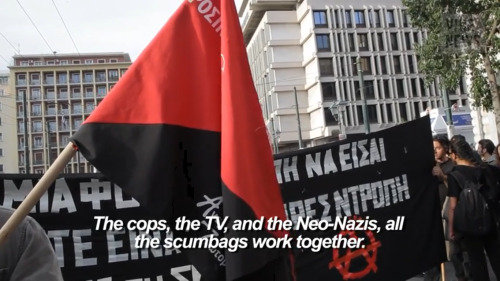
-
8bitagent

- Posts: 12250
- Joined: Fri Aug 24, 2007 6:49 am
Re: Fascists are the Tools of the State
Recent VICE special on the growing Anti Fascist youth movement against both the violent murderous neo Nazi Golden Dawn and their state sponsored enablers
"Do you know who I am? I am the arm, and I sound like this..."-man from another place, twin peaks fire walk with me
-
American Dream
- Posts: 19946
- Joined: Sat Sep 15, 2007 4:56 pm
- Location: Planet Earth
Re: Fascists are the Tools of the State
A N T I F A I N F O - B U L L E T I N
News * Analysis * Research * Action
Volume 1, Number 5 ***** March 7, 1996
News * Analysis * Research * Action
Volume 1, Number 5 ***** March 7, 1996
A Small Circle of Friends:
Larry Pratt, the Council for Inter-American Security and International Fascist Networks
by Tom Burghardt
Bay Area Coalition for Our Reproductive Rights
Introduction
Recent allegations of anti-Semitism and racism levelled against Larry Pratt, a national co-chairman of the Buchanan for President campaign committee, is an intriguing example of media obfuscation and "truth" on the half-shell. That Pratt addressed the 1992 "Christian Men's Meeting," organized by notorious Christian Identity racist, Pete Peters, is an established fact. That Pratt shared the platform with Aryan Nations fuhrer , Richard Butler and "former" Klan "Grand Dragon," Louis Beam, the neo-Nazi architect of "leaderless resistance," is incontestable. That he gave a speech at the 1993 Jubilation Conference in Sacramento, California, an annual gathering of far-rightists' sponsored by the anti-Semitic publisher of Jubilee, the flagship tabloid of the Christian Identity movement, is true and has been accurately reported by the bourgeois press.
What should be of equal concern to the media is information about Mr. Pratt which is far more damaging -- his close collaboration over a 20 year period with an international network of war criminals, neo-Nazi terrorists, and the organizers of Asian, European and Latin American death squads. But because such activities advanced the geopolitical and military goals of the United States, Pratt's actual record is passed over in silence ; a facet of media self-censorship that has been well- documented elsewhere.[1]
At the outset of this report I will emphasize, Pratt is a reactionary whose political orientation can aptly be described as clerical-fascist. On numerous occasions, he has expressed disdain for democracy and the economic, political and social rights of the oppressed. His ideological and personal links to the theocratic wing of the Christian Right, the anti-abortion movement and "Patriot" militias, though of interest, will be explored in another report currently in preparation.
This edition of AFIB however, will explore at some length, the dimensions of Larry Pratt's ties to the national security state. I will demonstrate that Pratt, Buchanan and a host of other "respectable conservatives," far from being "outsiders" or "populists" are active agents and apologists for the global crimes of U.S. imperialism.
The Council for Inter-American Security:
Intellectuals in the Service of Global Terror
The Council for Inter-American Security (CIS) is a rightist outfit that played a pivotal role formulating Washington's program for counter-revolutionary war and mass murder in Central America during the 1980s. Larry Pratt, was a central figure within the CIS hierarchy as was Patrick Buchanan; Pratt was secretary to the group while Buchanan functioned as an organizational director (see Appendix for complete list of board members and principle players).
But CIS was more than a New Right think-tank researching and formulating foreign policy for the Reagan administration. The group functioned in a dual-capacity; as an alarmist "public policy institute" and as a domestic spy ring, a "privatized" version of the FBI's infamous COINTELPRO operations. Having staked-out Latin America as their geopolitical niche, CIS targeted Central America solidarity activists, progressive clergy, and the Salvadoran exile community. The group gathered intelligence and disseminated disinformation, funneling data on foreign policy opponents to the FBI and the intelligence service of the Salvadoran death squad state.
The domestic side to illegal CIA-Contra operations were aided by a broad spectrum of domestic and international reactionaries. Many of the state-sanctioned criminals who sought to subvert democratic processes in the U.S. and overseas were connected to a network which included, among others: the John Birch Society (JBS); the World Anti-Communist League (WACL); Christian fundamentalist and Catholic theocrats; anti-Castro terrorists grouped in Alpha 66/Brigade 2506; the LaRouche organization and the Unification Movement of South Korean fascist, Rev. Sun Myung Moon.[2]
While such groups operated secretly, they did so with the knowledge, financial backing and encouragement of powerful American corporate and political interests. According to journalist Ross Gelbspan:
A...private group which flourished during the Reagan era was the Washington-based Council for Inter-American Security. The group disseminated reams of material during the 1980s purporting to prove linkages between a Soviet-inspired global terror network and liberal and left-wing American groups opposed to US foreign policies. CIS also expended considerable effort to improve the public image of the reputed Salvadoran death squad leader Roberto D'Aubuisson. When the FBI's CISPES files were pried open in 1988 by a lawsuit brought by the Center for Constitutional Rights they were found to contain several reports written by J. Michael Waller, a researcher whose work has been sponsored by the nongovernmental Council for Inter-American Security. But Waller's work to connect American political dissenters to an international communist-terrorist plot was part of a public- private partnership.[3]
By 1984, FBI "active measures" against CISPES and the Sanctuary Movement were in full-swing. Fifteen Bureau field offices, dozens of agents and hundreds of "private" right-wing intelligence "assets" were involved in these illegal operations. More than 200 incidents of harassment and intimidation against activists were documented. Many incidents involved church and office break-ins, theft of files and the infiltration of local CISPES chapters by Bureau informants. Peaceful public rallies and demonstrations were disrupted by goons affiliated with Rev. Moon's Collegiate Association for the Research of Principles (CARP).
One case that had particularly ominous implications was that of Yanira Corea, a 24 year old Salvadoran exile active in the Los Angeles CISPES chapter. In June 1987, the young woman was kidnapped, sexually assaulted, tortured and threatened with death if her "subversive" activities didn't stop. Corea's brother was a union activist in El Salvador. Prior to her abduction she received a threatening letter containing dried flower petals a photo of her three year old son and the notation -- "Flowers in the desert die," a traditional warning of the death squads.[4]
Though Bureau informants could not produce a shred of evidence linking these groups to "terrorism," the FBI actually increased the level of their attacks. According to the logic of Bureau red hunters, the lack of criminal activity in and of itself was demonstrable evidence of a broad "conspiracy" hatched by shrewd agents linked to the KGB. This was an illusion that the Council for Inter-American Security helped to create.
Throughout the period, the FBI were fed reports alleging that CISPES was a "terrorist" organization. Waller, a research director and editor of the CIS journal, West Watch , wrote a text with the fanciful title, "CISPES: A Terrorist Propaganda Network," that was given wide play by the media.[5] However, because Mr. Waller's services produced the desired propaganda effect intended by his handlers, he secured several generous grants from the State Department's Latin American Office of Public Diplomacy (OPD).[6] Recent American history is replete with examples of the profitability of lying in order to advance State interests; Elliot Abrams and Oliver North are but the tip of the iceberg in this regard.
Prior to Reagan's 1980 election, CIS was the principle organization leading the charge for an "activist" foreign policy to "defeat communism" in Central America. In 1980, they published the influential, A New Inter-American Policy for the Eighties , generally known as the "Santa Fe Document."
Lewis Tambs, "Sante Fe's" principle editor, would be appointed by Reagan as ambassador, first to Columbia and then to Costa Rica, the launching pad for Contra attacks into Nicaragua along the "Southern front."[7] Other Committee of Sante Fe members included Roger Fontaine, a National Security Council (NSC) adviser on Latin American affairs; retired Lt. General Gordon Sumner, who became a special assistant to the Secretary of State for Latin American affairs; and Lynn Francis Bouchey, an active organizer for the Unification Church's CAUSA operations in Central and South America.[8]
Bouchey, the co-author of The Strategy of Terror (written with Stefan Possony), was a former member of the Young Americans for Freedom employed by the American-Chilean Council, a front for the murderous Pinochet regime.[9] Possony, a Senior Fellow at the Hoover Institute, long-time WACL operative and board member of Lyndon LaRouche's, Fusion Energy Foundation, was a founding member of the Council, as was Dr. Anthony Bouscaren, a right-wing operative who had worked for the racist Pioneer Fund (see below).[10]
The Committee of Sante Fe alleged among other things, that the U.S. "must seize the initiative or perish. World War III is almost over." CIS viewed the Soviet Union as an "aggressor" that was "strangling the Western industrialized nations."[11]
Central America was described as "the soft underbelly of the United States." The authors called for the "restoration" of the Monroe Doctrine as the linchpin of U.S. regional strategy. In other words, the United States was free to pursue its regional interests unhindered. Bluntly, this meant that the internal politics of the Central American states were subject to "review" by the U.S.: "correctives" -- dictated from Washington -- would be applied as needed.
As a practical necessity, such "correctives" included the destruction of the Cuban, Grenadian and Nicaraguan Revolutions and the maintenance of "the fundamental order of things" in Guatemala, Honduras and El Salvador. The Committee wrote:
America is everywhere in retreat. The impending loss of the petroleum of the Middle East and potential interdiction of sea routes spanning the Indian Ocean, along with the Soviet satellization of the mineral zone of Southern Africa, foreshadow the Findlandization of Western Europe and the alienation of Japan.
Even the Caribbean, America's maritime crossroad and petroleum refining center is becoming a Marxist-Leninist lake. Never before has the Republic been in such jeopardy from its exposed southern flank. Never before has American foreign policy abused, abandoned and betrayed its allies to the south in Latin America.
...It is time to sound a clarion call for freedom, dignity and national self-interest which will echo the spirit of the American people. Either a Pax Sovietica or a world-wide counter-projection of American power is in the offing. The hour of decision can no longer be postponed.[12]
Though the authors freely employed alarmist rhetoric with little regard to the actual history of U.S. regional domination, "Sante Fe" was not the production of marginal right-wing "kooks" obsessed by the "red menace." According to the Interhemispheric Resource Center,
In the early years of the Reagan administration, the organization was one of the more influential think tanks of the New Right, providing both policy and policymakers to the new administration. In the heyday of its influence, one observer noted, top officials of CIS "shuttle[d] to and from key policy-making and advisory roles in the administration...." Among those tapped for administration positions were Patrick Buchanan, who became President Reagan's communications director...[13]
Today, Buchanan markets himself as an "outsider" standing up for the "workin' man," against a godless, secular humanist cabal of multinational corporations, abortionists, feminists, homosexuals, immigrants and socialistic "one-worlders" intent on imposing a New World Order on the American people. His project has been assisted by the media who have tossed his actual record down the Orwellian memory-hole.
As noted above, CIS was engaged in a covert war against U.S. leftists, progressive clergy and the Salvadoran exile community, channeling information gleaned by its operatives, to the FBI and the Salvadoran national security apparatus. This too, has a long history in the United States.[14]
Col. Samuel Dickens, a former intelligence officer and CIS board member, was the executive director for inter-hemispheric affairs for the American Security Council (ASC), an outfit founded by ex-FBI agents. ASC was an instrumental group which targeted leftists during the 1950s, the period of the McCarthyite witch-hunts. Founded in 1955, ASC funding has been provided by Motorola, Lockheed, Boeing and General Dynamics, among others.[15] The information they collected, much of it bogus, was then sold to ASC's dues-paying corporate members. At the height of their domestic operations ASC red hunters, including the sinister Roy Cohn, Senator McCarthy's chief inquisitor, were gathering the names of alleged "subversives" at the staggering rate of 20,000 per month. [16] One analyst has said that the ASC is "not just the representative of the military-industrial complex, it is the personification of the military-industrial complex."[17]
Another significant source of support for the Council and a host of other "conservative" organizations, was Rev. Moon's Unification Church. Bouchey helped organize two conferences for CAUSA, led by another retired general, E. David Woellner.[18] He was also a board member of the United States Global Strategy Council, identified by researchers, Louis Wolf and Frederick Clarkson as "another CAUSA operation."[19] In 1981, Bouchey was "specially commissioned" by Moon's World Media Institute to prepare and present a "content analysis" of media coverage of U.S. policy in El Salvador.[20]
Active chapters of Moon's organization existed throughout the region; the largest affiliates were centered in Argentina, Bolivia, Brazil and Paraguay. In Brazil, the director of CAUSA said, "we are forming the future base for a large political party, though at present we are still apolitical...we want to form a movement like Le Pen's in France." Needless to say, French fascist, Jean Le Pen, has done just that with the National Front, with significant financial backing from the Moon network.[21]
But Moon's extensive Latin American operations had a dual- purpose: the construction of an anti-communist "armed church" and as a "unofficial" link among CIA intelligence assets and the leaders of the death-squad states.
In Bolivia, Thomas Ward was a liaison between the CIA, Nazi war criminal Klaus Barbie, Barbie's organization, the "Fiances of Death" and the regime of "cocaine general" Luiz Garcia Meza, prior to Bolivia's bloody 1980 putsch. Ward and Barbie "were often seen together;" the introspective Ward was described as an individual "who always seemed to be absorbed in prayer." According to Col. Bo Hi Pak, Moon's chief lieutenant: "God has chosen the Bolivian people in the heart of South America as theones to conquer communism." This during a period when Bolivian narco-operations were greatly expanding -- with the knowledge of the U.S. Central Intelligence Agency.[22]
Other CIS board members or advisors who have had close ties to the Moon organization:
Roger Fontaine: a former member of the National Security Council. After leaving the NSC, Fontaine became a reporter and political analyst for the Washington Times , a newspaper owned by a subsidiary of the Moon network. Salvadoran death-squad leader, Roberto D'Aubuisson bragged of his ties to the Reagan administration, particularly Roger Fontaine, to the New York Times during a 1981 interview.[23]
Lt. General Gordon Sumner: a CIS director and advisor; Sumner was also a board member of the International Security Council (ISC), described by Herman and O'Sullivan as the "main U.S. agency of the Moon system in the field of terrorism propaganda." An international conference organized by ISC and CAUSA was held in January 1986 in Tel Aviv; speakers included Bo Hi Pak and Arnaud de Borchgrave, the publisher of the Washington Times. [24]
These were neither incidental nor marginal connections. CIS served both as an intelligence conduit from "private" sources such as the American Security Council and CAUSA, and as an informal employment agency which provided analysts to the Reagan administration at the inception of Washington's murderous counter-insurgency wars in Central America.
As CIS secretary, Larry Pratt was a well-placed "asset" in his own right, serving as a link between the public policy/research arms of the organization, the interventionist wing of the theocratic Christian Right and as an "informal" public relations spokesperson for Washington's Central American agenda via Gun Owners of America and the CIS-affiliated, North-South Institute.
But in order to fully appreciate the sinister nature of the Council for Inter-American Security, Pratt's involvement and his broader links to international fascist networks, there is another organization, also little explored by "mainstream" media, which deserves our attention, the World Anti-Communist League.
CIS and WACL: A Marriage Made in Hell
The World Anti-Communist League was founded in 1966 by two close Asian allies of the United States, Taiwan and South Korea, and a third organization, the Nazi-dominated, Anti-Bolshevik Block of Nations (ABN), led by the Ukrainian war criminal Yaroslav Stetsko.[25] As we have seen above with CIS, Rev. Moon's Unification network was an instrumental force operating behind the scenes. Moon assets were closely linked to the Korean Central Intelligence Agency and Japanese yakuza crime syndicates, many of whose leaders were convicted war criminals let off the hook by U.S. occupation forces at the war's end.
ABN was a organizational bridge linking Eastern and Western European fascists to the intelligence services of Britain and the United States. Indeed, ABN was formed with U.S. funds and was a model frequently employed by future anti-communist emigre groups. Washington's unflagging commitment to the destruction of the Soviet Union was a continuation of the Third Reich's "Operation Barbarossa" -- by other means. Christopher Simpson's description of the group provides a chilling glimpse into the modus operandi of "containment:"
The ABN was dominated by Ukrainian nationalist veterans of the OUN/UPA (Organization of Ukrainian Nationalists/Ukrainian Insurgent Army), and it included a half dozen open Nazi collaborators on its executive board. Its newspaper, ABN Correspondence , published praises of wartime genocidalists such as Ustachi _Fuhrer_ Ante Pavelic and Slovakian quisling Premier Monsignor Jozef Tiso. Alfreds Berzins, whom the U.S. government once termed a "fanatic Nazi" responsible for sending innocent people to concentration camps, was the president of the ABN "People's Council." Berzins was simultaneously a Latvian leader of the Assembly of Captive European Nations. His vice- president at the ABN was the Belorussian quisling Radislaw Ostrowsky.[26]
If such anti-communist "patriots" were serviceable as "democrats" abroad, why not at home? In the United States, WACL's first chairman was Roger Pearson, a white supremacist, eugenicist and neo-Nazi. Pearson was the editor of Willis Carto's anti-Semitic rag, Western Destiny , the forerunner of the Liberty Lobby's Spotlight tabloid. By the mid 1970s, Pearson served on the editorial boards of both the Heritage Foundation and the American Security Council.[27]
Last Fall, Mr. Pratt addressed a Liberty Lobby testimonial banquet in honor of the 20th anniversary of Spotlight . Though Larry Pratt has stated publicly he "loathes" groups such as Aryan Nations and other Nazis, it would appear his oft-quoted protestations of "innocence" are less than credible given Mr. Carto's documented history of bigotry and racism.
Pearson, who has described himself as a "mainstream conservative," boasted to an associate about his alleged role in hiding Nazi doctor Josef Mengele, the "Angel of Death" who directed Nazi "medical experiments" at the Auschwitz extermination camp. With degrees in anthropology and economics, Pearson is the author several books on eugenics. His most "popular" are Eugenics and Race and Race and Civilization . He credits Professor Hans F. K. Gunther, a Nazi racial theoretician, as the inspiration behind the latter volume.[28]
Under Pearson's tutelage, WACL added Western European chapters that were drawn from the ranks of Nazi war criminals, Third Reich collaborators, neo-Nazis and right-wing terrorists. Western European affiliates included the racist British League of Rights and Italy's Italian Social Movement (MSI). Pino Rauti, the founder of the outlawed group, Ordine Nuovo was a key WACL Western European contact.[29] Rauti and countless other Italian fascists including the war criminal, June Valerio "Black Prince" Borghese, and key members of the Italian general staff, were "rehabilitated" Nazi collaborators recruited by the CIA into NATO's "stay behind" anti-communist terror network, also known as "Gladio."[30]
An off-shoot of Ordine Nuovo was the terrorist group, the Armed Revolutionary Nuclei (ARN), responsible for the 1980 bombing of the Bologna train station which killed 85 people. The notorious neo-fascist killer, Stefano delle Chiaie, the ARN architect of the Bologna massacre, attended the pivotal 1980 conference of the WACL-affiliated, Latin American Anti-Communist Confederation (CAL), held in Buenos Aires at the height of the "dirty war" against the Argentine left.[31]
CAL was the organizational expression of a little-known group of Mexican neo-Nazis, the Tecos or "owls," centered at the Autonomous University of Guadalajara. Founded by Third Reich collaborator, Carlos Cuesta Gallardo, the Tecos have created several anti-communist front groups which include the Mexican Anti-Communist Federation (FEMACO) and the Inter-American Confederation of Continental Defense (IACCD). These "men of action" were drawn from the ranks of the Mexican secret police, military officers, wealthy landowners and industrialists.[32]
Tecos leader, Raimundo Guerrero, was recruited into the organization by Gallardo. According to Anderson and Anderson, the Tecos have close links with the remnants of the Romanian Iron Guard fascists of Horia Sima in Spain. The group publishes the anti-Semitic magazine, Replica . Serving as a liaison among right-wing death squads throughout Latin America, the Tecos joined WACL in 1972. But the Tecos are more than a collection of aging Nazis; investigative journalist Manuel Buendia, was assassinated in Mexico City after publishing a three-part series exposing "Los Tecos" in 1984.[33]
The 1980 CAL conclave was hosted by members of the military junta and the Argentine Anti-Communist Alliance (AAA) death squad. Delle Chiaie journeyed to Buenos Aires from Bolivia where he had forged a murder-for-hire and cocaine smuggling partnership with CIA asset, Klaus Barbie.[34]
Others who attended the CAL conference included, John Carbaugh, an aide to North Carolina Senator Jesse Helms and Mario Sandoval Alarcon, the "godfather" of the Guatemalan death squads. Sandoval brought along a protege to Buenos Aires, the cashiered Salvadoran army major, Roberto D'Aubuisson. In 1981, Sandoval was an invited guest at the Reagan inaugural ball.[35]
Another individual who was an honored guest at the Reagan fete was Adolpho Cuellar, the chairman of WACL's branch in El Salvador; that is, until he was permanently "removed from service" by the FMLN. According to Holly Sklar, "Cuellar is remembered by former Salvadoran army officers 'as a man who used to appear at interrogation centers and beg permission to torture the prisoners.'"[36]
Shortly after the CAL conference, 50 Argentine "military advisors" and unconventional warfare "specialists" arrived in El Salvador and began training the military junta in advanced counter-insurgency "techniques," much as their Israeli counterparts were doing in Guatemala and Honduras.[37] They were joining CIA and U.S. Army Special Forces operatives already in place. Massacres and "disappearances" escalated at an alarming rate.[38]
Such developments were greeted with enthusiasm by CIS and their fellow-travellers. Board member, Andy Messing, a close personal friend of Lt. Col. North and the president of the National Defense Council said at the time, "going to war is [my] favorite pastime."[39]
When Pearson became too hot to handle he was forced to resign in 1980, temporarily replaced as WACL's North American chairman by Elmer D. Greaves, an organizer of the segregationist Citizens Council.[40] But did Pearson leave in disgrace, discredited as a fascist, a racist and an apologist for the Nazi Holocaust? Hardly. Hanging on the wall of Pearson's Washington, D.C. office is a letter from then President, Ronald Reagan:
You are performing a valuable service in bringing to a wide audience the work of leading scholars who are supportive of a free enterprise economy, a firm and consistent foreign policy and a strong national defense.
Your substantial contributions to promoting and upholding those ideals and principles that we value at home and abroad are greatly appreciated.[41]
With Pearson's departure, WACL was in crisis and in danger of disbanding. It is during this period, that John K. Singlaub came to the rescue, reorganizing WACL's American chapter.
Retired U.S. Army General and CIS board member, John K. Singlaub, has a long, bloody history of involvement with the formulation and execution of U.S. counter-insurgency strategy and covert operations around the world. A member of the Office of Strategic Services (OSS) at the end of World War II, Singlaub moved up the ladder, becoming CIA desk officer for China in 1949 and deputy station chief in Korea during the war. During the Vietnam war he commanded the Special Operations Group, which implemented the CIA's Phoenix Operation, responsible for the cold-blooded murder of some 40,000 Vietnamese and the imprisonment of hundreds of thousands of other Vietnamese in "strategic hamlets." Singlaub was appointed head of the U.S command in South Korea in 1976, but was removed in 1978 when he publicly disagreed with President Carter's plans to withdraw U.S. troops.[42]
A significant figure, within the national security apparatus and the far-right, Singlaub was well-placed to serve as a contact who could network neo-fascist killers, drug peddlers and state- sanctioned terrorist "assets" employed by the national security state itself. Herman and O'Sullivan write:
Singlaub was...close to the Reagan White House. From April 1983 until October 1984 he chaired an official Pentagon panel established to design U.S. policies toward developing countries. The panel also included Brigadier General Heine Anderholt, a contributing editor to _Soldier of Fortune_, and another half dozen extreme right-wing military officers and academicians. In April 1984, Singlaub met with President Reagan and National Security Advisor Robert McFarlane and was named "the chief fund-raising contact" to the contra army in Central America. With this choice, the president plucked from the world of the paramilitary/neo- Nazi fringe a man who had spent six years since his forced retirement from the army in some of the most powerful and dangerous organizations on the U.S. and international extreme right, where his associates included former Nazis, Nazi collaborators, anti-Semites, leaders of death squads, and a motley crew of mercenaries. Reagan honored these with a warm greeting to WACL at its 1984 gathering, asserting that the organization was playing a "leadership role" in the "gallant struggle being waged by the true freedom fighters of our day." Within a year at Bitburg, Reagan would pay his respects to the Waffen-SS.[43]
It is within this context as well, that Patrick Buchanan, then Reagan's communications director, echoed calls issued by the Nazi-linked, Captive Nations Committee (CNC), to abolish the Justice Department's Office for Special Investigations (OSI), responsible for prosecuting war criminals still at large. This should not come as a shock to anyone, since many members of CNC held dual membership in WACL.
Andy Messing, as well as Howard Phillips, chairman of The Conservative Caucus and current leader of the United States Taxpayers Party (USTP), were key figures within WACL's American branch. Larry Pratt shares Phillips' ideological commitment to the clerical-fascist doctrine of Christian Reconstructionism; indeed, Pratt is a national committee member of Phillips' USTP.
Phillips and other American far-rightists, including Black "pro-life" Republican Party presidential candidate, Alan Keyes, were members of the South Africa lobby. The International Freedom Foundation (IFF), an organization founded by "conservative" activist, Jack Abramhoff, was recently exposed by senior South African military personnel as a cut-out of the South African military and Special Branch. IFF functioned as a propaganda arm for South African STRATCOM (strategic communications) counter-insurgency operations directed against the African National Congress and the trade union confederation.[44]
These are some of the individuals found within Mr. Pratt's small circle of friends, but for "reasons of state," the bourgeois media has tended to "forget" the invaluable services rendered to imperialism by such "extremist" representatives of the "radical religious right."
Larry Pratt, the Council for Inter-American Security and the War Against Immigrants
Fighting communism at home and abroad were not the only missions undertaken by the Council for Inter-American Security and their stalwart secretary, Larry Pratt. With the collapse of the degenerated workers' states in the USSR and Eastern Europe, crowned by the annexation of the German Democratic Republic by West German Capital, new "enemies" appeared on the horizon -- both in Europe and the United States.
By 1990, the "Culture Wars," the assault on the basic rights of people of color, the organized proletariat, immigrants, women, queers and the left had come to replace the mythological significance of the "Red Menace" for the far-right. Mr. Pratt, this time in the guise of "defender" of "traditional family values," and "America's Godly heritage," was equal to the task, "protecting" white Christians from a "flood" of "illegal" immigrants. Pratt would use his skills as a propagandist and his position as president of Gun Owners of America, to launch a new campaign -- to make English the official language of the United States.
Under the auspices of CIS, Pratt was the president of a racist, anti-immigration outfit, English First. Officers of Pratt's group are also leaders of the alarmist, United States Border Control (USBC). The Denver-based, North-South Institute (NSI) is a non-profit arm of the Council for Inter-American Security. NSI vice president and director, Lt. General Gordon Sumner, also a CIS director as we have seen, is an officer of USBC and NSI.[45]
A close ally of Pratt's in this enterprise is Anthony Bouscaren. A CIS advisor along with Singlaub and Sumner, Bouscaren was a board member of WACL's American branch. During the l960s, Bouscaren worked for Wycliffe Draper's Pioneer Fund, a racist organization which has bankrolled pseudoscientific "research" which allegedly proves that blacks are genetically inferior to whites. The Pioneer Fund has been an instrumental force behind the scenes, funding neo-eugenicist research such as that of Phillipe Rushton, as well as many anti-immigration groups, including the "mainstream" Federation for American Immigration Reform, whose oxymoronic acronym is "FAIR."[46]
During the 1970s, Bouscaren was a board member of the American-Chilean Council, a group which served as a public relations arm of the Pinochet death squad state. There Bouscaren worked with Ronald Docksai, the founder of the Council for Inter- American Security and L. Francis Bouchey, who would lead the organization during the 1980s.[47]
Well after his stint with the Pioneer Fund, Bouscaren published numerous articles in Roger Pearson's Journal for Social, Political and Economic Studies -- that is, after Pearson had been exposed as a Nazi by the Washington Post. [48]
Bouscaren signed the "Declaration of San Salvador," as a proxy for John Singlaub. The declaration was the result of a right-wing conference held in San Salvador in 1985; it included many WACL members and focused on ways to involve civilians in anti-communist efforts. The document announced the formation of the Central American Anti-Communist Defense Accord, intended to create a combat group known as the Central American Civilian Military Alliance (CACMA).[49]
But CACMA was more than a WACL propaganda project. Drawing on the experiences of Guatemala's notorious "Program of Assistance to Areas in Conflict" (PAAC), inspired by the CIA's Phoenix Operation in Vietnam, PAAC's "civic action" program included forced relocation of Mayan peasants into "model villages" and the creation of hated "civilian self-defense patrols." WACL, CACMA and their CIA handlers viewed these operations as a means of generalizing and standardizing the "Guatemalan experience" throughout the region. In this near- genocidal enterprise against the Mayan people, the death squad regime was offered much assistance by Israeli as well as domestic "assets" within the U.S. Christian Right, especially from the clerical-fascist Reconstructionist wing of the movement.[50]
The counter-insurgency doctrine of "low-intensity conflict" (LIC), became a significant factor on the home front. Beginning in the early 1990s, veterans of CIA-Contra operations and their intellectual architects, began propagandizing for a systematic application of LIC methodology within the imperialist heartland itself. The "war on drugs" and the Immigration and Naturalization Service's brutal border sweeps, detention and deportation of so-called "illegals," many of whom are political refugees, are but the tip of the iceberg in this regard.
Echoing the xenophobic campaign already in full-swing within the reunified Germany, CIS and English First issued a paper, Creating a Hispanic America: Nation Within a Nation? This racist diatribe virtually equates bilingual education with "terrorism." "Bilingual education has national security implications," its authors inform us. Given CIS's role in support of the CIA-Contra wars, their equation -- Latino = Terrorist -- certainly comes as no surprise. According to anti- racist researcher and activist, Michael Novick:
The paper compares the U.S. southwest to French-speaking Quebec, with its potential for separatism. It sees the Chicano and Spanish-speaking population as in themselves a threat to U.S. national security and unity.
The paper also indulges in more blatant racism. It describes the Indian ancestors of Latinos as "uncivilized barbaric squatters" with "a penchant for grotesque human sacrifices, cannibalism, and kidnapping women." This is the ideology that guides English First leader Pratt in his fund- raising appeals for the English Only cause. In one letter soliciting potential donors, Pratt claimed, "many immigrants these days are encouraged not to learn English. They remain stuck in a linguistic...ghetto, living off welfare and costing working Americans billions of tax dollars."[51]
Larry Pratt is a key leader of the reactionary U.S. Taxpayers Party (USTP). As touched upon briefly, Pratt is a national committee member of Howard Phillips' outfit, as well as a national co-chairman of Patrick Buchanan's campaign committee. A central plank of the USTP's platform is the requirement that English become the "official" language of the United States. The USTP is opposed both to bilingual education and the use of multilingual ballots for U.S. elections.
But buried within the USTP's 1992 platform is the bland phrase: the USTP "reject the practice of bestowing U.S. citizenship on children born to illegal alien parents while in this country." This is an attack on the 13th and 14th amendments to the U.S. Constitution. The 13th amendment abolished slavery, while the 14th amendment granted full citizenship rights to former slaves as well as to the children of non-citizen immigrants born in the U.S., legal or otherwise. In fact, Pratt and his cohorts within the "Patriot" movement seek to repeal these amendments as part of their drive to create a "Christian Republic."
The origins of "Patriot" thinking regarding constitutional "revisions" of citizenship rights, is the little known but virulently racist, League of Pace Amendment Advocates. Daniel Johnson, the author of the so-called Pace Amendment is a far- rightist with close ties to many neo-Nazis, including Richard Barrett's Mississippi-based Nationalist Movement and the Populist Party, founded by arch anti-Semite, Willis Carto, the leader of the Liberty Lobby.[52]
Mr. Pratt and his cohorts within the Council for Inter- American Security have much to answer for in their service to U.S. imperialism. Their role as active agents for murderous policies designed to bring the Central American people "in line" with the "rule of law" and the "civilized norms of the Western democracies," have had very grave consequences indeed.
Their close collaboration with the FBI and the Salvadoran intelligence service unquestionably resulted in the deaths of hundreds of refugees after their forced deportation to El Salvador. According to the Political Asylum Project of the American Civil Liberties Union, out of 154 refugees deported in 1983 and 1984, 42 returnees were killed, seven were arrested, five were jailed, 47 were "disappeared" and an additional 43 others "disappeared" under violent circumstances. Certainly an admirable record Mr. Pratt and his "Patriot" companions can reminisce over during Bible study, perhaps.[53]
Conclusion
Far from being an innocent wrongly accused of anti-Semitism and racism, Larry Pratt is an individual committed to a world- view which begins and ends with global economic-political- cultural-military domination by U.S. imperialism; this is the context and ideology behind Patrick Buchanan's allegiance to xenophobic "America First" nationalism.
Mr. Pratt's 1990 book, Armed People Victorious, touted by the bourgeois press as a "passionate defense" of gun rights and the militia movement, is a volume inspired by the anti-communist death squads which operated so "efficiently" in Guatemala and the Philippines.
Pratt's close working relationship with the Council for Inter-American Security and the World Anti-Communist League provided him both with the theoretical and practical knowledge necessary to forge effective links among a host of individuals and organizations who actively sympathized with U.S.-sponsored terror and mass murder in Central America.
It should come as no surprise, least of all to a mendacious press that remained silent while imperialism implemented a policy of extermination , that fascists such as Pratt would recommend the creation of the domestic equivalent of Central American death squads in the United States to deal with troublesome enemies of today's "Culture Wars."
What is significant is not that individuals such as Mr. Pratt are "extremists" or the "enemies" of a supposedly "pluralist democracy." Of far greater significance is that this "public-private partnership" among a host of reactionary organizations and the national security state, is the norm; an enduring legacy of settler-colonialism grounded in white supremacist ideologies -- and ideologues -- who are hell-bent on maintaining imperialism's global domination by any means necessary.
American Dream » Mon Oct 13, 2014 5:39 pm wrote:excerpted from the book
The Iran-Contra Connection
Secret Teams and Covert Operations in the Reagan Era
by Jonathan Marshall, Peter Dale Scott , Jane Hunter
South End Press, 1987
The Strategy of Tension: CAL, P-2, Drugs, and the Mafia
Reports linking WACL to drugs became particularly flagrant in the period 1976-80, as the rift between WACL and Carter's CIA widened, and as a new Argentine-dominated affiliate of WACL in Latin America (the Confederacion Anticomunista Latina, or CAL) plotted to extirpate radical Roman Catholic priests and prelates fostering liberation theology.
A high-point or low-point of the CAL plotting was reached in 1980, when Argentine officers, bankrolled by the lords of Bolivia's cocaine traffic, installed the Bolivian drug dictatorship of Luis Garcia Meza. Two of the Argentine officers involved turned out to be wanted Italian terrorists, Stefano delle Chiaie and Pierluigi Pagliai; together with the veteran Nazi fugitive and drug trafficker Klaus Barbie, the neo-fascists seized the radio station as a signal to launch the coup.
Barbie and delle Chiaie were both deeply involved in the CAL project to identify and exterminate leftists and radical priests. Through this project delle Chiaie had advised d'Aubuisson by 1979; and at the September 1980 meeting of CAL in Argentina, delle Chiaie and d'Aubuisson met and arranged for weapons and money to be sent to d'Aubuisson in El Salvador.
That 1980 CAL Conference was presided over by Argentine General Suarez Mason, today a fugitive wanted on charges arising from the Argentine junta's death squads. In attendance were Bolivia's dictator, Garcia Meza, wanted by U.S. drug authorities for his involvement in cocaine trafficking, and Argentine President Videla, today serving a life sentence for his policies of mass murder and torture. A featured speaker at the conference was Mario Sandoval Alarcon, who had brought his protege d'Aubuisson and arranged for him to be put in touch with delle Chiaie.
What was being brokered at the September 1980 CAL Conference was nothing less than an "Argentine solution" of death squad dictatorships from Buenos Aires to Guatemala City. The inspiration and direction of this scheme was however not just Argentine, but truly international, involving the Italo-Argentine secret Masonic Lodge P-2 (of which General Suarez Mason was a member), and possibly through them the financial manipulations by insiders of the Milan Banco Ambrosiano and Vatican Bank.
P-2 has come under considerable scrutiny in Italy, where it began, because of its on-going involvement in intelligence-tolerated coup attempts, bank manipulations, and terrorist bombings. All of this has contributed to a right-wing "strategy of tension," a tactic of developing a popular case for right-wing order, by fomenting violence and disruption, and blaming this when possible on the left. Stefano delle Chiaie was perhaps the master activist for P-2's strategy of tension, assisted by a group of French intelligence veterans working out of Portugal as the so-called press agency Aginter-Presse. The Aginter group had their own connections to WACL in Latin America before delle Chiaie did, especially to the Mexican chapter (the so-called "Tecos") and to Sandoval's WACL chapter in Guatemala.
According to the Italian Parliamentary Report on P-2:
P-2 contributed to the strategy of tension, that was pursued by right-wing extremist groups in Italy during those years when the purpose was to destabilize Italian politics, creating a situation that such groups might be able to exploit in their own interest to bring about an authoritarian solution to Italy's problems.
Del'e Chiaie was a principal organizer for three of the most famous of these incidents, the 1969 bomb in the crowded Piazza Fontana of Milan (16 deaths, 90 injuries), the 1970 coup attempt of Prince Valerio Borghese (a CIA client since 1945), and the Bologna station bombing of August 2, 1980 (85 deaths, 200 injuries). In December 1985 magistrates in Bologna issued 16 arrest warrants, including at least three to P-2 members, accusing members of the Italian intelligence service SISMI of first planning and then covering up the Bologna bombing. One of these 16 was P-2's leader Licio Gelli, who had spent most of the post-war years in Argentina.
A small group of anarchists, penetrated by delle Chiaie's man Mario Merlino, were blamed at first for the Piazza Fontana bombing, even though Sismi knew within six days that delle Chiaie was responsible, and Merlino had planted the bomb.
After 1974, when the right-wing "strategists of tension" lost critical support with the ending of the Greek, Portuguese, and Spanish dictatorships, they appear to have looked increasingly for new friendly governments in Latin America. Delle Chiaie began to work for Chile's service DINA in 1975, the first contacts having been made through Aginter by Michael Townley, who would later murder Letelier with the help of CORU Cubans for DINA. (Delle Chiaie is said to have come from South America to Miami in 1982, with a Turkish leader of the fascist Grey Wolves who was a friend of the Pope's assassin Mehmet Agca.)
The P-2's support for Latin American terror seems to have been in part a matter of internal Roman Catholic politics: an attempt by one faction to use right-wing death squads to eliminate the Church's liberation theologians and moderate Christian Democrats. Both the contras and Mario Sandoval Alarcon were part of the anti-liberationist campaign: the contra radio maintained a steady propaganda campaign against the Maryknoll Sisters in Nicaragua; Lau of the contras murdered Archbishop Romero of El Salvador; and Lau's patron Sandoval, at the 11th WACL Conference in 1978, denounced the "intense Marxist penetration...acting within the highest echelons of the Catholic hierarchy." During the two years after the CAL adopted the Banzer Plan in 1978, "at least twenty-eight bishops, priests, and lay persons were killed in Latin America; most of their murders were attributed to government security forces or rightist death squads. That number multiplied after 1980 as civil war spread through Guatemala and El Salvador." We have already seen how Reagan's termination of the Carter "human rights" policies was followed by the decimation of the Guatemalan Christian Democrats.
The CAL/P-2 connection was and remains a drug connection as well. The terrorist delle Chiaie has been accused of ties to some of the French Connection heroin merchants who had relocated to Italy; while CAL Chairman Suarez Mason, according to the Italian magazine Panorama, became "one of Latin America's chief drug traffickers."
This Latin American WACL drug connection appears to have been originally put together by former Argentine Interior Minister Jose Lopez Rega, a P-2 member and Gelli intimate who was responsible for restoring Peron to power in 1973 and arranging for European experts in "dirty war" tactics to launch death squad tactics against the terrorist left. Lopez-Rega was later said to have been directly involved with other P-2 members in the Argentine-Paraguayan cocaine traffic, and to have used French members of the Ricord drug network as terrorists for his underground AAA (Alianza Argentina Anticomunista). Ex-CIA Cuban exile terrorists involved in the drug traffic also worked with the AAA, as well as for Somoza.
Paraguayan Intelligence Chief Pastor Coronel, a CAL participant and death squad co-ordinator, was also a smuggling partner of the Corsican drug kingpin in Latin America, Auguste Ricord, whose network trafficked with the Gambino Mafia family in New York. Michele Sindona, the author of the Ambrosiano-Vatican Bank connection to P-2, had his own connections to the Gambino family, which surfaced when in 1979 he used them to stage his own "abduction" to avoid a New York court appearance. According to Penny Lernoux, "the P-2 crowd obtained money from the kidnappings of well-to-do businessmen in Europe and from the drug traffic in South America. Sindona's bank laundered money from the notorious [Italian] Mafia kidnappers of Anonima Sequestri, who worked with ... Ordine Nuovo." Significantly, Mario Sandoval Alarcon has also been accused of resorting to the kidnapping of rich coffee-growers in Guatemala to get financing for his political faction. Since the fall of the Argentine junta and Suarez Mason in 1982-83, the AAA, abetted by delle Chiaie, has also taken to bank robberies and kidnapping.
-
American Dream
- Posts: 19946
- Joined: Sat Sep 15, 2007 4:56 pm
- Location: Planet Earth