Who was Shakespeare?
Moderators: Elvis, DrVolin, Jeff


-
barracuda

- Posts: 12890
- Joined: Thu Sep 06, 2007 5:58 pm
- Location: Niles, California
I've never really understood the kerfuffle over the authorship of the Shakespearian opus. I mean, let's face it - the collected plays of the first folio fill a book of some 900 pages. So it's not as if he wrote too much, but too well instead. And the chronological trajectory of the plays across the breadth of the omnibus - from comedy through history, tragedy, then romance - too neatly follows the temperaments of a man's mood from youth to maturity to be the haphazard collection of autonomous works by several discrete authors. Collaborators, yes; anyone who has experienced the realities of theatrical production would assent to that, but under the clear directorship of a single individual's voice. I doubt that Marlowe had the spare time.
More interesting to me almost than the question of who wrote the plays is: Could Shakespeare be pictured in the Cobb portrait, newly discovered after nearly 400 years? The picture has a solid provenance, has tested out period, and has "Horace's dictum" (did I just say that?), Principum amicitias! to lend the requisite aire of mystery. Many experts say no, but I'd like to think that the principles of productions past were as required as our film stars of today to be possessed of the charismatic beauty present in the possible picture of the Bard, and that genius, so often envisioned as harried and wizened, may have passed through the streets of London looking as so:
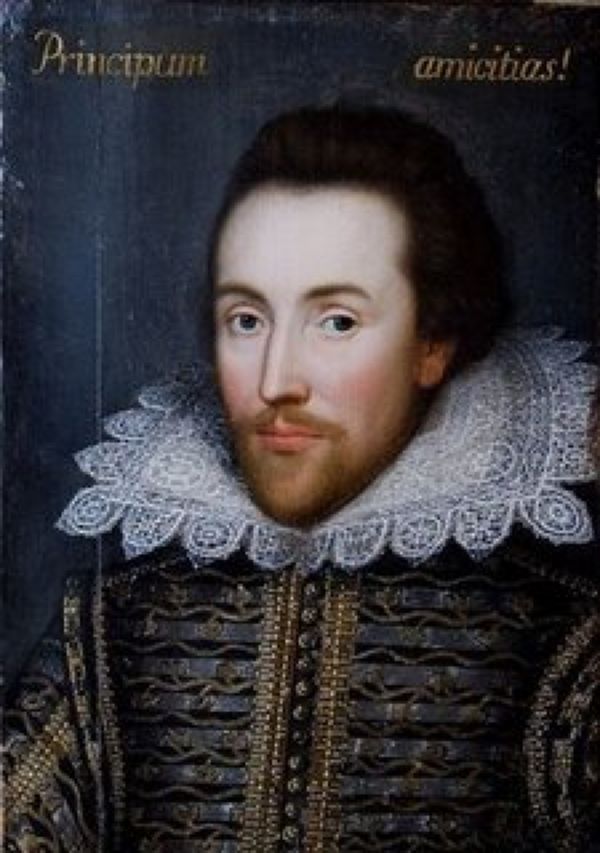
On the other hand, it might be a picture of anybody.
More interesting to me almost than the question of who wrote the plays is: Could Shakespeare be pictured in the Cobb portrait, newly discovered after nearly 400 years? The picture has a solid provenance, has tested out period, and has "Horace's dictum" (did I just say that?), Principum amicitias! to lend the requisite aire of mystery. Many experts say no, but I'd like to think that the principles of productions past were as required as our film stars of today to be possessed of the charismatic beauty present in the possible picture of the Bard, and that genius, so often envisioned as harried and wizened, may have passed through the streets of London looking as so:
On the other hand, it might be a picture of anybody.
The most dangerous traps are the ones you set for yourself. - [i]Phillip Marlowe[/i]
-
AhabsOtherLeg

- Posts: 3285
- Joined: Sun Dec 30, 2007 8:43 pm
I checked his MySpace Friends page, and Shakespeare's on it. This proves that they cannot possibly be the same man. Check it out:yathrib wrote:Adam Weishaupt.
http://friends.myspace.com/index.cfm?fu ... =266754165
.
.

-
AhabsOtherLeg
- Posts: 3285
- Joined: Sun Dec 30, 2007 8:43 pm
Do you think Weishaupt used an alt account to Friend himself as Shakespeare and throw people off the scent. That makes sense now that I think about it.
Shakespeare's current listening is All In Good Time by W. Stubbs (who he?) whereas Weishaupt has no music at all, but a link to the video of Roxette's Must've Been Love. Weishaupt's tastes seem way more mainstream - I don't think it's the same guy.
BTW, I had forgot, but now have remembered, this excellent quote from "Money" by Martin Amis. Mac might come back and chase me for mentioning his name again, but I think he's okay with Amis' fiction - Mac and Amis have a love of Joyce in common at least, if nothing else.
It's from the character of John Self, talking about, I think, the Flower Portrait that everyone automatically thinks of as Shakey.
Shakespeare's current listening is All In Good Time by W. Stubbs (who he?) whereas Weishaupt has no music at all, but a link to the video of Roxette's Must've Been Love. Weishaupt's tastes seem way more mainstream - I don't think it's the same guy.
BTW, I had forgot, but now have remembered, this excellent quote from "Money" by Martin Amis. Mac might come back and chase me for mentioning his name again, but I think he's okay with Amis' fiction - Mac and Amis have a love of Joyce in common at least, if nothing else.
It's from the character of John Self, talking about, I think, the Flower Portrait that everyone automatically thinks of as Shakey.
Always loved that bit.Above the entrance to the saloon bar there is a picture of Shakespeare on the swinging sign. It is the same picture of Shakespeare that I remember from schooldays, when I frowned over Timon of Athens and The Merchant of Venice. Haven't they got a better one? Did he really look like that all the time? You'd have thought that by now his publicity people would have come up with something a little more attractive. The beaked and bum-fluffed upper lip, the oafish swelling of the jawline, the granny's rockpool eyes. And that rug? Isn't it a killer? I have always derived great comfort from William Shakespeare. After a depressing visit to the mirror or an unkind word from a girlfriend or an incredulous stare in the street, I say to myself: "Well. Shakespeare looked like shit." It works wonders.
-
AhabsOtherLeg
- Posts: 3285
- Joined: Sun Dec 30, 2007 8:43 pm
He'd totally knock you out if he he heard you say that. You better hope he doesn't lurk here.
...I wonder if he's got a MySpace...
EDIT: He has, and he wasn't too bad a looker in his youth.
Certainly not short of female company in his friends' list.
http://www.myspace.com/65886592
.
.
...I wonder if he's got a MySpace...
EDIT: He has, and he wasn't too bad a looker in his youth.
Certainly not short of female company in his friends' list.
http://www.myspace.com/65886592
.
.
-
MacCruiskeen

- Posts: 10558
- Joined: Thu Nov 16, 2006 6:47 pm
Well, well. I was just about to quote that very bit.AhabsOtherLeg wrote:BTW, I had forgot, but now have remembered, this excellent quote from "Money" by Martin Amis. Mac might come back and chase me for mentioning his name again, but I think he's okay with Amis' fiction - Mac and Amis have a love of Joyce in common at least, if nothing else.
It's from the character of John Self, talking about, I think, the Flower Portrait that everyone automatically thinks of as Shakey.
Always loved that bit.Above the entrance to the saloon bar there is a picture of Shakespeare on the swinging sign. It is the same picture of Shakespeare that I remember from schooldays, when I frowned over Timon of Athens and The Merchant of Venice. Haven't they got a better one? Did he really look like that all the time? You'd have thought that by now his publicity people would have come up with something a little more attractive. The beaked and bum-fluffed upper lip, the oafish swelling of the jawline, the granny's rockpool eyes. And that rug? Isn't it a killer? I have always derived great comfort from William Shakespeare. After a depressing visit to the mirror or an unkind word from a girlfriend or an incredulous stare in the street, I say to myself: "Well. Shakespeare looked like shit." It works wonders.
I don't know who Shakespeare was, but I am beginning to suspect that AhabsOtherLeg is me.
"Ich kann gar nicht so viel fressen, wie ich kotzen möchte." - Max Liebermann,, Berlin, 1933
"Science is the belief in the ignorance of experts." - Richard Feynman, NYC, 1966
TESTDEMIC ➝ "CASE"DEMIC
"Science is the belief in the ignorance of experts." - Richard Feynman, NYC, 1966
TESTDEMIC ➝ "CASE"DEMIC
-
JackRiddler
- Posts: 16007
- Joined: Wed Jan 02, 2008 2:59 pm
- Location: New York City
By that standard I suppose we should question if J.K. Rowling really authored the last Harry Potter book! (Wait a minute, wait a minute...) But too well is the issue: the breadth, the power, the depth. This isn't fuggin' John Updike cranking out 30 books about a car salesman, see? What other body of work attributed to one man is comparable?barracuda wrote:I've never really understood the kerfuffle over the authorship of the Shakespearian opus. I mean, let's face it - the collected plays of the first folio fill a book of some 900 pages. So it's not as if he wrote too much, but too well instead.
All the same I'm inclined to agree, seeing as the authorship was first questioned almost two centuries later. It's the lack of evidence for anyone's authorship, or for practically anything about the life of the man from Stratford, including compared to other prominent artists from that time, that sets off the speculation. Given that the Globe was theater, a big and risky entertainment business, and possibly the most important propaganda producer of its time, a collaborative model seems very probable to me.
That's an excellent point. But I didn't say haphazard or autonomous. I'm sure the enterprise had one director, and 99 percent sure he was Shakespeare. But I don't think it's that neat. Subject matter seems to mark the trends more than genre. That can reflect marketing as well as the evolution of one person's interests as he lives his years.And the chronological trajectory of the plays across the breadth of the omnibus - from comedy through history, tragedy, then romance - too neatly follows the temperaments of a man's mood from youth to maturity to be the haphazard collection of autonomous works by several discrete authors
1589 Comedy of Errors
1590 Henry VI, Part II
Henry VI, Part III
1591 Henry VI, Part I
1592 Richard III
1593 Taming of the Shrew
Titus Andronicus
1594 Romeo and Juliet
Two Gentlemen of Verona
Love's Labour's Lost
1595 Richard II
Midsummer Night's Dream
1596 King John
Merchant of Venice
1597 Henry IV, Part I
Henry IV, Part II
1598 Henry V
Much Ado about Nothing
1599 Twelfth Night
As You Like It
Julius Caesar
1600 Hamlet
Merry Wives of Windsor
1601 Troilus and Cressida
1602 All's Well That Ends Well
1604 Othello
Measure for Measure
1605 King Lear
Macbeth
1606 Antony and Cleopatra
1607 Coriolanus
Timon of Athens
1608 Pericles
1609 Cymbeline
1610 Winter's Tale
1611 Tempest
1612 Henry VIII
We're down.Collaborators, yes; anyone who has experienced the realities of theatrical production would assent to that, but under the clear directorship of a single individual's voice. I doubt that Marlowe had the spare time.
-
barracuda
- Posts: 12890
- Joined: Thu Sep 06, 2007 5:58 pm
- Location: Niles, California
It's hard to predict what an exceptional lauditory critic on the order of Harold Bloom may take it upon himself to promote some two-hundred years hence. Who knows? Maybe Denmark will be replaced by Glengarry and Blake's soliloquy may relieve that of Hamlet, come the mid 2270's:JackRiddler wrote:But too well is the issue: the breadth, the power, the depth. This isn't fuggin' John Updike cranking out 30 books about a car salesman, see? What other body of work attributed to one man is comparable?
- Blake: Your name is "you're wanting", and you can't play the man's game, you can't close them, and then tell your wife your troubles. 'Cause only one thing counts in this world: get them to sign on the line which is dotted. You hear me you fuckin' faggots?
And the fact that authorship was unquestioned up until Shakespeare was retroactively proclaimed the world's greatest writer in the eighteenth century should tell you something.All the same I'm inclined to agree, seeing as the authorship was first questioned almost two centuries later. It's the lack of evidence for anyone's authorship, or for practically anything about the life of the man from Stratford, including compared to other prominent artists from that time, that sets off the speculation.
The real issue I have with the numerous authors approach is a practical one. I have never heard of any situation in which the presence of two writers on a single manuscript has produced an improvement in the outcome of the work.Given that the Globe was theater, a big and risky entertainment business, and possibly the most important propaganda producer of its time, a collaborative model seems very probable to me.
Last edited by barracuda on Mon Nov 02, 2009 1:45 am, edited 1 time in total.
The most dangerous traps are the ones you set for yourself. - [i]Phillip Marlowe[/i]
-
exojuridik

- Posts: 258
- Joined: Tue May 20, 2008 9:40 pm
- Location: South of No North
All the same I'm inclined to agree, seeing as the authorship was first questioned almost two centuries later. It's the lack of evidence for anyone's authorship, or for practically anything about the life of the man from Stratford, including compared to other prominent artists from that time, that sets off the speculation. Given that the Globe was theater, a big and risky entertainment business, and possibly the most important propaganda producer of its time, a collaborative model seems very probable to me.
This question over authorship reflects more on current obsessions over individuality and singular ownership of intellectual property-rights, than does it illuminate the community of creative and intellectual foement from which "shakespeares'" work emerged. Modern notions of personal autonomy and individual identity are an artefact of late capitalist society and "I" has been reifed by the administrative need for constituent production units to differentiate themselves in terms of value creation and organizational hierarchy. Go back several hundred years, the only words recognized as coming from a single individual were those refering to codes of honor and attacks thereon. Unless the outcome was a duel between gentlemen or Treasonous Offense aginst the sovereign, authorship were was attributed to God or the King or the Devil or Elves or even Witches.
Perhaps this line of questioning of authorship can reveal the true genius of Shakespeare if the participants holding forth on this iniquitious inquiry are made to confront the spirits and muses directing their apprehensions and attention. Verily, we are all sock-puppets soiled by the spots of our festering presumptions concerning what quinessential firmament ultimately composes that cataract of divinity which lesser men call "self." or something like that.
"Memory believes before knowing remembers. Believes longer than recollects, longer than knowing even wonders."
-
JackRiddler
- Posts: 16007
- Joined: Wed Jan 02, 2008 2:59 pm
- Location: New York City
Lennon and McCartney?!barracuda wrote:The real issue I have with the numerous authors approach is a practical one. I have never heard of any situation in which the presence of two writers on a single manuscript has produced an improvement in the outcome of the work.
I'm specifically thinking of TV series like The Wire, i.e. when the whole and its subsets remain under the firm direction of a chief writer.
---
@exo: quite my thinking. Though the development toward modern ideas of the individual and free will is already evident in Shakespeare's work. It's hard to see a play like Hamlet otherwise.
-
AhabsOtherLeg
- Posts: 3285
- Joined: Sun Dec 30, 2007 8:43 pm
.
.
Othello, Act3, Scene3.
I hope you're not accusing yourself of running me as a sock-puppet, though, 'cos we've had enough of all that round here to fill another folio.
JackRiddler said:It's the lack of evidence for anyone's authorship, or for practically anything about the life of the man from Stratford, including compared to other prominent artists from that time,
I'Faith, it is not so. This is from the Prefatory (?) Remarks to my Othello (yeah, it's mine, I wrote it):
Edit: Thought the bit about his education was interesting too.
.
Iago: "I am your own for ever."MacCruiskeen wrote: I don't know who Shakespeare was, but I am beginning to suspect that AhabsOtherLeg is me.
Othello, Act3, Scene3.
I hope you're not accusing yourself of running me as a sock-puppet, though, 'cos we've had enough of all that round here to fill another folio.
JackRiddler said:It's the lack of evidence for anyone's authorship, or for practically anything about the life of the man from Stratford, including compared to other prominent artists from that time,
I'Faith, it is not so. This is from the Prefatory (?) Remarks to my Othello (yeah, it's mine, I wrote it):
There's loads more but I'll have to go through it to see what I can find. It's specifically about documents signed by him, about him, marriage license and all that, and mentions and notices in the press. There seems to be quite a lot of documentary evidence of and about his life, which was a bit of a surprise to me as well.Between the record of his baptism in Stratford on 26 April 1564 and the record of his burial in Stratford on 25 April 1616, some forty documents name Shakespeare, and many others name his parents, his children, and his grandchildren. More facts are known about William Shakespeare than about any other playwright of the period except Ben Jonson. The facts should, however, be distinguished from the legends...
...The birthday of William Shakespeare, the eldest son of this locally prominent man [apparently his Dad wasn't just a glovemaker, but reached the rank of high-bailiff, equivalent to mayor, which meant he could call himself "Mr." - a big deal in those days, it seems} is unrecorded; but the Stratford Parish register records that the infant was baptised on 26 April 1564...
...The attendance records of the Stratford grammar school of the period are not extant, but it is reasonable to assume that the son of a local official would have attended the school and recieved substantial training in Latin. The masters of the school from Shakespeare's seventh to fifteenth years held Oxford degrees; the Elizabethan curriculum excluded mathematics and the natural sciences but taught a good deal of Latin rhetoric, logic, and literature."
Edit: Thought the bit about his education was interesting too.
Last edited by AhabsOtherLeg on Mon Nov 02, 2009 6:40 am, edited 1 time in total.
-
AhabsOtherLeg
- Posts: 3285
- Joined: Sun Dec 30, 2007 8:43 pm
.
.
I'm in ur thread, double-posting.
@Barracuda: Glengarry is great, and so is everything else of his (edit: David Mamet's) I've read or seen, but he doesn't have the sheer breadth of knowledge, and setting, and character. Maybe Arthur miller comes closer, with both contemporary and historical plays - and great ones they are. There have been lots of great plays and great scenes and great lines in the last fifty odd years or so, but to rival Shakespeare they would've all had to be written by the same guy. Before the age of 52. A lot of writers, lazy gits that they are, are just starting to hit their stride into the "mature, developed" work at that age.
Most guys who do write across a range of genres and period settings are either crap or have big weaknesses in one or more of the genres or periods they experiment with. Somehow, Shakespeare didn't have those faults. Except that he was never any good at comedy.

The evidence is undeniable.
.
.
.
I'm in ur thread, double-posting.
@Barracuda: Glengarry is great, and so is everything else of his (edit: David Mamet's) I've read or seen, but he doesn't have the sheer breadth of knowledge, and setting, and character. Maybe Arthur miller comes closer, with both contemporary and historical plays - and great ones they are. There have been lots of great plays and great scenes and great lines in the last fifty odd years or so, but to rival Shakespeare they would've all had to be written by the same guy. Before the age of 52. A lot of writers, lazy gits that they are, are just starting to hit their stride into the "mature, developed" work at that age.
Most guys who do write across a range of genres and period settings are either crap or have big weaknesses in one or more of the genres or periods they experiment with. Somehow, Shakespeare didn't have those faults. Except that he was never any good at comedy.
I'm guessing even I wouldn't have a clue what they were talking about. It's obvious reading that words that rhymed back then don;t anymore because of the changes in pronunciation. Actually, I shouldn't say it's obvious 'cos I don't know whether it's true or not, but it seems that way to me.barracuda wrote:What would the Elizabethan's pentameter sound like voiced by an actor from 1600? We sort of don't know, but I have my doubts regarding intelligibility. I can often hardly understand contemporary spoken English English; I don't think I'd fare well if transported to the mezzanine at the Globe.
http://www.youtube.com/watch?v=qgzEfV3QbCUbarracuda wrote: The real issue I have with the numerous authors approach is a practical one. I have never heard of any situation in which the presence of two writers on a single manuscript has produced an improvement in the outcome of the work.
The evidence is undeniable.
.
.