The Rosslyn Code The real mystery lurking in the chapel
Posted: Wed May 25, 2011 2:25 pm
The Rosslyn Code
The real mystery lurking in the chapel where Dan Brown set The Da Vinci Code.
By Chris WilsonUpdated Tuesday, May 17, 2011, at 7:00 AM ET
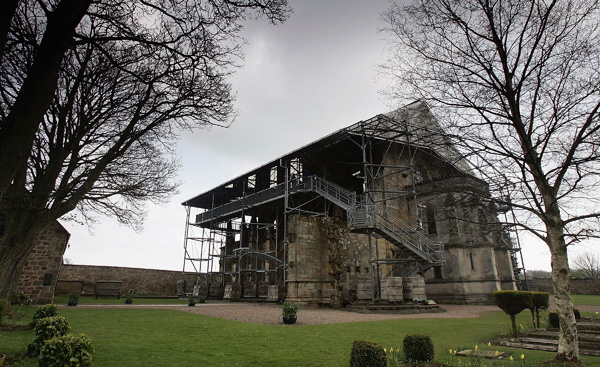
From the outside, the Rosslyn Chapel does not look like a suitable place to hide Jesus' head. It's not much bigger than a country church, standing inconspicuously on a small hill in the miniature Scottish town of Roslin, a few miles south of Edinburgh. Its Gothic pinnacles, flying buttresses, and pointed arches have been battered by 500 years of capricious weather, and for years it has been encased in an exoskeleton of scaffolding as restoration efforts plod along. Until recently, it was covered by a giant black canopy.
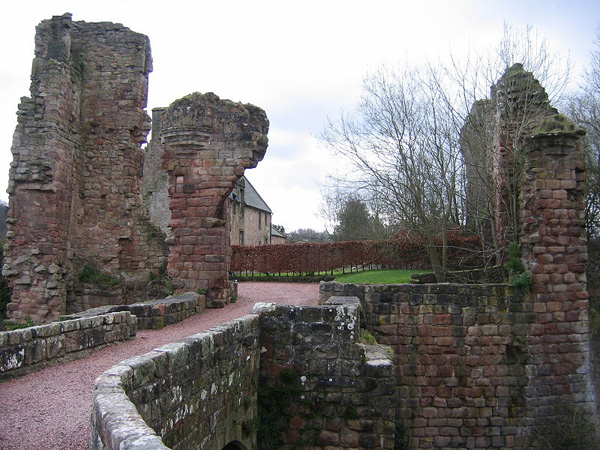
But inside the chapel, beneath the carvings that blanket the walls and ceiling, is a spartan stone crypt that figures into one of history's most famous mythologies. According to legend, the treasure of the fabled Knights Templar is stowed in a still-deeper vault whose entrance is sealed off by a stone wall. Depending on whom you ask, that treasure is the Holy Grail, sacred scrolls from the time of Christ, a fragment of the cross on which he died, or even his embalmed head, secreted out of the Holy Land as the Templars fled prosecution 700 years ago. Rosslyn Chapel as seen from the southwest. .Rosslyn Chapel as seen from the southwest. Repairs have been ongoing for years.
If any of this sounds familiar, it's because Dan Brown borrowed this legend for The Da Vinci Code. In the book's climactic scene, the heroes race from London to Roslin, tailed by a hodgepodge group of French police and Catholic thugs. (At this point, they're on the brink of exposing a 2,000-year conspiracy to erase evidence that Christ had children.) They discover that the Holy Grail itself did once reside at Rosslyn, left there by the Templars so many centuries back, but has since vanished again.
The Da Vinci Code brought the Rosslyn Chapel to the world's attention. (Note: "Rosslyn" and "Roslin" derive from the same name, but by custom the chapel uses the former while the town and nearby castle use the latter.) While it had been popular among grail nerds and imaginative scholars for decades—Dan Brown didn't invent the Templar legend—the chapel was relatively obscure even in Scotland prior to the novel's 2003 debut. Tom Hanks and Audrey Tautou filmed the Rosslyn scene on location for the movie adaptation, further elevating its profile. Visits to the chapel increased by more than 50 percent, boosting revenue needed for the Rosslyn restoration project. (The chapel is still owned by descendants of its founder, Sir William St. Clair, but guided by a trust that oversees the site.)
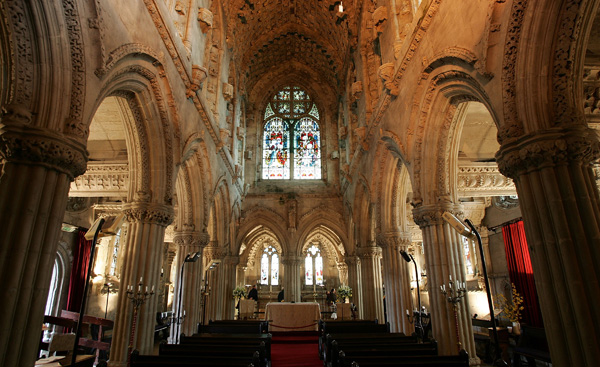
Inside the Rosslyn Chapel. Click image to expand.The view as you enter Rosslyn Chapel. It is much smaller than it looks from the outside.
You only need to spend a few minutes in the church to understand how it led to Dan Brown's flights of fancy. The Rosslyn Chapel is a conspiracy theorist's playroom, its interior a madhouse of mysterious stone carvings. In the movie version of The Da Vinci Code, Tom Hanks' professor of "symbology" stares reverently at the crowded walls. "Christian, Jewish, Egyptian, Masonic, Pagan," he says, ticking off the influences present in the place.
This isn't far off the mark, except for the Masonic part. (The chapel was completed more than a century before the founding of the Freemasons, though the order has retroactively claimed Rosslyn as part of its history.) The place is truly cluttered, like a person who's completely slathered with incongruous tattoos. Eight Nordic dragons form a ring around the base of one ornate pillar, while dozens of sylvan pagan deities known as Green Men peer out from the stone foliage. One arch depicts a richly detailed Danse Macabre, in which figures waltz with their future skeletons. A double-humped camel makes a curious appearance, even though such an animal was rare in Scotland at the time. Stories from both the New and Old Testament appear again and again.
Little documentation that might explain what the chapel's founders meant by all these carvings has survived. (Several fires at the nearby Roslin Castle consumed much of the St. Clair family's archives.) This lack of contradictory evidence is quite convenient for anyone who cares to theorize about the church's place in history. Rosslyn Chapel is a trove of mismatched puzzle pieces. The odds that you can find one to fit into whatever legend you're trying to sell are exceedingly high.
The Knights Templar were a real band of well-armored bankers, founded around 1120. The Knights' original detail was to protect pilgrims on their way to the Holy Land. But after the Egyptian sultan Saladin captured Jerusalem later that century, there wasn't much need for their services. No fewer than six crusades in the next 200 years would fail to establish a lasting Christian lease on the sacred territories. The Templars—reinterpreting their calling card as the "Poor Fellow-Soldiers of Christ and of the Temple of Solomon"—amassed great wealth and land, which was bestowed to them by European kings. By the early 14th century, they were in the lending business, charging healthy interest rates and milking their political ties to sidestep the church's ban on usury.
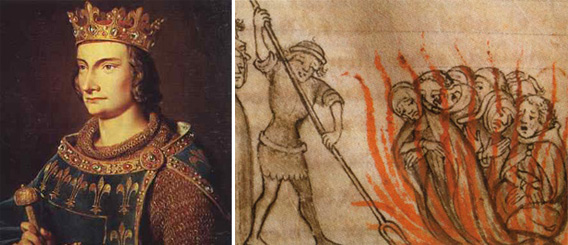
Without a large army to defend their great wealth, the knights became an easy target. In 1307, France's cash poor King Philip IV began a relentless campaign to round them up, culminating seven years later when the order's last grandmaster was burned at the stake. Most accounts end here, 150 years before the first stone was laid at Rosslyn Chapel. More creative historians, however, add an epilogue to the story: A handful of knights escaped persecution and fled to Scotland with the Templar treasure, finding succor under King Robert the Bruce—himself an exile from the church after he murdered a Scottish nobleman. Through various assimilations, the story goes, the Templars survived long enough to secret their sacred treasure to the Rosslyn Chapel, which was completed around 1480.
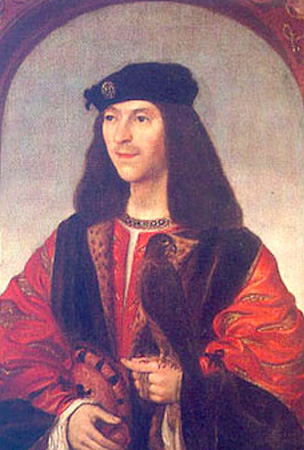
France's King Philip IV (left) disbanded the Knights Templar in 1307, burning many at the stake.France's King Philip IV (left) disbanded the Knights Templar in 1307, burning many at the stake. Click image to expand.
This is almost certainly untrue for a variety of reasons—it was nearly impossible, for example, to sail from northwest France to Scotland in the treacherous month of October, when the persecution began. But the association between Rosslyn and the grail remains unshakable, and the trust that oversees the chapel does little to correct the record, lest it run off conspiracy-minded tourists. (In addition to the usual run of T-shirts and mugs, the Rosslyn gift shop sells copies of The Da Vinci Code and a variety of other myth-mongering volumes.)
Like the chapel's crypt, Rosslyn's stone carvings are encrusted with dubious stories. One holds that a plant resembling maize, carved over an arch near the crypt, is proof that a Scotsman discovered the New World decades before Columbus and returned with this uniquely American crop. In reality, the cornhusks are probably bundled wheat, in keeping with the carvings' agrarian themes. But any sort of ambiguity is fuel for conspiracy theorists. Even the most outlandish story will persist so long as it meets two conditions: The theory has an ardent spokesman, and it's impossible to definitively disprove.
This is precisely why Tommy Mitchell is so easy to write off as bogus. His theory that there's a secret code hidden away in Rosslyn's stone carvings is outlandish, fantastical, and unfalsifiable. But after I spent a few days in Scotland scrutinizing his hypothesis, I found it increasingly difficult to be a skeptic.
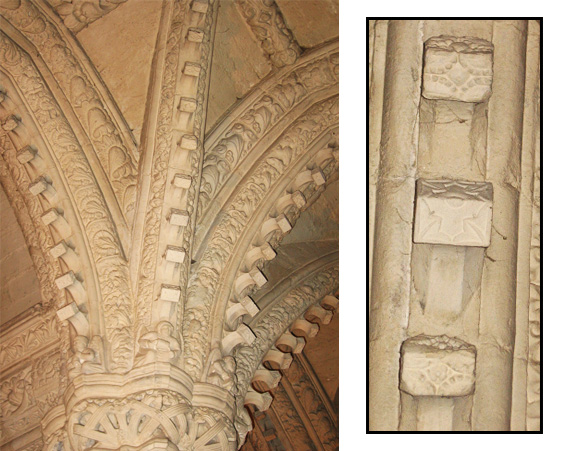
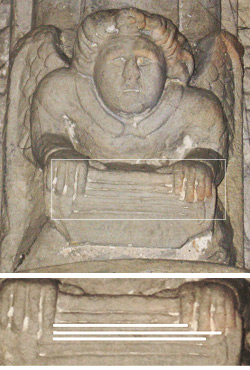
The east end of Rosslyn Chapel sits under 13 crisscrossing arches that run the length of the room from north to south. While plenty of Gothic cathedrals feature a similar architectural flourish, the Rosslyn arches have a distinct feature: small sandstone cubes that protrude at regular intervals, like teeth. There are 213 cubes in all, 17 or 18 per arch. Each one bears a geometric pattern—a diamond, a rosette, an inverted circle. In all, 12 patterns repeat in irregular sequences, some appearing frequently, others just once or twice. At the base of each arch, save for the first and last, is an exquisitely carved stone angel either playing an instrument or singing from a hymnal.
Left: Arches with protruding stone cubes. Right: A close-up of three cubes.Left: Arches with protruding stone cubes. Right: A close-up of three cubes.
Mitchell, a former cryptographer with the Royal Air Force, first stumbled upon the chapel nearly 40 years ago, when it was largely unknown and in disrepair. He would return to Rosslyn with increasing frequency over the years, always drawn to the cubes and their mysterious symbols. While there was no obvious order to the sequence of the cubes, Mitchell noticed that, as on a strand of DNA, little patterns would repeat. The same sequence of three symbols appears at the base of two of the arches, for instance, and one arch contains long stretches in which just one symbol is repeated.
Mitchell is certain this is no accident. The symbols, he believes, form a 500-year-old code bequeathed by the chapel's founders. And the angels are the key to deciphering it.
Are the chapel's mysterious stone symbols a musical score?
By Chris WilsonUpdated Tuesday, May 17, 2011, at 10:08 AM ET
Rosslyn Chapel was deserted when Tommy Mitchell's son, Stuart, stepped into the small antechamber one frozen afternoon last December. Savage blizzards had blanketed Scotland for the previous two weeks, and much of the chapel's staff had left early to beat the icy conditions. The cold was marshalling its forces against the scattered heat lamps inside as Stuart walked to the back of the room, where 13 stone arches crisscross along the ceiling.
Stuart Mitchell, who is 45, is thin and spry with wavy brown hair and emits a rapid-fire laugh when he finds something amusing, which is often. Stuart first took an interest in the Rosslyn Chapel when his father, a former Royal Air Force cryptographer, invited him along for a visit about 10 years ago. As a professional composer, Stuart was instantly enchanted by Rosslyn's angelic stone musicians. He has come back often in the years since, but he still can't get inside the chapel without buying a ticket, which he does begrudgingly.
Tommy and Stuart Mitchell in the Rosslyn Chapel. Click image to expand.Tommy and Stuart Mitchell in the Rosslyn Chapel.Once inside, Stuart leads me straight to the far end of the small chapel, which is supported by three broad pillars, known as the Master Pillar, the Journeyman Pillar, and the Apprentice Pillar. The Apprentice Pillar, adorned with beautiful, intricate stone flora that snakes around it like a helix, is a major attraction in and of itself. (A replica is displayed in London's Victoria and Albert Museum, and artists' renderings are sold in the Rosslyn gift shop.) But it's what sits on top of the pillars that interests Stuart—13 stone angels, each one singing or playing an instrument.
The angels, with their childlike faces and great bird wings, are unquestionably medieval. By contrast, the angels' instruments are exquisitely rendered. "Any string instrument you'll see here has pegs for tuning," Stuart says, pointing to the neck of a fiddle. A lutist's fingers are positioned correctly over the frets, the finger holes on the reed instruments are in the proper places, and the pipes on an organlike device descend in length in proportion with the change in pitch they would produce. No sword or farmer's pike elsewhere in the chapel got such attention.
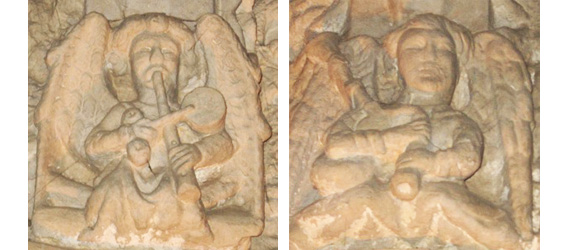
Stone angels playing the drumlike tabor (left) and bagpipes (right).Stone angels playing the drumlike tabor (left) and bagpipes (right).
The great care that went into rendering this heavenly jam band, Stuart argues, reveals that this is not mere decoration. The instrumentation is also quite modern for 1450. The most remarkable angel is playing a set of bagpipes, one of the earliest known representations of the instrument, which had only started showing up in Scotland a few decades earlier. The hand-held organ depicted in Rosslyn is also unusually complex. The angels' creator, in other words, knew a lot about music, and he wanted the chapel's visitors to notice.
There's one problem with speculating about the intent of Rosslyn's designer: No one knows who carved the angels or anything else in the chapel. While its patron, William St. Clair, clearly spared no expense in bringing in master masons, it's unlikely that he micromanaged the design. When Stuart contemplates the meaning of the angels and the cubes that hang above them, he attributes the creations to a singular mystery man—and he thinks that mystery man was a songwriter. "It's a very neat sound that the guy has put together," he says.
Humans have a long history of conjuring meaning out of noise, particularly when they have decades to gin up a plausible-sounding explanation. But the musical solution the Mitchells believe they have uncovered in the Rosslyn Chapel is so elegant that it's hard to resist humming along. How could something that seems so natural be a fabrication?
There is no one archetype for the natural-born code breaker. Some cryptographic geniuses show an aptitude for patterns and language from childhood. Jean-François Champollion, who published the first translation of the Rosetta Stone, is said to have mastered a dozen languages by age 16. Alan Turing, the most famous member of the World War II-era British cryptography effort at Bletchley Park, was a precocious reader and mathematician—while on a picnic at age 7, he tracked the flights of honeybees to find where they converged. Others, like Revolutionary War-era cipher maker James Lovell or the early 20th-century code breaker William Friedman, stumbled into the field while pursuing other interests. (Lovell was a teacher and member of the Continental Congress; Friedman initially studied genetics.)
If there is any common strain here, it's that codebreakers must be creative, catholic thinkers. Tommy Mitchell's interests are indeed all over the map. He has studied ancient civilizations and Freemasonry and the stages of human evolution. He's a talented pianist and brass player, and he loves the Greek study of sacred geometry. He likes to pore over high-resolution pictures taken by NASA satellites. He also has more than a passing interest in cryptography.
The elder Mitchell first learned how to break codes in his early 20s as a leading aircraftsman in the Royal Air Force. Tommy was stationed in Iraq in the early 1950s as part of a signals-intelligence unit that listened in on encrypted Russian communications. (He was trained for the job at the Government Communications Headquarters, a direct successor to the wartime organization that Turing had starred in.) Iraq was still a monarchy at this point, though it would fall six years later, when forces led by a nationalist general murdered the royal family. (A year after that, a 22-year-old Saddam Hussein would make an unsuccessful attempt on the general's life.)
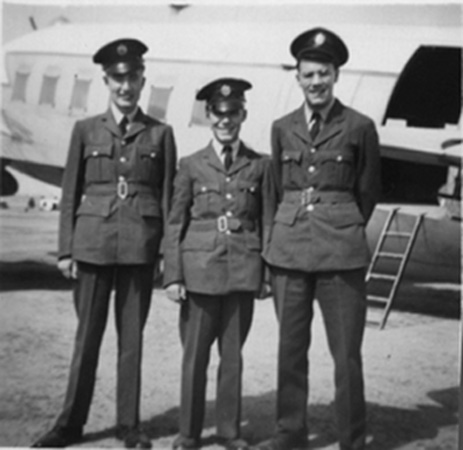
Tommy Mitchell. Click image to expand.Tommy Mitchell (right) as a leading aircraftsman in the Royal Air Force.
Sixty years after his stint in the Middle East, Tommy—now 78—credits a single road trip for changing his life. Iraq was relatively easy to traverse at the time, so Mitchell and his comrades were able to drive to the ruins of Babylon. When they arrived, they found the remnants of the ancient city-state deserted, the excavators driven away by the heat. Only a portion of the ruins had been unearthed, but Tommy was still floored by their sophistication. "Most of all," he explains in the introduction to a short book he's written about the Rosslyn Chapel, "I was impressed by the inescapable sense of antiquity, and I came away with a conviction that we in the West, with our technological civilization, had little or no idea regarding the Sumerians and how they lived."
His promenade through Babylon on that scorching day put Mitchell on a quest for hidden knowledge. At the same time, he was receiving extensive training in cryptography—something he will still describe only in general terms, so as not to run afoul of the Official Secrets Act. As he left the military and returned home to Scotland, these two interests synthesized in his mind. History was a puzzle to be probed and decoded.
If the Scottish economy hadn't taken a dive in the 1970s, Tommy Mitchell may never have set foot in Rosslyn Chapel. But when the hotel company he worked for went under, Mitchell made a "right-angle turn," as he puts it, and became a professional musician. Tommy had played music his whole life and was an accomplished brass player—he'd volunteered for the RAF band in Iraq, playing cornet and flugelhorn—but it was a stroke of luck that one of his former colleagues happened to be looking for a pianist just as Tommy lost his hotel job. Within weeks, he was a piano man in Edinburgh.
This was mainly night work, which left Tommy the daytime to continue his spiritual explorations. He knew that God wouldn't lead him to the keys he sought. Mitchell had been to Jerusalem during his time abroad, and the bloody religious conflict left him with a bitter taste for religion. In search of a more satisfying explanation of how the world worked, Mitchell dabbled in Freemasonry before taking an interest in 20th-century English writer John Michell, whose writings cover everything from sacred geometry to the true authorship of Shakespeare's works. Michell was particularly interested in "ley lines"—ethereal routes that connect major ancient landmarks and channel great energy at places where they intersect. In his free time, Tommy began tracing these lines around Edinburgh. One led him five miles south, to the doorstep of Rosslyn Chapel.
Mitchell doesn't remember the precise day he first stepped into the chapel, but he places it around 1971. In those days Rosslyn was in a pretty sorry state, its waterlogged stonework threatening to collapse. The chapel was still open to the public, but you had to get a key from a woman in town to get in. There wasn't a commemorative T-shirt or coffee mug to be found.
Undeterred by the chapel's shabby condition, Tommy believed that great meaning was concealed within its walls. Year after year, he puzzled over the strange symbols on the stone cubes at the back of the chapel. They reminded him of the Enneagram, a geometric symbol he'd come across while investigating the teachings of G. I. Gurdjieff, an obscure mystic who believed in reaching higher planes of consciousness through guided meditation. The Ennegram, a series of straight lines circumscribed by a circle, represents Gurdjieff's teachings about the relationship between the body, the heart, and the mind.
Tommy searched deeper into Gurdjieff's teachings for anything resembling the Rosslyn symbols. He came up empty. He moved on to Freemason imagery, ancient mathematics systems, Pythagorean geometry, and even quantum physics. Still no match. Years would go by during which he wouldn't think about the chapel much at all before some new clue would reignite his fascination. "My wife would say to me, You going to sit there all night?" he recalls.
Tommy talks about his early quest with the awareness that it sounds a little kooky, but he's unapologetic. "I'm not a conspiracy freak, but I have found that after everything I have studied, I have a very open mind now," he says. Tommy's undiscriminating attitude ultimately guided him to a promising lead, some 30 years after he first came across the chapel. The cubes' placement directly above the stone musicians, he hypothesized, could mean that the carvings had some sort of musical aspect. At this point, he recalled an obscure tidbit he'd gleaned while studying the properties of the musical scale years earlier—something to do with patterns associated with notes. Around 2000, Tommy asked his composer son to have a look, and Stuart soon dug up the name of the symbols. They are called Chladni patterns.
The German-born scientist Ernst Chladni had two chief passions: physics and music. (Meteorites were a close third.) Most of Chladni's career was spent studying the emerging field of acoustics, which he is sometimes credited as founding. Chladni wanted to know what happens to materials when they are vibrated to make music. When you pluck a violin, for instance, you don't just vibrate the string; the whole body of the instrument moves, particularly when it has a chamber to amplify the sound.
Chladni came up with a simple technique to deduce an instrument's microscopic movements. First, he spread sand along the instrument's surface. Then he vibrated it with a bow and observed where the sand collected. The resulting pattern revealed the material's minuscule oscillations, previously unobservable to the naked eye.
Using modern machinery, it's possible to cycle through a huge number of Chladni patterns in a few minutes.
Watch the video below, in which sand on a vibrating plate transitions from one pattern to the next. Each pattern corresponds to a specific frequency.
It's easy to see what Ernst Chladni discovered during his experiments: The sand patterns grow increasingly complex as the frequencies get higher. For a low note, you might see a simple diamond. Jump up a few octaves, and you get a rosetta. Go up still higher and you see patterns reminiscent of what a piece of paper looks like when you fold and unfold an origami animal.
About 100 years after Chladni's discovery, another scientist named John Tyndall produced a chart of the patterns that's still in circulation today. Finding Tyndall's chart was a eureka moment for Tommy and Stuart Mitchell. Several Chladni patterns resemble the cubes in the chapel, and others are at least fairly similar. The resemblance isn't unmistakable, but it's eerily close.
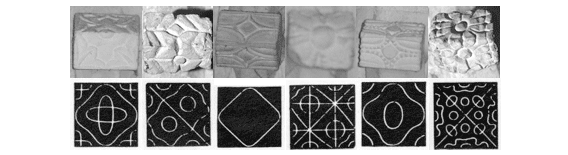
For the Mitchells, the implication was clear: The code in the ceiling of the Rosslyn Chapel was not a message written out in letters. It was a melody, and each cube represented one note. There was only one problem. The chapel was built in the 15th century. Ernst Chladni wouldn't be born for another 200 years.