Re: NSA Chief Russia Hacked '16 Election Congress Must Inves
Posted: Tue Mar 06, 2018 1:23 pm
Polly Sigh
CIA's Aug 2016 “intelligence bombshell” from GCHQ was NOT Christopher Steele's Dossier: "Head of UK's intelligence service flew to DC & briefed Director @JohnBrennan on an *intercepted stream of illicit communications* btwn Trump’s team & Moscow.
https://www.newyorker.com/magazine/2018 ... mp-dossier …
10:36 AM - 5 Mar 2018
via @JaneMayerNYer: Christopher Steele wrote another memo in Nov 2016 that said the Kremlin had intervened to block Trump’s initial Sec of State choice, Mitt Romney & asked him to appoint someone who would be prepared to lift Russian sanctions.
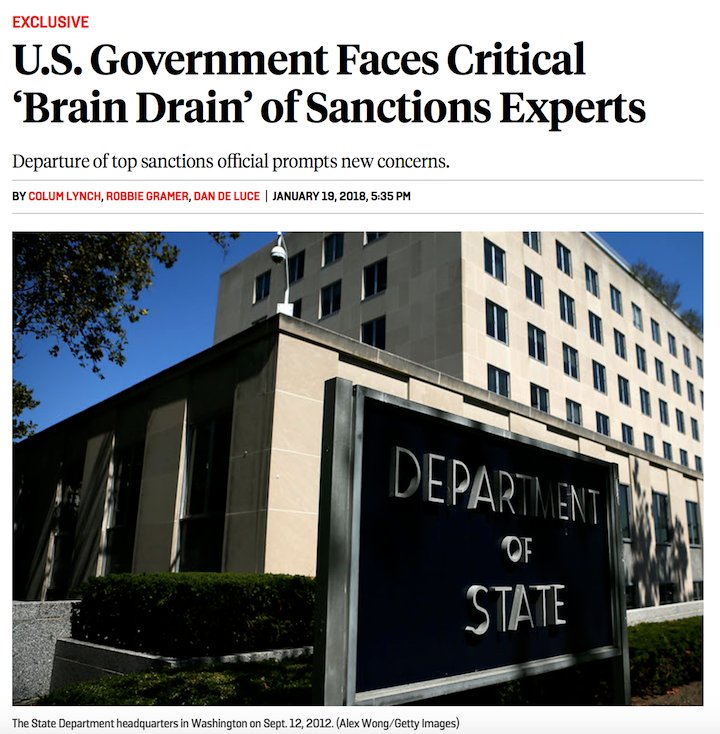
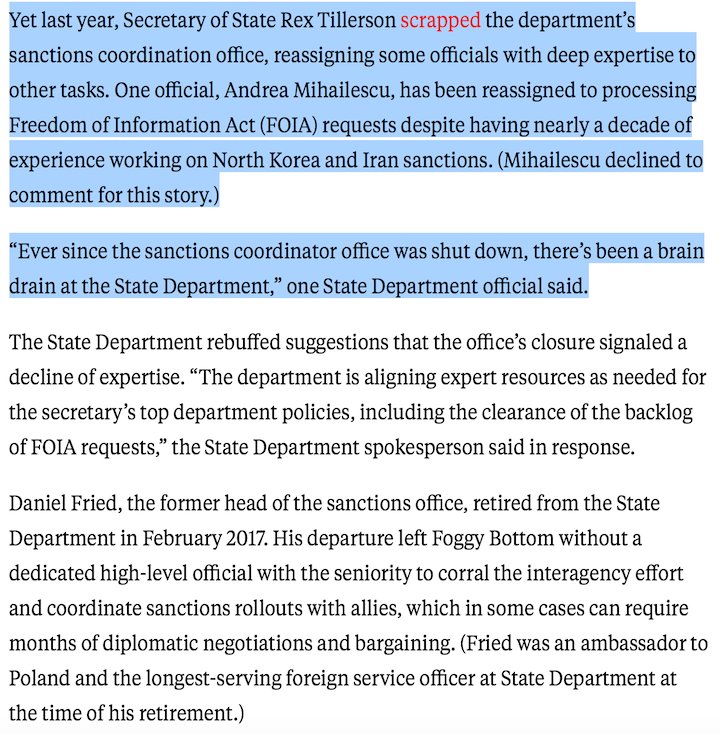
Ever since Rex Tillerson scrapped the sanctions coordination office last year, the US Gov't has faced a critical ‘Brain Drain’ of sanctions experts. The State Dept’s most experienced UN-based sanctions expert stepped down on Friday.The Trump administration was three weeks late on the Russia sanctions deadline. But it’s killed the office that coordinates them.
State Department Scraps Sanctions Office
The Trump administration was three weeks late on a Russia sanctions deadline. But it’s killed the office that coordinates them.
BY ROBBIE GRAMER, DAN DE LUCE | OCTOBER 26, 2017, 7:26 PM
The State Department shuttered an office that oversees sanctions policy, even as the Donald Trump administration faced criticism from lawmakers over its handling of new economic penalties against Russia.
Secretary of State Rex Tillerson eliminated the Coordinator for Sanctions Policy office, which had been led by a veteran ambassador-rank diplomat with at least five staff, as part of an overhaul of the department, former diplomats and congressional sources told Foreign Policy.
Instead, the role of coordinating U.S. sanctions across the State Department and other government agencies now falls to just one mid-level official — David Tessler, the deputy director of the Policy Planning Office. The Policy Planning Office, which previously operated as a small team providing strategic advice to the secretary but did not manage programs or initiatives, has grown in power under Tillerson’s “redesign” of the department.
While the sanctions office was dissolved, the administration missed a key Oct. 1 deadline to implement new penalties against Russia adopted by Congress in August. The move reinforced concerns among both Democratic and Republican lawmakers that the Trump White House is mismanaging the State Department and undercutting the role of U.S. diplomacy.
The “elimination of the sanctions coordinator appears to be part of the larger reorganization debacle underway at the State Department,” said Sean Bartlett, spokesman for Sen. Ben Cardin (D-Md.), ranking member of the Senate Foreign Relations Committee.
A State Department spokesperson told FP they notified Congress last month the office would be shutting down and moving to the policy planning office. “No movement of funds or personnel has taken place,” the spokesperson added.
Both Cardin and Republican Sen. Bob Corker (Tenn.), chairman of the Senate Foreign Relations Committee, had blasted the administration over its failure to implement new sanctions against Russia enacted by Congress. After blowing past the Oct. 1 deadline, the State Department finally issue belated guidance for the measures, identifying entities and officials linked to Russia’s defense and intelligence sectors.
State Department spokeswoman Heather Nauert said on Thursday this came after a call between Corker and Deputy Secretary of State John Sullivan, who updated the committee chairman on their progress.
“A lot of you had had questions about why the delay, why it’s taken a bit of time for the State Department to deliver this information to Congress, and that is because it’s complex, complicated, and industry needs to know what will happen if they engage in certain activities,” she told reporters at a press briefing on Thursday.
Former officials and experts are torn on whether or not eliminating the Coordinator for Sanctions Policy office will undercut the State Department’s ability to oversee sanctions. Sanctions have become a cornerstone of U.S. foreign policy toward adversaries such as Iran and North Korea.
Daniel Fried, a now-retired career diplomat who served as the coordinator for sanctions policy through February 2017, cautioned against misinterpreting the move.
“You can’t read into that a lack of commitment to sanctions,” he told FP, adding as long as State devotes staff to the issue, their title or bureaucratic placement in the department wasn’t important. “It’s not as if [the administration] is gutting sanctions altogether.”
Other former officials said scrapping the office and putting the job on the shoulders of only one policy planning official was a mistake, particularly at a time when the administration seems to be struggling to manage an array of foreign-policy issues and to articulate its stance.
“They messed up on this. They scrapped this when they could’ve taken it further,” said a former State Department official. “They said, ‘We’re just going to back to the point where there’s no clear coordination.’”
Another former government official familiar with sanctions said, without the office, there’s a danger of bureaucratic turf battles cropping up inside the State Department and with other agencies on sanctions. “This could be a real problem,” the former official said.
The Treasury Department takes the lead on the technical aspect of sanctions, but implementing punitive measures requires elaborate coordination with allies, particularly the European Union, to build diplomatic support and to ensure a unified approach. As a result, the State Department plays a crucial role in making sanctions effective.
As secretary of state under the Obama administration, Hillary Clinton created the coordinator for sanctions policy role. Fried said during his tenure, the office worked hand in glove with Treasury to carry out tasks such as working with Asian allies to push North Korea sanctions and identifying individual Russians trying to evade targeted U.S. sanctions.
The office kept the trains running on time, said Edward Fishman, a former sanctions policy official in the Obama administration. But for State to pack the biggest punch on sanctions, it needs a full-fledged and permanent bureau to coordinate sanctions issues, he said. Sanctions issues are currently scattered across a slew of offices including the Burea of Economic and Business Affairs, the International Security and Nonproliferation Bureau, and the Bureau of International Organization Affairs.
The move also highlights the growing influence of the Policy Planning Office under Tillerson. Some State Department employees and lawmakers have widely criticized Tillerson for expanding the office, historically used as an in-house think tank for long-term strategic issues and speechwriting. Under Tillerson, it’s grown in scope and influence, prompting concern he’s creating what one senior State Department official described as a “miniature fiefdom” to sidestep the wider department and legislative oversight.
The move, critics say, both cuts off department-wide input on key policy decisions and bottlenecks the department’s overall work as policy planning staff are stretched to the brink with an array of new responsibilities.
Sanctions have become a pillar of U.S. foreign policy, and the Trump administration has touted them as a pivotal tool to counter regimes in North Korea and Iran. Wherever sanctions policy is managed inside Foggy Bottom, the State Department has a pivotal role in determining whether sanctions actually work.
“You can churn out all the sanctions you want,” Fishman said. “But if you don’t have diplomats around the world pounding the pavement every day to get allies on board, they won’t be effective.”
Update: This article was updated to include information on guidance on Russian sanctions and reflect the fact that the State Department informed Congress about the closure of the office last month
http://foreignpolicy.com/2017/10/26/sta ... ns-office/.
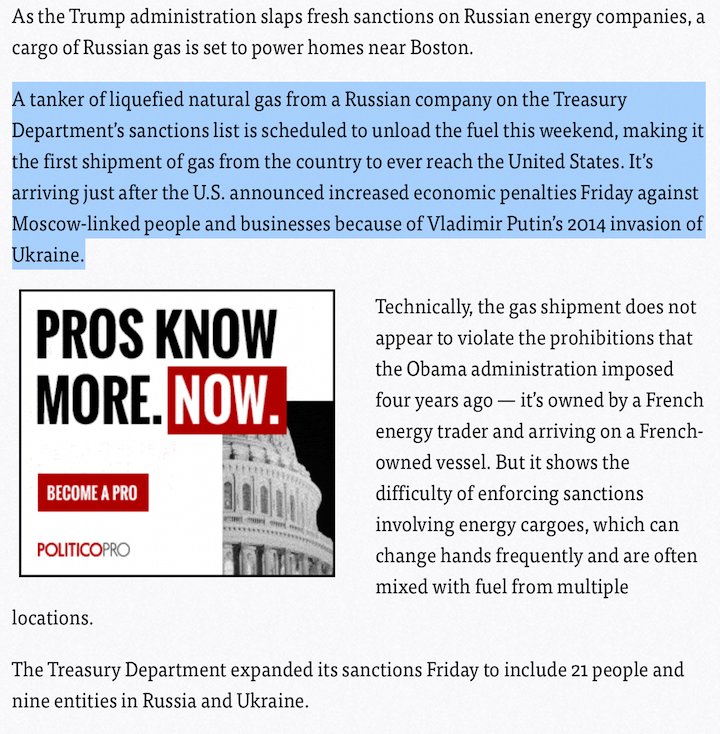
Russian gas defies US sanctions to reach New England this weekend, making it the first shipment of gas from Russia to ever reach the US. The ship's circuitous route drew attention from energy traders.
Treasury & State Dept had no comment.
The Russian gas is aboard a French vessel, which has been anchored in Mass Bay since Wed, undergoing inspections. "We alerted authorities there's a mixture of gas aboard this cargo. I don’t believe they’ve flagged the RU gas as a concern."Russian gas defies U.S. sanctions to reach New England
BEN LEFEBVRE01/26/2018 06:35 PM EST
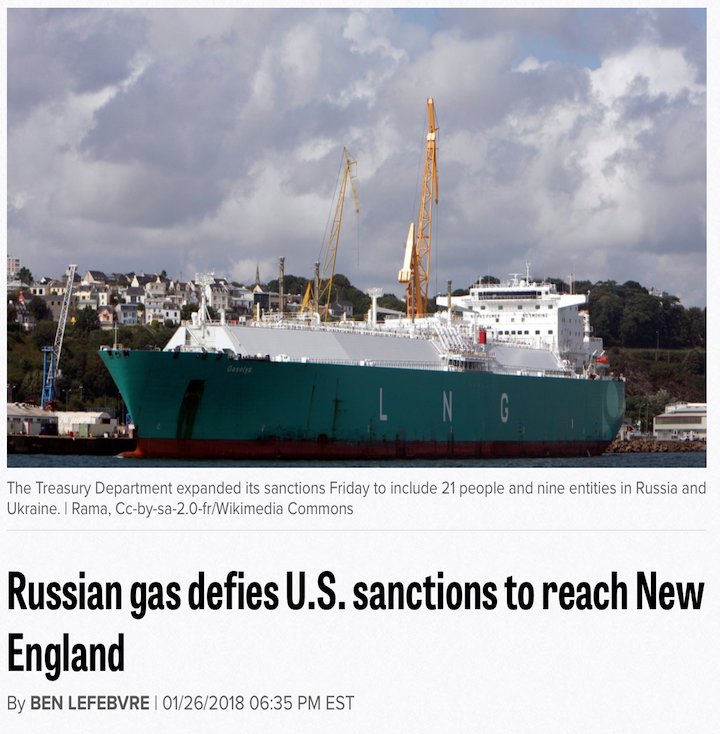
The ship Gaselys is pictured. | Rama, Cc-by-sa-2.0-fr/Wikimedia Commons
The Treasury Department expanded its sanctions Friday to include 21 people and nine entities in Russia and Ukraine.
As the Trump administration slaps fresh sanctions on Russian energy companies, a cargo of Russian gas is set to power homes near Boston.
A tanker of liquefied natural gas from a Russian company on the Treasury Department’s sanctions list is scheduled to unload the fuel this weekend, making it the first shipment of gas from the country to ever reach the United States. It’s arriving just after the U.S. announced increased economic penalties Friday against Moscow-linked people and businesses because of Vladimir Putin’s 2014 invasion of Ukraine.
Technically, the gas shipment does not appear to violate the prohibitions that the Obama administration imposed four years ago — it’s owned by a French energy trader and arriving on a French-owned vessel. But it shows the difficulty of enforcing sanctions involving energy cargoes, which can change hands frequently and are often mixed with fuel from multiple locations.
The Treasury Department expanded its sanctions Friday to include 21 people and nine entities in Russia and Ukraine.
The cargo is aboard the French LNG vessel Gaselys, which has been anchored in Massachusetts Bay since Wednesday while it undergoes safety and environmental inspections, according to Chief Petty Officer Luke Pinneo at the Coast Guard’s First District in Boston. It is headed to the Everett LNG import terminal a few miles north of Boston.
“They are expected to be in port sometime this weekend,” Pinneo said.
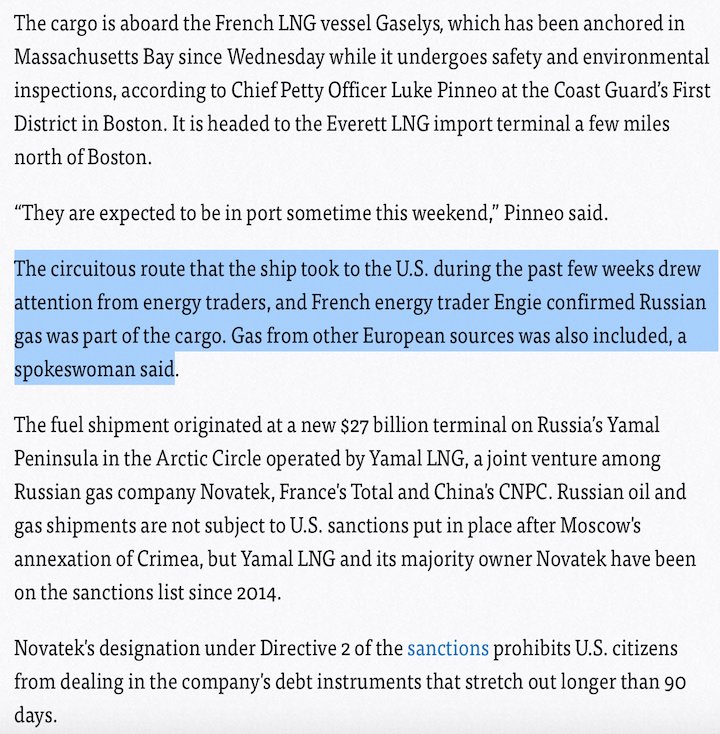
The circuitous route that the ship took to the U.S. during the past few weeks drew attention from energy traders, and French energy trader Engie confirmed Russian gas was part of the cargo. Gas from other European sources was also included, a spokeswoman said.
The fuel shipment originated at a new $27 billion terminal on Russia’s Yamal Peninsula in the Arctic Circle operated by Yamal LNG, a joint venture among Russian gas company Novatek, France's Total and China's CNPC. Russian oil and gas shipments are not subject to U.S. sanctions put in place after Moscow's annexation of Crimea, but Yamal LNG and its majority owner Novatek have been on the sanctions list since 2014.
Novatek's designation under Directive 2 of the sanctions prohibits U.S. citizens from dealing in the company's debt instruments that stretch out longer than 90 days.
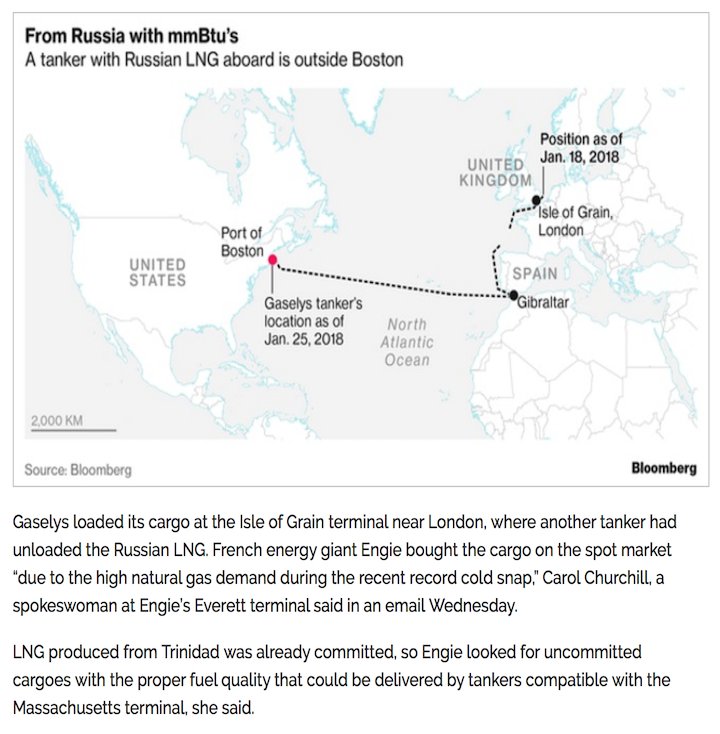
Engie loaded the Gaselys at the Isle of Grain LNG terminal in the United Kingdom, according to an Engie spokeswoman. That terminal received the first shipment of gas from Yamal, which Putin inaugurated last month.
Engie bought the gas in a one-off deal in response to the winter cold snap that has plunged much of the Northeast into freezing temperatures and sapped the region's fuel supplies. The gas was to be delivered to the Mystic Power Generation plant in Massachusetts and other local utilities, spokeswoman Julie Vitek said.
”We have communicated the fact that there is a mixture of gas aboard this cargo — we communicated that to a variety of authorities,” Vitek said. “I don’t believe they’ve flagged the Russian gas as a concern.”
The Treasury Department declined to comment on shipment, citing departmental policy, and the State Department did not respond to inquiries.
https://www.politico.com/story/2018/01/ ... mes-312866
The Russian fuel shipment arriving in New England this weekend originated at a new $27B terminal which was inaugurated by Putin last month & is operated by Yamal LNG, a company that has been on the Treasury Dept’s sanctions list since 2014.
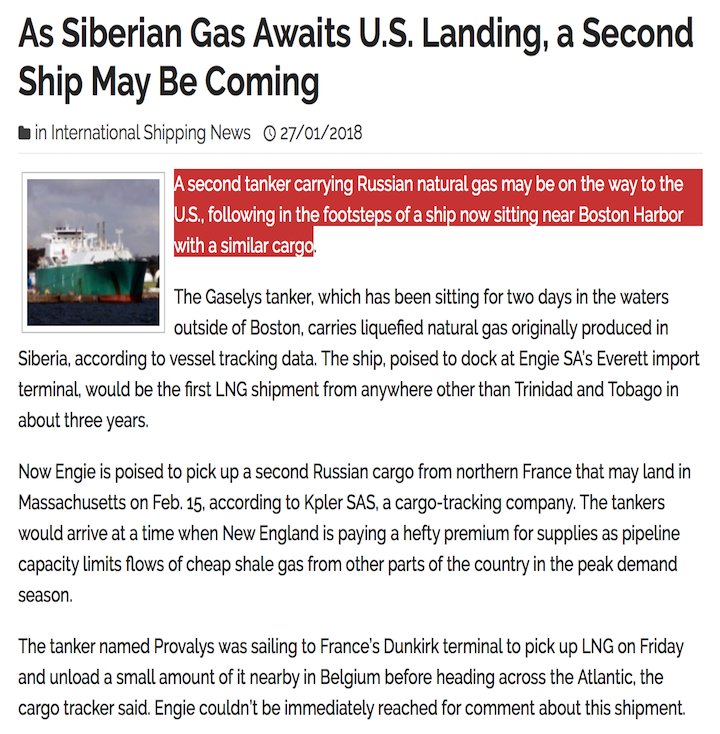
A SECOND tanker carrying Russian natural gas may be on the way to the US [due to dock Feb 15], following in the footsteps of a ship now docked near Boston Harbor carrying similar cargo – the first shipment of gas from Russia to ever reach the US.
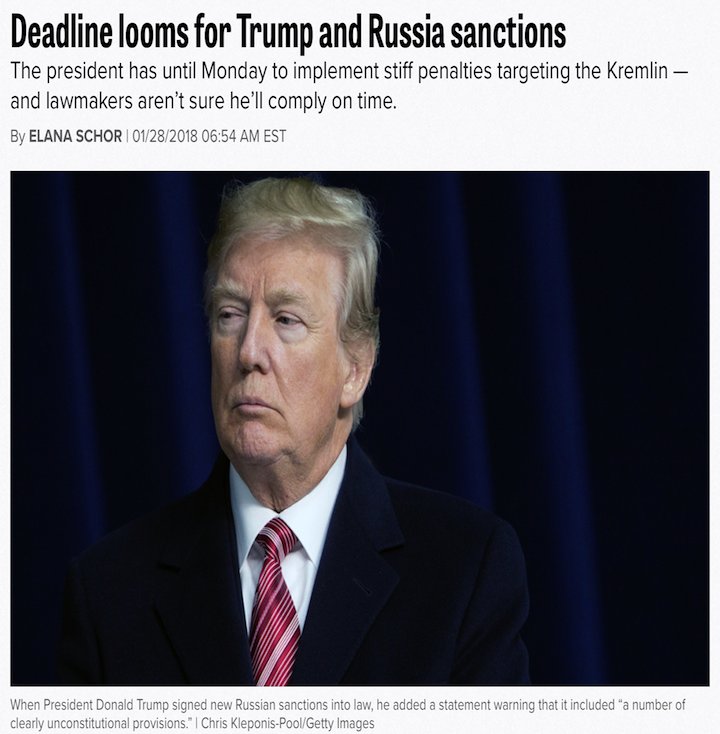
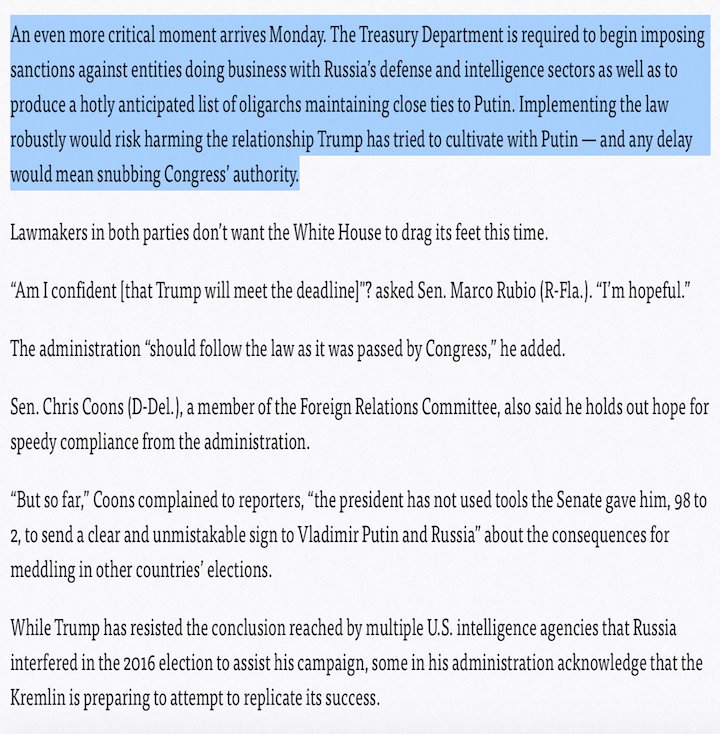
Deadine for implementing latest round of Russian sanctions is TODAY. Treasury is required to begin imposing sanctions against entities doing business with Russia’s defense & intel sectors and produce a list of oligarchs with close ties to Putin.
State Dept: "Trump admin has notified Congress that last year’s bipartisan Russia sanctions bill is serving as a 'deterrent' and as such, SPECIFIC SANCTIONS AREN'T NEEDED AT THIS TIME. When & if we have sanctions to announce, we will do so." WTAF?Deadline looms for Trump and Russia sanctions
The president has until Monday to implement stiff penalties targeting the Kremlin — and lawmakers aren’t sure he’ll comply on time.
ELANA SCHOR01/28/2018 06:54 AM EST
President Donald Trump’s willingness to crack down on Russia will be seriously tested come Monday.
Trump faces a major deadline to use the Russia sanctions power that Congress overwhelmingly voted to give him — and it’s anybody’s guess as to whether he’ll comply on time after missing the last deadline.
Scrutiny is high, amid lingering suspicion of Trump’s eagerness to mend fences with Russia and with special counsel Robert Mueller’s investigation still digging into election meddling by Moscow. Lawmakers on both sides of the aisle remain keen to get tough on Vladimir Putin’s government.
And they have reason to worry about whether the popular sanctions package Trump reluctantly signed in August will be implemented just as hesitantly. The Russia provisions of the bill were designed as a response to Moscow’s meddling in the 2016 election, which the president himself has downplayed.
Furthermore, the last time Trump’s administration confronted a deadline to set in motion penalties against Putin’s government, it took more than three weeks — and a nudge from Senate Foreign Relations Committee Chairman Bob Corker (R-Tenn.) — for Trump’s team to comply.
An even more critical moment arrives Monday. The Treasury Department is required to begin imposing sanctions against entities doing business with Russia’s defense and intelligence sectors as well as to produce a hotly anticipated list of oligarchs maintaining close ties to Putin. Implementing the law robustly would risk harming the relationship Trump has tried to cultivate with Putin — and any delay would mean snubbing Congress’ authority.
Lawmakers in both parties don’t want the White House to drag its feet this time.
“Am I confident [that Trump will meet the deadline]"? asked Sen. Marco Rubio (R-Fla.). “I’m hopeful.”
The administration “should follow the law as it was passed by Congress,” he added.
Sen. Chris Coons (D-Del.), a member of the Foreign Relations Committee, also said he holds out hope for speedy compliance from the administration.
“But so far,” Coons complained to reporters, “the president has not used tools the Senate gave him, 98 to 2, to send a clear and unmistakable sign to Vladimir Putin and Russia” about the consequences for meddling in other countries’ elections.
While Trump has resisted the conclusion reached by multiple U.S. intelligence agencies that Russia interfered in the 2016 election to assist his campaign, some in his administration acknowledge that the Kremlin is preparing to attempt to replicate its success.
White House national security adviser H.R. McMaster publicly acknowledged last month that Russia is showing signs of trying to upend this May’s Mexican election, and Attorney General Jeff Sessions testified in November that preventing Russian disruption of the 2018 midterm elections is an “important” goal.
Whether the administration can be persuaded to use the full extent of the authority Congress gave it last year, however, is another matter. The sanctions due Monday under the bill that Trump signed in August can be delayed or waived, but any waiver would have to come with a certification to lawmakers that Russia has made major progress in cutting back on cyber-meddling.
Trump called Corker in July to blast it as a bad deal. When Trump did ultimately sign the bill into law, the president added a statement warning that it included “a number of clearly unconstitutional provisions.”
Those signals kept Democrats on high alert for slow-walking of the Russia penalties. Sen. Ben Cardin of Maryland, the top Democrat on the Foreign Relations panel, joined House Minority Whip Steny Hoyer (D-Md.) and two other senior Democrats on Friday in a public reminder to Trump about the full extent of Monday’s sanctions deadline.
In addition to the report on Putin-linked oligarchs and imposition of sanctions on those doing business with Russia’s defense and intelligence sectors, they noted, the Treasury Department is also expected to release a report on the consequences of adding sanctions to Moscow’s sovereign debt.
The peril that Russian “actions pose to our democratic institutions and those of our allies is growing in intensity and urgency,” Cardin and Hoyer warned in a letter also signed by the top Democrat on the Senate Banking Committee, Sherrod Brown of Ohio, and the top Democrat on the House Foreign Affairs Committee, New York Rep. Eliot Engel.
“You have a constitutional responsibility to defend those institutions,” they told Trump.
Cardin, whose staff released an extensive report this month slamming Russia for subverting democracies across Europe, vowed in an interview to keep pressing the issue if the Trump administration doesn’t comply on time with Monday’s deadlines.
“We’ve been doing informal conversations” with the administration, focused primarily on the defense and intelligence sanctions, as well as public pressure, Cardin said. “So you can rest assured that if we don’t have a satisfactory response by Monday, I will be out there asking ... to get something done. And I’d expect to have Sen. Corker’s help.”
Corker — a sometime antagonist of Trump who praised the president’s “unpredictability” last week in remarks at the World Economic Forum in Davos, Switzerland — has made clear he won’t let the Russia sanctions bill he helped author drop off the radar.
When the administration missed its October deadline, the Tennessean told reporters he would “get on the phone with someone” at the State Department within 24 hours to shake loose the information — and did. The day after Corker made his vow, the administration released guidance on entities potentially subject to the sanctions due Monday.
"We remain in close communication with the administration regarding implementation of this important legislation and are in the process of scheduling a briefing with State and Treasury officials," a Senate Foreign Relations Committee aide said by email.
The State Department referred a question on Monday’s sanctions deadlines to the Treasury Department, which did not return a request for comment.
Treasury took one key step forward on Friday by broadening sanctions against Russia imposed in the wake of its annexation of Crimea, hitting 21 individuals and nine entities. Those penalties, first imposed before the passage of last year's sanctions bill, were then codified into law by it.
Cardin described the October sanctions holdup as a consequence of “a younger administration” finding its footing. “Now they’ve had more experience on these things,” he said.
https://www.politico.com/story/2018/01/ ... ine-373106
The Trump admin has notified Congress that last year’s bipartisan Russia sanctions bill is serving as a “deterrent” and as such, specific sanctions aren’t needed at this time. From a State Dept spox:
According to Chris Steele's Nov 2016 memo [NOT published in Buzzfeed], the Kremlin intervened to block Trump’s initial Sec of State pick, Mitt Romney, & asked him to appoint someone ready to lift Russian sanctions & cooperate w/ RU security issues.
https://twitter.com/dcpoll