zangtang » Wed Oct 29, 2014 8:07 am wrote:many thanks for those - if i disappear for a month i'm truffling around the varchive!
your comment on 'Velikovsky's error' is ........is damning, and sounds pretty terminal - is there some concensus (amongst aficionados et al) on this,
or ist your personal take on what for me are frustratingly shifting sands?
sounds like an error fundamental enough to invalidate an entire body of work? -pretty catastrophic itself!
I have only just (no moren a month ago) got self 'earth in upheaval' - alas it is playing 2nd fiddle to Wilcock's 'source field investigations', about which much excitement (for me)
so, permission to slap self on back for intuiting that dendrochronology should be the tool (or 1st amongst equals) for herding these various anomalous timeline cats into a cohesive whole (HA!) ?
assuming, as i do, (and being unlearned in that branch (on fire man, on fire!) that you have reference points that serve as resolute & undeniable anchors on which to hang everything else ??
finally, you humbly make mere mention of your own alternate timeline?
.......pray, do tell more......one is somewhat agog!
Thanks (for taking me seriously!). I do have a few followers and correspondents, but they are few, at least the ones who talk to me. I get a lot of hits from China, suggesting that my identification of Shao Kang with Sargon has struck a cord, but it's hard to tell. I don't hear from them.
Let's see, first,
Earth in Upheaval is probably Velikovsky's best work. It is
not dependent on his revised chronology and presents a lot of good evidence that the deep past wasn't quite as deep as the academic types think it was, though certainly nothing within the fundamentalist range.
Also, Livio Stecchini is worth reading. He's at Sammer's other site,
Metrum.org. Stecchini's only other easily accessible work is a long appendix to Peter Tompkins'
Secrets of the Great Pyramid. Stecchini was an expert in ancient geodetic science, though he began in the field of numismatics--using coins to date ancient civilizations. He finds evidence of Egyptian cartographic knowledge of the world that extended to southern Russia.
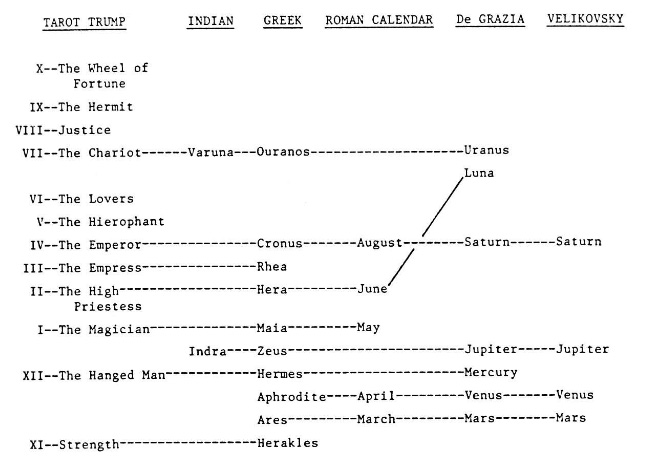
Signs of the zodiac as, basically magically associated with, signs of the zodiac is just me, though the fact itself is widely known. As an explanation of where V went wrong, the wider catastrophist community remains blissfully unaware of how ridiculous planets changing their orbits really is. This is not to say that his theory of cyclical catastrophes is wrong. It's just that the offending agent really
was a comet, not a succession of planets.
Unlike guys like Velikovsky and Rohl, I didn't feel free to move large chunks of ancient history around like pieces on a chessboard. My take on the problem is at my
web site. The timeline is in the yellow table. Note the prominence of tree ring minima and ice core acidity peaks. My take is that Hebrew and Egyptian timelines are, in fact, out of line, but, unlike V, it is the biblical timeline that has been artificially extended to cover a 1200 year gap between Menes (Noah) and Hammurabi (Ham). There are also, though must less common, extensions of the Egyptian timeline as received from Manetho. But, generally speaking, the accepted history is pretty good, though not perfect. The most revolutionary aspect of my own reconstruction is that the Egyptian 16th Dynasty was actually the period of the Judges, who were, in reality, a secondary Egyptian dynasty under the control of Thebes, thus explaining the lack of a Hebrew king. The religious explanation that "God" was king isn't all that far from the truth, since "God" on earth in that part of the world was the king of Egypt. And I strongly suspect that the reason Manetho's king list for that period is missing is that the Church fathers recognized those kings as the Judges and suppressed their names because they didn't fit the distorted biblical timeline.
Permission to pat yourself on the back.

. Dendrochronology cannot be ignored. Where it contradicts theory, theory must be changed. The only caveat, to borrow terms from Abraham Malamat, is that the tree ring minimum may represent a single "punctual" aspect of what was in reality a "durative event" spread out over many years, if not decades.