Indians, Beats, and Hippies
Even as Brand was participating in the technocentric rituals of USCO, he was continuing to search for new, flexible modes of living in other realms as well. Soon after Brand left the army, an old family friend, Dick Raymond, commissioned him to take photographs of the Warm Springs Indian Reservation in central Oregon for a brochure. Over the next three years, when he was not working with USCO, Brand visited the Warm Springs Reservation and Blackfoot, Navajo, Hopi, and Papago reservations as well. When he began this project, he saw Native Americans in terms long set by Anglo-American myth. They were the custodians of the American landscape and, as such, guides to the preservation of the American wilderness. Over time, however, Brand began to reimagine Native Americans in light of his readings of McLuhan and Fuller. In his journals of 1964, he wrote that a new era was dawning. The old era had been dominated by a "Protestant consciousness" ; under it, "mystery subsided into number, uniform and linear. Specialization gradually pervaded Western society, became malignant, and then suddenly, with the acceleration of electricity and computer automation, it passed its own breakpoint into an era of tribal endeavor and cosmic consciousness still un-named. Americans dwelling in the wilderness of changing eras are re-learning to be natives from the most native Americans, The Indians, studying with the new clarity the ancient harmony of a shared land-heritage." For Brand, as for many counterculturalists in the decade to follow, Native Americans became symbolic figures of authenticity and alternative community. If the white-collar man of the 1950s had become detached from the land and from his own emotions, the Native American could show him how to be at home again, physically and psychologically. If the large corporations and governments of the twentieth century were organized in psychologically and socially divisive hierarchies, the world of the Native American was organized into tribes. Polis, family, community: within Brand's heavily idealized vision of Native Americans, all three exist harmoniously as elements of a single unity, the tribe. And if technology had finally begun to draw Americans toward a "cosmic consciousness," well, the Indians had been there all along.
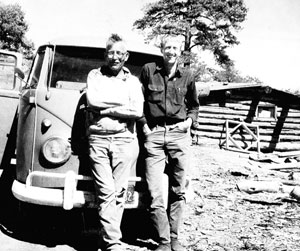 Stewart Brand with Navaho peyote roadman Hola Tso and obligatory Volkswagon van.
Not long after he started working with the Warm Springs Indians, Brand read a book that seemed to confirm his inkling that Indians might hold the key to a nonhierarchical world, Ken Kesey's 1962 novel One Flew Over the Cuckoo's Nest. There Kesey told the story of McMurphy, an individualistic con man imprisoned in a mental hospital, and his struggle against his rigid, unfeeling floor manager, Nurse Ratched (also known as "Big Nurse" ). His narrator was another patient, the Native American Chief Bromden. McMurphy's struggle with Ratched and Chief Bromden's ultimate escape from the ward served, in Brand's view, as emblems of his own struggle to establish an independent identity. The novel, he wrote in his journal, gave him "the answer to my dilemma between revolution against the Combine and preservation of things like old Indian ways. No dilemma. They're identical. As Kesey writes it, the battle of McMurphy versus Big Nurse is identical with [Warm Springs] Indians versus Dalles Dam [on Oregon's Columbia River] or me versus the Army." For Brand, the hierarchical institutions of the hospital in Kesey's book and the government on the reservation mirrored each other. McMurphy's struggle for independence was Brand's own, and Chief Bromden's escape from the hospital at novel's end neatly described Brand's own desire for de-institutionalized freedom. As he read One Flew Over the Cuckoo's Nest and as he traveled from reservation to reservation, Brand, like Kesey, began to link his own struggle against hierarchy and his generation's struggle against technocracy to a mythic American past.
 Brand in his desert period, with fellow hippies Jack and Jean Loeffler.
As he did so, however, he found a way to bring a countercultural version of that past to life. In 1963 Brand wrote a low-key letter introducing himself to Ken Kesey and soon after met him face-to-face. By that time, Kesey was not only an increasingly famous author, but the host of a burgeoning psychedelic scene on the San Francisco peninsula as well. In 1958 Kesey had come to Palo Alto as a graduate student in Stanford's creative writing program. Over the next few years, the program admitted a stellar roster, including future novelists Larry McMurtry, Ed McClanahan, Robert Stone, and Gurney Norman. While there, Kesey wrote much of One Flew Over the Cuckoo's Nest. He also began to develop an affection for psychedelic drugs. In 1959 Kesey became a subject in a series of experimental protocols at the Veterans Hospital in Menlo Park, sponsored by the CIA's MK-ULTRA program. Doctors in these experiments gave volunteer subjects various psychedelic drugs and observed their behavior. In return they offered the subjects small amounts of cash. Between 1959 and 1960, Kesey tried LSD, psilocybin mushrooms, mescaline, and the amphetamine IT-290. The CIA believed that these drugs had the potential to become weapons in the cold war, breaking down the psyches of spies, for instance, and making them more amenable to questioning. Kesey saw quite a different effect:
The first drug trips were, for most of us, shell-shattering ordeals that left us blinking knee deep in the cracked crusts of our pie-in-sky personalities. Suddenly people were stripped before one another and behold! As we looked, and were looked on, we all made a great discovery: we were beautiful. Naked and helpless and sensitive as a snake after skinning, but far more human than that shining knightmare that had stood creaking in previous parade rest. We were alive and life was us. We joined hands and danced barefoot amongst the rubble. We had been cleansed, liberated! We would never don the old armors again.
For Kesey, LSD served as a weapon in the same generational struggle that occupied Stewart Brand. Symbolically, Kesey's "knightmare" echoes Brand's undergraduate fear of growing up to don psychic armor on behalf of a militarized corporate state. In this context, LSD was a benevolent wake-up call, one that allowed Kesey to step out of the regimented ranks of adulthood and become childlike, flexible, barefoot and dancing. Stewart Brand's first experience taught him a somewhat different lesson. Brand was first given LSD in December of 1962 at the International Federation for Advanced Study (IFAS), an organization founded a year earlier by Myron Stolaroff, an engineer from the Ampex Corporation, and Willis Harman, a professor of engineering at Stanford and later a futurist at the Stanford Research Institute. Stolaroff and Harman had built the institute in order to explore the psychological effects of LSD; by 1962 they were charging subjects like Brand five hundred dollars for a daylong trip guided by one of several local psychologists. The man in charge of Brand's procedure was Jim Fadiman, who later served for several months at Stanford Research Institute's Augmentation Research Center—the division that in 1963 sponsored Douglas Engelbart's research on networked computing. According to Brand's journals, he received two doses of LSD, one in a "goblet" and the other, an hour later, by injection. Fadiman and others then had Brand look at a mural, a yin-yang mandala, and a series of other images, including pictures of his family. They played classical music. They asked Brand how he felt ("very thing" he replied). Eventually, the session ended and Brand wandered off to dinner at Fadiman's house, still high.
Brand was put off by the highly structured, pseudoscientific trappings of the IFAS procedure, but the notion that psychedelic drugs could alter one's perceptions took. Brand soon began to hang out with a group devoted to "tripping" in every sense: the Merry Pranksters. The Pranksters had first come together around Kesey's house on Perry Lane on the edge of the Stanford campus. Not long after he began visiting the Veterans Hospital in Menlo Park, Kesey began bringing drugs home. A scene began to emerge: some of the writers from Stanford, the artist Roy Seburn, psychologist Richard Alpert (later known as Baba Ram Dass), guitarist Jerry Garcia, Page Browning—all had begun to appear for various parties. Within a year, Kesey had put together a new scene, with Page Browning and Gurney Norman remaining from the original Perry Lane crew, and in the fall of 1964 he and the Pranksters painted up an old school bus and drove east on the first leg of the legendary tour chronicled in Tom Wolfe's The Electric Kool-Aid Acid Test. Brand did not go with them. As Wolfe put it, Brand represented "the restrained, reflective wing of the Merry Pranksters.
Even so, to Brand the Pranksters were a West Coast version of USCO's techno-tribalism. If USCO had emerged out of an East Coast engagement with cold war avant-garde art, the Pranksters drew on the bohemian energy of San Francisco's Beatnik scene. Since the mid-1940s, the Beats had built a small, highly influential social world, and with it a literature and a way of being that had an extraordinary impact on the counterculture, especially on its West Coast contingent. The origins of the Beat movement can probably best be dated to 1944, when novelists William Burroughs and Jack Kerouac met poet Allen Ginsberg in Manhattan. Over the next fifteen years, these three writers traveled to Europe, North Africa, New York, and San Francisco; together with writers and artists in each of those locations, they built a vision within which, as Ginsberg put it, "existence itself was God." For the Beats, cold war society was plagued by mechanical ways of living and thinking. In the years after World War II, Ginsberg later recalled, "there was a definitive shrinkage of sensation, of sensory experience, and a definite mechanical disorder of mentality that led to the cold war. . . . The desensitization had begun, the compartmentalization of the mind and heart, the cutting off of the head from the rest of the body, the robotization of mentality." In response to this mechanistic world, Ginsberg and company launched a celebration of individual, embodied experience. Drawing on influences ranging from German historian and mystic Oswald Spengler and nineteenth-century American Romantics such as Walt Whitman to psychologist Wilhelm Reich and semanticist Alfred Korzybski, they imagined that both the material world and the social world were imbued with meaning. That meaning could be experienced as an ecstatic state of enlightenment that was itself in tune with the deeper, mystical laws of experience: satori.
The Merry Pranksters thought the Beats offered a model of how to step outside mainstream American culture, build an alternative community, and pursue psychic wholeness even within the bowels of a militarized state. Yet the Pranksters extended the Beat vision as well. Like the Beats, they sought to experience a condition of harmonious flow, and they turned to drugs to do it. Also like the Beats, they saw the whole world as their stage and their own lives as roles that could be played for pleasure. Like USCO, however, the Pranksters appropriated technologies developed in industrial and sometimes military contexts (including LSD) and put them to work as tools for the transformation of self and community. Although Brand later recalled that Kesey and the Pranksters were unfamiliar with Buckminster Fuller's writings and with cybernetic theory when he first met them, their technological performances suggest a deep sympathy with both. For Kesey and company, body and landscape, community and state, and sometimes even biological and electronic systems were mirrors of one another. Metaphorically, when they drove their school bus into the heart of the United States, its sheet-metal skin coated with Day-Glo paint, its insides and often outsides wired with speakers and microphones, its inhabitants hairy, costumed, nicknamed, and alert, Kesey and the Pranksters dropped a tab of LSD into the belly of America. They wanted to turn the country on, to do for the nation what LSD had done for them as individuals and as a community. They wanted to show cold war America an alternative and apparently a much more adventurous, harmonious, and fun way to live. The bus was both the vehicle by which to make this new lifestyle visible and a prototype of that lifestyle itself. Are you "on the bus" ? asked the Pranksters. Or not?
Both on and off the bus, the Pranksters played with the boundaries between self, community, and technology. As they drove across America, they kept a movie camera rolling. If all the world was a stage, they were living here and now, in the real, material space of everyday life, and at the same time inside a movie, in media space. They were both themselves and characters in a scene—a pattern of self-understanding that they saw as congruent with the experience of self on LSD. In part, they were self-consciously seeking to make history, and of course they did. Yet they were also working out a new relationship to technologies of communication and transportation. At one party, for instance, Tom Wolfe recalls seeing Kesey and a half dozen Pranksters sprawled out across the floor, high on LSD, ululating. They were pretending to be a "Humanoid Radio." This was partly a party joke, a prank. "The idea was to try to hit that beam and that mode that would enable you to communicate with beings on other planets, other galaxies. . . . They were all high as hell," wrote Wolfe. But it also marked a weird attempt to appropriate the radio's ability to transcend distance and reach faraway minds with a single, disembodied signal. In the Pranksters" world, LSD and radio were harbingers of New Communalist possibilities. They were communication technologies through which humans could not only exchange information, but, at least imaginatively, merge with one another in a spiritually harmonious state.
Whereas USCO took up technology to make art, the Merry Pranksters deployed technology expressly to create a new consciousness and a new form of social organization. In this sense, the Pranksters represent a key origin point not only for the psychedelic side of the counterculture, but for the New Communalist movement. By 1965 the San Francisco Bay area had seen the Free Speech Movement emerge at Berkeley and had witnessed its first antiwar protests as well. In this increasingly politicized atmosphere, Kesey and the Pranksters turned away from the politics of struggle and embraced the politics of consciousness. On October 15, 1965, Kesey was invited to speak at a rally against the Vietnam War in Berkeley. Organizers expected a fiery speech and a joining of the New Left and the growing counterculture. But rather than orate, Kesey simply stood up and announced to the audience, "You know, you're not gonna stop this war with this rally, by marching. . . . That's what they do." He then pulled out his harmonica and played "Home on the Range." In keeping with psychedelic visions of transpersonal harmony (and with cybernetic and Romantic visions of a world linked by invisible currents of energy and information), Kesey rejected as fundamentally false the dynamics of confrontation called for by the moment and by the logic of the cold war more generally. He simply stood up and demanded that the audience not confront their enemies, but instead turn away from them and come together elsewhere.
After some confusion, the audience ignored him and continued their march. But in retrospect, Kesey's action marked a key moment in the public emergence of a New Communalist style of social action. For the Free Speech and antiwar movements, to attempt to change society meant to pursue claims on the existing political structure. In both cases, demonstrators asked for changes in policies—the policies of a university in the first case and of a nation in the second. Kesey sought nothing from established politicians, other than to be left alone. Having rejected agonistic politics, he asked demonstrators to turn away from the centers of established political power and look inward, toward each other. In place of politics, he offered the experience of togetherness; in place of a rigid, violent society, he presented the possibility of a leveled, playful community.
At the same time, he exhibited a style of leadership that would soon characterize Stewart Brand's work at the Whole Earth Catalog and that, over the next three decades, would migrate into debates around the social impact of digital technologies. At the Vietnam Day rally, Kesey simultaneously denied his role as a leader and assumed it, albeit in a new way, by playing his harmonica. Like the members of USCO, the Pranksters worked to step outside traditional political arrangements and celebrated a tribal togetherness. But unlike USCO, they also had a single, de facto leader: Kesey, called "the Chief " by the Pranksters. It was Kesey's earnings from One Flew Over the Cuckoo's Nest that had paid for the bus trip in 1964, and it was Kesey who was paying most if not all of the group's expenses (which Wolfe estimated at a hefty twenty thousand dollars per year). But neither Kesey nor anyone else would acknowledge this power explicitly. Wolfe put it this way: "Kesey took great pains not to make his role explicit. He wasn't the authority, someone else was: 'Babbs says . . ." 'Page says . . ." He wasn't the leader, he was the 'non-navigator." He was also the non-teacher. . . . Kesey's explicit teachings were all cryptic, metaphorical; parables, aphorisms." Within the Pranksters, Wolfe argued, Kesey's leadership and the group's direction were "The Unspoken Thing.'
Rather than identify the power to lead with Kesey himself, Kesey and the Pranksters turned to various devices to distribute and, ostensibly, level that power. One of the devices was a simple spinner. The Pranksters regularly played a game in which a number of them would sit in a circle. Someone would spin the spinner, and whoever it pointed to would then have full power over the group for the next thirty minutes. Another tool they used was the I Ching. When important decisions loomed, Kesey and others—like hippies everywhere in the coming years—would throw a set of coins, find a correlated bit of text in the book, and use it as the basis for taking action.
The spinner and the I Ching did serve to take power out of the hands of designated leaders. If the former turned group members into followers, it did so only temporarily, and only with the members" consent. If the latter threw up an obscure ancient fortune, it also demanded that one work out its meaning on one's own. In both cases, the individual remained empowered. But within the context of the Pranksters, these devices also served an ideological function. That is, they not only distributed some power among group members and decision-making devices, but they also diverted attention from the very real and centralized leadership Kesey was exerting. Having walked away from what they believed were the excesses of the traditional party politics practiced by the American government and its cold war allies and enemies, Kesey and the Pranksters did everything they could to deny the fact of concentrated power in their midst. In a pattern that would become familiar around the digital technologies of the 1990s, they reassigned it, at least temporarily and at least symbolically, to devices.
For Stewart Brand, Kesey became a role model and a collaborator. In January of 1966, Brand and Kesey mingled the Pranksters" vision of power with USCO's high-tech tool kit to create the single event that, more than any other, would take the San Francisco psychedelic scene public: the Trips Festival. Over the preceding year, Kesey and the Pranksters had staged about a dozen "Acid Tests." According to Tom Wolfe, Kesey had originally dreamed up the notion of an acid test as a multimedia LSD fest to be staged within one of Fuller's geodesic domes with psychedelic lighting by Gerd Stern of USCO. In the end, the tests tended to be more modest—they included long-hair gatherings featuring LSD in various venues in Palo Alto, Portland, San Francisco, Los Angeles, and even Mexico. The Grateful Dead supplied much of the music. Toward the end of 1965, Brand and Ramón Sender Barayón, a composer of electronic music and a friend of USCO's Michael Callahan, thought up the Trips Festival as a way to bring the burgeoning scene together. Together, they found promoter Bill Graham (then a member of the San Francisco Mime Troupe) and hired the Longshoreman's Hall in San Francisco for three nights: Friday, January 21, through Sunday, January 23. By this time, the federal government had outlawed LSD, so posters promised an Acid Test—a full-blown psychedelic experience—without LSD.
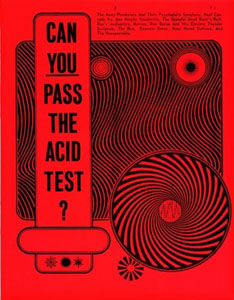 Ken Kesey introduced Da-glo as a color for art, along with op-art moirŽ references and a high-tech oscilloscope sine wave for this handout advertising the 1966 "Trips Festival." Designed by soon-to-be-famous cartoonist Wes Wilson.
As it turned out, the Trips Festival featured plenty of LSD. But more importantly, it represented a coming together of the Beatnik-derived San Francisco psychedelic scene and the multimedia technophilia of art troupes such as USCO. On the first night, Brand and some friends performed his multimedia piece America Needs Indians. When he developed it during his time with USCO, America Needs Indians consisted of sound tracks, three slide projection systems, and four Native American dancers. Brand thought of it as an immersive experience, a "peyote meeting without peyote." In the open, industrial space of the Longshoremen's Hall however, the piece looked tiny, like "a teepee and some slide projectors," according to one visitor. That evening, visitors wandered throughout the hall, sometimes dancing, talking and playing with bits of electronic gear scattered around the floor.
The second night brought the scene into focus. Kesey had called for the audience "to wear ecstatic dress and to bring their own gadgets (A.C. outlets will be provided)," and they did. Audience members painted in Day-Glo colors danced and watched their dancing rebroadcast live on a series of closed-circuit televisions. The hosts had arranged for live microphones and sound gear for anyone to play with. Five slide projectors splashed images on the wall; light machines scanned the room. Two bands played: the Grateful Dead and Big Brother & the Holding Company. Above it all hovered Kesey. Stationed on a balcony and wearing a space suit, he wrote messages on acetate slides and projected them onto a wall below. Jerry Garcia, lead guitarist with the Dead, recalled the feeling that characterized the early Acid Tests and the Trips Festival: "Thousands of people, man, all helplessly stoned, all finding themselves in a room of thousands of people, none of whom any of them were afraid of. It was magic, far-out beautiful magic.
'
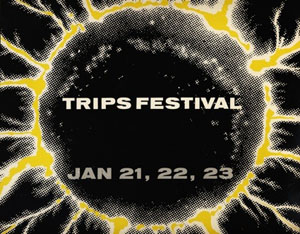
Stewart Brand designed this poster for the 1966 Trips Festival with graphic artist Peter Bailey.
According to Tom Wolfe, it was also the start of the Haight-Ashbury era. The festival grossed $12,500 within three days and had spent very little in the way of overhead. Two weeks later, Bill Graham could be found staging a trips festival every weekend at the Fillmore. Within a year, teenagers from across America would be streaming into Haight-Ashbury, looking for the sort of bohemian utopia Graham was marketing. Reporters for Time and Life were not far behind. Almost immediately, San Francisco became Oz to a generation that had feared it would grow up into a black-and-white Kansas of a world—if it lived long enough in the face of nuclear weapons and the draft to grow up at all. In myth, if not always in fact, Kesey and the Merry Pranksters became San Francisco's wizards, and as they did, they made visible to mainstream Americans the possibility of living a mobile, tribal life, a world in which the role-playing and psychological fragmentation common to the institutions of technocracy dissolved in a whirlwind of drugs, music, and travel and left standing only a more authentic, and seemingly childlike, self. For the teenagers then beginning to think of heading west, and for the reporters packing their bags to follow suit, the Trips Festival and the San Francisco scene heralded the birth of a new and open world.
The Trips Festival marked Stewart Brand's emergence as a countercultural entrepreneur—but in a deeply technocratic mold. Ten years earlier, Brand had feared that he would grow up into a world where he would have to partition his psyche and wield what power he had from within a hierarchical organization. He would have to become a soldier, cut off from both the world around him and the world within him by his uniform and his place in the ranks. At the Trips Festival, in contrast, Brand acted as a Comprehensive Designer. He built a world in which he and the dancers on the floor were part of a single, leveled social system. At one level, that system responded to the norms of the countercultural critique of technocracy. It shunned hierarchy in favor of anarchic togetherness; it turned away from emotionally removed, objective consciousness and toward a delicious, embodied, experiential magic. Like the happenings of Allan Kaprow and the music of John Cage, the Trips Festival transformed every moment into an all-encompassing now—itself a version of Beatnik satori.
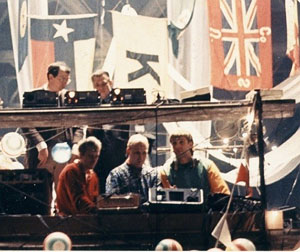 The command module at the Trips Festival, January 1966. Lower row, left to right: Stewart Brand, Ken Kesey, Ken Babbs.
At another level, though, the swirling scene at the Trips Festival, and Brand's role in it, represented a coming together of the New Communalist social ideals then emerging and the ideological and technological products of cold war technocracy. The festival itself was a techno-social hybrid. The Longshoreman's Hall surrounded dancers with the lights, images, and music of electronic media. The bodies of many dancers were infused with LSD. To the extent that they felt a sense of communion with one another, the sensation was brought about by their integration into a single techno-biological system within which, as Buckminster Fuller put it, echoing Norbert Wiener, the individual human being was simply another "pattern-complex." Brand himself had organized the event in keeping with the systems principles he had encountered at Stanford and afterward. Far from asserting direct control over events, he had built an environment, a happening, a laboratory. He had set forth the conditions under which a system might evolve and flower, and he had stocked the biological and social worlds of those who entered that system with technologies that allowed them to feel as though the boundaries between the social and the biological, between their minds and their bodies, and between themselves and their friends, were highly permeable. He had helped found a new tribe of technology-loving Indians, artistic engineers of the self. Very soon these new Comprehensive Designers would set out from San Francisco to found their own communities in the wilderness.
When they got there, thought Brand, what they would need most would be tools and information.
~~


