NOVEMBER 14, 2012
The Petraeus Saga
Epitaph for a Four Star
by Col. DOUGLAS MACGREGOR, Ret.
When Major General David H. Petraeus, commander of the 101st Airborne Division met Lieutenant General William Wallace, commander of the U.S. Army’s V Corps on 27 March 2003 at a site near Najaf, only five days after American forces began the attack to Baghdad Petraeus and Wallace were deeply pessimistic. They concluded, “The war was in dismal shape.”8 Petraeus, an officer who had risen to Major General and Division Command with no previous combat experience, was deeply worried about the level of Iraqi resistance.
The fact that 3rd Infantry Division (mechanized), an armored force of hundreds of tanks and armored fighting vehicles was already 50 miles south of Baghdad and poised to attack the city did not seem to matter. Gen. George S. Patton, Jr. would have flown into a rage and fired them on the spot. Yet both men went on to four stars.
Was General David Petraeus the heroic figure his press releases suggested or a piece of fiction created, packaged and presented to the American people by the Bush Administration and its Neocon allies in the media and academia as the poster boy for counterinsurgency? Was he simply a world class aid de camp, military assistant and speech writer, a slick briefer who successfully cultivated dozens of Army four stars and political appointees on the ladder to four stars? Or is Petraeus simply the victim of his own press releases?
Consider these points: The Shiite dominated government of Iraq is not only more corrupt today than its secular Baathist predecessor. It’s also among the most corrupt states in the world, far worse than North Korea or Russia. And, unlike Saddam Hussein’s Iraq it is unambiguously tied to and aligned with Iran. In Afghanistan, Afghan National Security Forces (ANSF) continue to run from fights with pathetic Taliban in bed sheets and flip flops and more Afghan civilians died during the 18 months of Petraeus’s “Afghan Surge” than at any time in the previous ten years. How did these things come about? Who is responsible for this debacle?
How many times have Americans read the flattering assessments of Petraeus on the editorial pages of The Washington Post, The New York Times, The Wall Street Journal or heard Journalists repeat Petraeus’s assertions of “progress” and “success” on CNN, Fox News and MSNBC? Whenever Petraeus wanted to show that his alleged “counterinsurgency” strategy was delivering significant progress in Iraq or Afghanistan, the mainstream media offered unconditional support for whatever narrative Petraeus provided.[ii]
Vacuous statements removed from the facts were routinely treated like sermons on the mount, “It’s about being comfortable with a degree of chaos,” he [Petraeus] said in the interview. “And the whole point is that I am comfortable with that kind of situation. What you want to do is constantly push the envelope in every respect.”[iii] Huh???
When the Surge in Iraq began, no one in Washington was interested in explaining why the world’s most powerful military establishment led by Petraeus was buying off its Sunni Arab opponents with hundreds of millions of dollars, effectively supplanting counterinsurgency with cash-based cooptation.[iv] When the Surge in Iraq ended, no one in Washington wanted to discuss why Tehran’s Shiite allies in Baghdad restrained their fighters, and waited until the U.S. occupation ended before consolidating their control of Arab Iraq. In 2009, an Iraqi journalist described the outcome in terms no serious observer of the conflict could ignore:
“Observers not steeped in Iraqi history might be bemused to find that six years after the toppling of a dictator, after the death of several hundred thousand Iraqis, a brutal insurgency, trillions of wasted dollars and more than 4,000 dead US soldiers, the country is being rebuilt along very familiar lines: concentration of power, shadowy intelligence services and corruption.”[v]
A year later, Al-Qaida together with its Sunni Islamist affiliates in Iraq was also making a comeback recruiting scores of Sunni Muslim Arabs to rejoin the fight against the “crusaders and the Shiites” by paying them more than the monthly salary they received from the Maliki Government.[vi] Petraeus had brought the country back to where it started. Members of the House and the Senate privately acknowledged Iraq was a failure,[vii] but this tragic outcome did not obstruct the Petraeus proposal to repeat the folly of Iraq in Afghanistan.
On 7 October 2009 before the surge in Afghanistan began, Marc Sageman, a veteran intelligence officer with years of experience in Pakistan and the region warned the Senate Foreign Relations Committee, “The proposed counter-insurgency strategy in Afghanistan is at present irrelevant to the goal of disrupting, dismantling and defeating al Qaeda, which is located in Pakistan. None of the plots in the West has any connection to any Afghan insurgent group, labeled under the umbrella name “Afghan Taliban.”[viii] Reason and facts took a back seat. Sageman was ignored.
A year later, when I asked a field grade officer in Washington, DC with experience in Afghanistan if the simultaneous departure of General Petraeus and Ambassador Eikenberry from their posts in Kabul at the start of the security transition and after two high-profile assassinations (Jan Mohammad and Ahmed Wali) would undermine the Afghan population’s confidence in the U.S. leadership, he answered, “Absolutely not! There is no public confidence to lose. Read the local media translated every day in opensource.gov. The matter is absolutely irrelevant to the population-Uzbek, Tajik, Huzzara or Pashtun.”[ix]
Sadly, what happened in Afghanistan was also irrelevant to the American people. By now, Americans had figured out that large-scale U.S. military occupations of non-Western societies to transform them into images of the West inevitably provoke resentment and breed violence; even when the U.S. pays $25 million a month in hard cash to its enemies not to fight.
Why did these things happen?
The short answer involves the skillful use of data and information to create a false picture of military action in faraway places. It’s not a new practice,[x] but in Iraq, Petraeus elevated it to an art form. With the backing of the Bush Administration, Petraeus created a narrative based on the illusion the he, David Petraeus, had “discovered” a military solution to Iraq’s societal misery in the form of counterinsurgency.
Secretary of State Dean Acheson said it best, “Americans are suckers for good news.” And P.T. Barnum insisted, “A sucker is born every minute.” Both were right.
However, in Afghanistan, Petraeus overestimated his ability to control the narrative even with a friendly U.S. press. True, the chronic absence of accountability for lost funds and failed nation building projects persisted as they did in Iraq,[xi] but when Marjah, the alleged test case for the Afghan Surge faltered badly, IED strikes multiplied and U.S. casualties rose, the Afghan narrative fell apart.[xii] Unfortunately for General Stanley McChrystal, he arrived in Kabul just in time to embrace Petraeus’s false counterinsurgency strategy and supporting narrative, an act that brought him down as much as any imprudent remarks he made under the influence.
When Petraeus finally left joined the CIA, a place from which he could direct black operations that are largely unmonitored and uncontrolled by the president and congress, Americans simply tuned out operations in Afghanistan that were going nowhere. If such disastrous leadership did not result in the pointless loss of American life in uniform,[xiii] undermine American strategic interests abroad, and empty the U.S. Treasury of its hard earned tax dollars,[xiv] it would almost be comedic.
Of course, these observations still don’t completely explain the meteoric rise of Dave Petraeus, or how his carefully crafted image swayed American public opinion. One reason is very that few Americans know much about the military. Most are conditioned to see generals through the prism of Hollywood films. They are easily persuaded that today’s generals are indistinguishable from the battle-hardened leaders of the Second World War or the Korean conflict. Nothing could be more inaccurate.
Directing air strikes, raids and patrols from the safety of the Green Zone, a place that compares favorably with any number of elaborate shopping malls and motels in the United States, is not waging war. Suppressing hostile Muslim populations that resent Western occupation is not the same as confronting the Waffen SS in the Ardennes or hundreds of thousands of Chinese troops on the Korean Peninsula. In Iraq and Afghanistan, there are no opposing armies, air forces or air defenses.
In truth, only a fraction of the soldiers, sailors, airmen and Marines who deploy, are ever under fire. Their courage and devotion are never in question, but confusing them with generals is tantamount to equating senators and Wall Street Bankers with American citizens struggling to survive the economic meltdown. In such an artificial war environment, sacred cows like Petraeus are never slain, they simply vanish.
In addition, Petraeus made a common mistake that is all too common in the Army’s four star ranks. He concluded he was the smartest guy in the room and he made sure everyone in the room knew it. Petraeus was always one of those guys who wanted to be a general for the sake of being a general and he was prepared to do anything to secure the stars,[xv] the product of extreme careerism coupled with the façade of false humility. President Bush and the Neocons in his administration needed a “hero,” an alleged “great captain” to make the case for victory in Iraq when there was none.
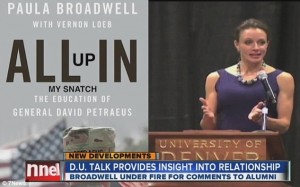
Petraeus was eager to play the role and, the otherwise unknown Paula Broadwell, a former Army officer and West Point graduate, was anxious to tell Petraeus’s story. Broadwell and Petraeus were simply two people with converging agendas.
Petraeus wanted a biographer who would cultivate the myth he worked so hard to create, someone who would glorify him, his “surges” and legitimate the Neocon policy of occupation and nation building with which he identified himself. Broadwell wanted the fame and fortune that access to Petraeus and his narrative would bring. Both got what they wanted, at least, for a while.
However, given that amateur hour in Benghazi is taking center stage on Capitol Hill, there’s little reason for the Obama Administration to keep up appearances with its generals. The latest revelations cast doubt on General John Allen’s future.
It turns out that in two years Allen sent approximately 30,000 pages containing hundreds of emails to Jill Kelley, a volunteer social organizer at the MacDill Air Force Base, in Tampa, and a bit player in the Petraeus-Broadwell affair. How many emails a day is anyone’s guess, but how could Allen have any time left over to focus on operations in Afghanistan when he was sending so many messages to the magnetic Mrs. Kelley!!!
None of the generals’ peccadillos is newsworthy, but for its commentary on the generals. The affairs are genuinely irrelevant. But the events demonstrate that the readiness of four stars like David Petraeus and John Allen to enthusiastically push utterly foolish and self-defeating policies conceived in Washington, DC is not the result of individual failures, but the crisis of an entire institution.[xvi]
Americans must wake up. The contemporary American military is not led by a Roman or Prussian class of hardened professionals. On the contrary, for the most part, the senior leadership is really an overgrown bureaucracy committed to jobs for generals. But these bureaucrats in uniform have gone too far. They are now responsible for the extraordinary loss of American blood, treasure, as well as, strategic ground in Iraq and Afghanistan at a point in time when the American people just cannot afford it.
Evidence Emerges That GOP Leader Tried to Use Petraeus Affair to Hurt Obama Before Election
House Majority Leader Eric Cantor has some explaining to do.
November 13, 2012 |
Amidst the sordid details of the high-ranking CIA sex scandal (that has now spread to an investigation of Jill Kelley, the woman who complained of being harassed by Gen. David Petraeus's mistress (Paula Broadwell), being involved in voluminous and questionable e-mail exchanges with the current commander of forces in Afghanistan, Gen. John Allen), one important political factor has emerged in the last day: Republican House Majority Leader Eric Cantor appears to have tried to put pressure on the FBI to advance the investigation, with the likely goal of an October surprise scandal that would have potentially harmed Obama's chance of re-election. The Wall Street Journal and The New York Times provided insight into the Cantor involvement, with the Journal noting in the beginning of a November 12 article: A federal agent who launched the investigation that ultimately led to the resignation of Central Intelligence Agency chief David Petraeus was barred from taking part in the case over the summer due to superiors' concerns that he was personally involved in the case, according to officials familiar with the probe. After being blocked from the case, the agent continued to press the matter, relaying his concerns to a member of Congress, the officials said. New details about how the Federal Bureau of Investigation handled the case suggest that even as the bureau delved into Mr. Petraeus's personal life, the agency had to address conduct by its own agent—who allegedly sent shirtless photos of himself to a woman involved in the case prior to the investigation. The Journal went on to reveal that the "The [shirtless photograph] agent is now under investigation by the Office of Professional Responsibility, the internal-affairs arm of the FBI, according to two officials familiar with the matter." A quick recap is called for here. Some time earlier this year, the unidentified FBI agent filed an agency request to investigate alleged threatening e-mails from the mistress of Petraeus (then C.I.A. director) to one Tampa Bay resident Jill Kelley, a married socialite who is a "volunteer liaison" (whatever that means) with one of the most top secret military units (based in the Tampa area). The agent who sent shirtless photos of himself to Kelley, via a mobile phone one presumes, was obviously a close friend of hers. Jane Mayer of the New Yorker takes the political dimensions of the story from there: The [New York] Times uses the word “murky” to describe what happened next, and there are many puzzling aspects. But according to the Times, at the end of October, a week or so after the F.B.I. investigators confronted Petraeus, an unidentified F.B.I. employee took the matter into his own hands. Evidently without authorization, he went to the Republicans in Congress. First he informed a Republican congressman, Dave Reichert of Washington State. According to the Times, Reichert advised this F.B.I. employee to go to the Republican leadership in the House. The F.B.I. employee then told what he knew about the investigation to Eric Cantor, the House Majority Leader. Cantor released a statement to the Times confirming that he had spoken to the F.B.I. informant, whom his staff described as a “whistleblower.” Cantor said, “I was contacted by an F.B.I. employee who was concerned that sensitive, classified information might have been compromised.” But what, exactly, was this F.B.I. employee trying to expose? Was he blowing the whistle on his bosses? If so, why? Was he dissatisfied with their apparent exoneration of Petraeus? Given that this drama was playing out in the final days of a very heated Presidential campaign, and he was taking a potentially scandalous story to the Republican leadership in Congress, was there a political motive? According to the Times, Cantor said he took the information, and “made certain that director Mueller”—that is Robert Mueller III, the director of the F.B.I.—“was aware of these serious allegations, and the potential risk to our national security.” This is a strange way to explain his contact with the F.B.I. on this matter, because it is almost inconceivable that director Mueller was not already aware that the bureau he runs had examined the e-mail account of the director of the C.I.A., and, further, confronted him in person. Such a meeting between the bureau and head of the C.I.A. would have been extraordinary, and it is fairly unthinkable that Mueller wouldn’t have been consulted. So what information was Cantor conveying when he got in touch with Mueller? The New York Times reports of an interesting wrinkle in the political implications of the conduct of the "shirtless" agent who seemed to be pursuing Mrs. Kelley and "advocating" on her behalf with keen interest: "Later, the agent became convinced — incorrectly, the official said — that the case had stalled. Because of his 'worldview,' as the [F.B.I.] official put it, he [the "shirtless" agent] suspected a politically motivated cover-up to protect President Obama." Normally, it should be noted, the FBI does not become involved in investigating adulterous affairs of government officials unless there is proof that national security has been compromised. The unidentified "shirtless" F.B.I. agent now under investigation -- and his end run around the bureau through Eric Cantor during the days leading up to Election Day -- raise more serious issues than adulterous sex in terms of what appears to be a last ditch effort to influence a national election. Fortunately, Cantor didn't bully F.B.I. Director Mueller into an October Surprise revelation of Petraeus having had an adulterous affair. More may come out, given that Broadwell may have a penchant for wanting people to know that she has inside information (including her questionable public claim that the C.I.A. was holding prisoners in Benghazi) -- and that there are questions of whether any classified information was revealed or rendered vulnerable. But it would take a leap of unjustified faith to believe that Eric Cantor's telephone call to the head of the F.B.I. on Halloween was not an attempt to force the salacious scandal of lust (as it stands at this moment) to the front pages before the election. Fortunately, global warming's October surprise -- Hurricane Sandy -- trumped Cantor's inappropriate meddling into an FBI investigation for opportunistic political purposes likely aimed at influencing an election.