Page 15 of 27

Re: Who Parked The Moon?

Posted: Sun Sep 27, 2015 5:29 pm
by DrEvil
coffin_dodger » Sat Sep 26, 2015 2:56 pm wrote:
smoking since 1879 wrote:what gives?
We live on a surface that is spinning, on a planet that is speeding around an elliptical orbit of the sun, in a solar system that is speeding through the galaxy, which in turn is moving through the space beyond at some incredible speed, the whole of which is expanding.

Stationary we ain't. We live an existance of motion. :eeyaa
Isaac Asimov has a great short story about this (SPOILER ALERT):

Two scientists (and rivals) discover a way to cancel out gravity and try it out on a billiard ball. This makes the ball come to a complete stop relative to everything, while the planet and galaxy keep traveling at however many thousands of miles per hour, conveniently making the billiard ball go off like a shot and "accidentally" killing one of the scientists. :)

Re: Who Parked The Moon?

Posted: Thu Jan 12, 2017 8:38 am
by seemslikeadream
How Old Is the Moon? Scientists Say They Finally Know
By Mike Wall, Space.com Senior Writer | January 11, 2017 02:01pm ET

How Old Is the Moon? Scientists Say They Finally Know
The "supermoon" of Nov. 13, 2016, as seen from the University of California, Los Angeles.
Credit: Mélanie Barboni
The moon is a very old soul, it turns out.

A new analysis of lunar rocks brought to Earth by Apollo astronauts suggests that the moon formed 4.51 billion years ago — just 60 million years after the solar system itself took shape.

Some previous studies have come up with similar estimates, while others have argued for a younger moon that coalesced 150 million to 200 million years after the solar system was born. The new finding, which was published today (Jan. 11) in the journal Science Advances, should settle this long-standing debate, team members said. [How the Moon Formed: 5 Wild Lunar Theories]

"We are really sure that this age is very, very robust," lead author Melanie Barboni, a researcher in UCLA's Earth, Planetary, and Space Sciences Department, told Space.com.

The moon's birth

Astronomers think the moon was born after a Mars-size body (or a series of such big objects) slammed into the early Earth. Some of the material blasted into space coalesced to form Earth's nearest neighbor, the thinking goes.

But it's been hard to pin down exactly when this impact, or these impacts, occurred, Barboni said. That's because the rocks collected by Apollo astronauts and studied by scientists tend to be breccias — jumbles of different rock types mashed together by meteorite strikes (which are very common on the lunar surface, because the moon has almost no atmosphere to burn up falling space rocks).

"You don't have pristine, old rock preserved on the moon," Barboni said. "That's one of the biggest problems — the whole-rock record on the moon is not there."

So Barboni and her team decided to take a different tack. Rather than study entire rocks and hope they date all the way back to the moon's birth, the team dated the formation of the object's mantle and overlying crust.

This "differentiation" occurred shortly after the giant impact(s), when a global liquid-magma ocean initially present on the moon cooled and solidified. And this solidification left a signal, Barboni said — a mineral called zircon.


"If you want to date this process, we use the mineral zircon, because that's the best time capsule you can find," she said.

The researchers studied zircon fragments in rocks collected by Apollo 14 astronauts in 1971. The team dated the samples radiometrically, by measuring how much of their uranium had decayed into lead, and how their hafnium had decayed into various "daughter isotopes." (Isotopes are variants of an element that have the same number of protons in their nuclei but different numbers of neutrons.)

The team's analyses show that the zircon fragments are pristine and ancient, dating back to the solidification of the magma ocean, Barboni said. The researchers also managed to correct for the influence of galactic cosmic-ray impacts, which can complicate dating attempts by injecting neutrons into samples, she added.

The age the team came up with for the moon — 4.51 billion years, give or take 10 million years — should therefore stand the test of time, Barboni said.

"We were able to correct for everything that was a problem before, the reasons people said zircon couldn't be used," she said.

The moon's advanced age also makes sense from a dynamics point of view, especially if the giant-impact(s) theory is correct, Barboni said. That's because more impactors were flying around in the solar system's very early days than 100 million years or so later, she said.

Zircon extracted from lunar breccia 14304 collected during the Apollo 14 mission in 1971.
Credit: Mélanie Barboni
Ties to life on Earth

The new result should be of interest to any astronomer who wants a better understanding of how the moon, Earth and solar system in general formed and evolved, according to Barboni.

For example, life on Earth appears to have gotten a foothold by at least 4.1 billion years ago. This extreme antiquity may seem surprising, given that the moon-forming impact(s) likely heated up Earth tremendously, completely reshaping and remaking the planet's surface.

But it's less surprising with an old moon than with a young one, Barboni said.

"That makes much more sense, if actually the Earth started evolving from 4.5 [billion years ago] rather than the Earth evolving from 4.3 [billion years ago]," she said.
http://www.space.com/35291-moon-age-pinned-down.html
Many tiny moons came together to form moon, simulations suggest
One giant impact may not be responsible for Earth’s satellite
BY THOMAS SUMNER 11:00AM, JANUARY 9, 2017

MINI MOONS The moon may have been formed by a series of medium to large impacts that created mini moons that merged, rather than from a single colossal impact.
DORI/WIKIMEDIA COMMONS (CC BY-SA 3.0)

The moon is made of moons, new simulations suggest. Instead of a single colossal collision forming Earth’s cosmic companion, researchers propose that a series of medium to large impacts created mini moons that eventually coalesced to form one giant moon.

This mini-moon amalgamation explains why the moon has an Earthlike chemical makeup, the researchers propose January 9 in Nature Geoscience.

“I think this is a real contender in with the other moon-forming scenarios,” says Robin Canup, a planetary scientist at the Southwest Research Institute in Boulder, Colo., who was not involved in the new work. “This out-of-the-box idea isn’t any less probable — and it might be more probable — than the other existing scenarios.”

A collision between Earth and a Mars-sized object called Theia around 4.5 billion years ago is the current leading candidate for how the moon formed. This impact would have been a glancing blow rather than a dead-on collision, with most of the resulting building materials for the moon coming from Theia. But the moon and Earth are compositional dead ringers for one another, casting doubts on a mostly extraterrestrial origin of lunar material and thus the single impact explanation.

Image

Making a moon
A series of impacts created disks of debris around the young Earth that combined into moonlets, researchers propose. Over millions of years, these moonlets merged into a single large moon.


R. RUFU ET AL/NATURE GEOSCIENCE 2017

Planetary scientist Raluca Rufu of the Weizmann Institute of Science in Rehovot, Israel, and colleagues dusted off a decades-old, largely disregarded hypothesis that the moon instead formed from multiple impacts. In this scenario, the early Earth was hit by a series of objects a hundredth to a tenth of Earth’s mass. Each impact could have created a disk of debris around Earth that assembled into a moonlet, the researchers’ simulations show. Over tens of millions of years, about 20 moonlets could have ultimately combined to form the moon.

Multiple impacts help explain why Earth and the moon are chemically similar. For example, each impact may have hit Earth at a different angle, excavating more earthly material into space than a singular impact would.

The single impact hypothesis has about a 1 to 2 percent chance of yielding the right lunar mix based on the makeup of potential impactors in the solar system. In the researchers’ simulations, the multiple impact scenario is correct tens of percent of the time. Further investigation of the interiors and composition of the Earth and moon, the researchers say, should reveal whether this explanation is correct.

Re: Who Parked The Moon?

Posted: Thu Jan 12, 2017 8:59 am
by 82_28
We are remiss to take our perspective of what we observe temporally. The Solar System that we "know" is not "finished" yet. It will never be finished until the Sun burns out but that is just the beginning. The only reason we have shit made out of iron or our very carbon cores for example come from extremely ancient super novas. As far as we know. But the who parked the moon question is quite interesting.

Also I don't know where all you cats are, but full moon tonight. It should be pretty full tomorrow night as it begins to wane.

Re: Who Parked The Moon?

Posted: Thu Jan 12, 2017 12:28 pm
by Elvis
Great classic thread.

I did see the moon last evening—near the horizon, pale yellow, and YUGE. Wish I'd had a camera on me.

Re: Who Parked The Moon?

Posted: Wed Jul 25, 2018 4:37 am
by 82_28
Did life once exist on the moon?
(CNN)Although the moon might look desolate and pock-marked with impact craters today, new research suggests that it may have once supported life.
A study published Monday in the journal Astrobiology cites two time periods during the moon's distant past when conditions on the surface were potentially habitable.
Shortly after the moon was forming from a debris disk 4 billion years ago, it was releasing water vapor and other volatile gases in mass quantities. The second event happened about 3.5 billion years ago, when volcanic activity on the moon reached a peak.

On both occasions, the release of these volatile gases would have created liquid water pools on the surface, as well as a dense atmosphere that could stay in place for millions of years. It most likely had a magnetic field as well that could have protected any life on the surface from solar wind, a deadly flow of charged particles streaming out of the sun.
Today, the moon doesn't have an atmosphere but a very thin layer of gases, including sodium and potassium, that try to act like an atmosphere.

"It looks very much like the moon was habitable at this time" billions of years ago, study author Dirk Schulze-Makuch, an astrobiologist at Washington State University, said in a statement. "There could have actually been microbes thriving in water pools on the Moon until the surface became dry and dead."
The new study relies on data from space missions and analysis of rock and soil samples from the moon. In recent years, studies have suggested that there is more water ice on the moon than previously believed and that water could exist beneath the surface.
But what would life have looked like if it existed on the moon, and how did it originate?
On Earth, the earliest evidence of life can be traced to cyanobacteria fossils between 3.5 billion and 3.8 billion years old. Cyanobacteria are microscopic single-celled organisms that produce oxygen through photosynthesis.

The ingredients for life have been found in meteorites before, and it is believed that meteorites could have helped bring water to Earth in the early time of its formation. The researchers for this study propose that in the early days of our solar system, it's possible that meteorites that came in contact with Earth and "blasted off its surface" could have also landed on the moon.
This was common in the early solar system, when giant impacts and the transfer of meteorites between planets occurred, according to the study.
If so, the meteorites could have carried microbes to the moon, and those microbes could have lived in pools of water on the surface.
"If liquid water and a significant atmosphere were present on the early Moon for long periods of time, we think the lunar surface would have been at least transiently habitable," Schulze-Makuch said in a statement.

Now, the moon is essentially dead and dry, its surface covered with dust. But if future missions revisit the moon, the researchers believe that retrieving samples from areas dating back to the peak of volcanic activity could provide evidence of water or life.
Experiments simulating the conditions on the moon 3 billion to 4 billion years ago could also be carried out in labs on Earth or the International Space Station to see whether microbes could survive, according to the study.
https://www.cnn.com/2018/07/23/us/moon- ... index.html

That C&P formatted like hell. But here's that to add to lunar mystery and there are obviously better sources than CNN. But we can all find those on our own.

Re: Who Parked The Moon?

Posted: Tue Aug 07, 2018 9:31 pm
by Iamwhomiam
I think I found the culprit responsible for parking our Moon:


https://www.youtube.com/watch?v=A8LRxIANzQs

Re: Who Parked The Moon?

Posted: Wed Aug 08, 2018 1:20 pm
by stickdog99
As for life on the Moon, the real puzzling question is and should have always been, "What is keeping Earth microbes from currently colonizing the Moon?"

Viable microbes that can live off of sunlight and/or by eating rocks most certainly arrive at the Moon and Mars from Earth constantly. So what is stopping these microbes from colonizing the Moon to the point that we can detect their metabolism? Why is the Earth (and Venus? and many of Jupiter's and Saturn's moons?) a living biosphere while the Moon and Mars are not?

Re: Who Parked The Moon?

Posted: Wed Aug 08, 2018 3:02 pm
by dada
I just don't see how anyone can ask 'who parked the moon' in orbit. Nobody does that good of a parking job. Not with all that speed, calculations for billions of years of duration, and the push and pull of gravity to contend with. Parking the moon would be far more difficult than parking on it. And that ain't easy. Ever try playing Lunar Lander? Now that's a hard game.

I mean, unless we're being whimsical. If that's the case, I blame the moon rabbit.

Why is there no thin layer of biological film on the Moon or Mars. I don't know, maybe the Earth's Moon and Mars are just smarter than the Earth and the other planets and moons? Or they just don't like film, not big fans of the medium. Maybe they read books.

Re: Who Parked The Moon?

Posted: Wed Aug 08, 2018 10:55 pm
by stickdog99
dada » 08 Aug 2018 19:02 wrote: Why is there no thin layer of biological film on the Moon or Mars. I don't know, maybe the Earth's Moon and Mars are just smarter than the Earth and the other planets and moons? Or they just don't like film, not big fans of the medium. Maybe they read books.
OK, but that's a very filmsy explanation.

Re: Who Parked The Moon?

Posted: Thu Aug 09, 2018 11:18 pm
by dada
I asked the moon rabbit about the missing microbes. He said they aren't missing, it's that Earth's Moon and Mars are places where microbes go to die. Some heavenly bodies are designated space graveyards.

I don't know if I buy that, but I sure like the idea. Planet-sized graveyards in space, what's not to like?

Filmsy is great by the way. I liked it so much that I used it in my post in the 'what are you reading now' thread last night.

Re: Who Parked The Moon?

Posted: Thu Dec 20, 2018 6:46 pm
by Laodicean

Re: Who Parked The Moon?

Posted: Sat Dec 22, 2018 8:40 pm
by BenDhyan
Seems a good place to establish a colony...
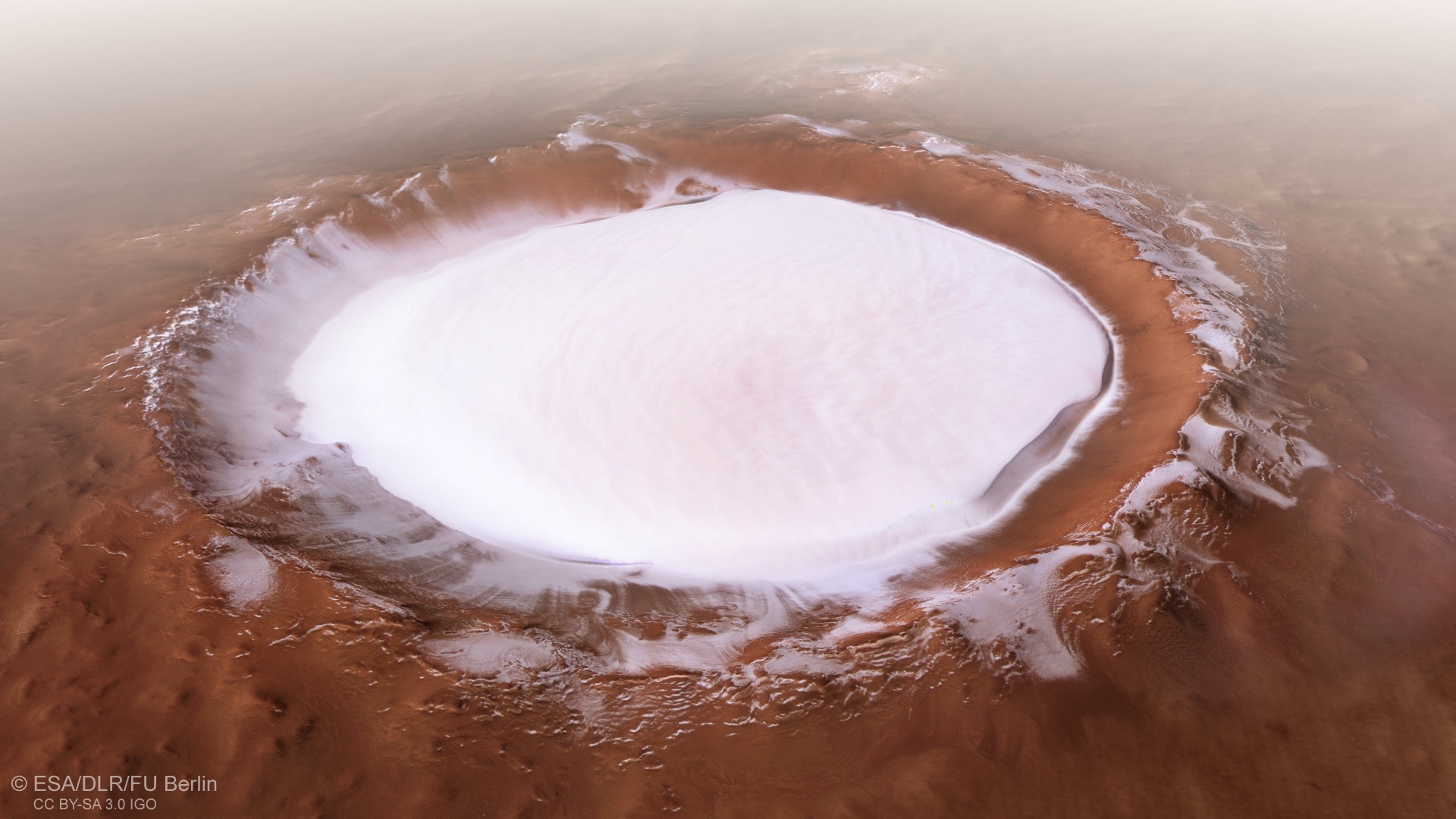
This Crater on Mars Traps the Cold, and Remains Filled With Ice, All Year Roun

December 22, 2018

On June 2nd, 2003, the European Space Agency’s Mars Express mission left Earth to begin its journey to Mars. Six months later (on December 25th) the spacecraft fired its main engine and entered orbit around Mars. This Christmas will therefore mark the fifteenth anniversary of the orbiter’s arrival and all the observations it has made of the Red Planet since then.

Appropriately, the Mars Express mission was able to commemorate this occasion by capturing some beautiful photos of a Martian crater that remains filled with ice all year round. This feature is known as the Korolev crater, which measures 82 km (51 mi) in diameter and is located in the northern lowlands, just south of the northern polar ice cap.

Image

The images were taken by the orbiter’s High Resolution Stereo Camera (HRSC), which was contributed to the Mars Express mission by the German Aerospace Center (DLR). This instrument captured five “strips” of the Korolev crater during five different orbits around the poles, which were then combined to produce images of the crater in perspective, and context, and offer a more complete view of its place in the north polar plateau (or Planum Boreum).

The region has also been of interest to other missions like the ESA’s ExoMars program, which is tasked with finding out if life ever existed on Mars. On April 28th, 2018, the ExoMars Trace Gas Orbiter (TGO) managed to get an image of a 40 km-long segment of the Korolev crater using its Color and Stereo Surface Imaging System (CaSSIS) instrument.

This was the first image sent back to Earth by the TGO mission and was taken as part of a test to ensure that CaSSIS was working properly in preparation for its main mission – which includes determining if Mars’ atmosphere contains trace amounts of methane (a telltale indicator of organic processes and maybe even life).

The sight of such a massive, ice-filled crater… doesn’t that just put you in the holiday mood? And is it not entirely crazy to think that someday, this crater could be a popular tourist destination? Strap on some skates, maybe play a little game of ice hockey? And all the while you get to enjoy the experience of doing it all in about one-third Earth’s gravity!

https://www.universetoday.com/140958/th ... ear-round/

Re: Who Parked The Moon?

Posted: Sat Dec 22, 2018 10:23 pm
by chump
Image

Re: Who Parked The Moon?

Posted: Thu Dec 27, 2018 4:51 am
by stickdog99
It's roughly a 1.5 second delay for any electromagnetic signal to get from the Earth to the Moon and vice versa.

The person who made the video is patently ignorant.

Re: Who Parked The Moon?

Posted: Thu Dec 27, 2018 6:08 am
by BenDhyan
^ The video is a joke, it's actually well done in how it all sounds so serious...tv signals can only go 8 miles.. haha....