Re: Get Ready, Inflation Is On The Way
Posted: Sun Apr 25, 2010 3:34 am
What you don't know can't hurt them.
https://www.rigorousintuition.ca/board2/
https://www.rigorousintuition.ca/board2/viewtopic.php?t=27913
"Did Your Momma Tell You That?"
The Greek Crisis
May 5, 2010
By DEAN BAKER
Keynes quipped in the General Theory that the world is ruled by the ideas of long dead economists. I was reminded of this comment when I heard a member of Germany’s parliament scornfully dismiss the suggestion that the European Central Bank should target a somewhat higher rate of inflation. This suggestion had been put forward by Oliver Blanchard, one of the world’s leading macroeconomists. Furthermore, he had proposed a higher inflation target in his role as the chief economist for the International Monetary Fund.
There is nothing wrong with disagreeing with an economist, no matter how prominent they are or where they work. But what was striking was the nature of the dismissal. The parliamentarian just asserted that: “inflation never solved anything.”
That’s a strong statement. Did he get that information from his parents? Or, as we used to say growing up in Chicago, “Did your momma tell you that?”
Blanchard and others arguing for a higher inflation target actually have very good reasons as to why higher inflation might be very helpful in solving the world economic crisis. First, a higher inflation rate will erode the real value of debt. This will benefit all debtors, households, businesses and countries.
In the case of households, tens of millions of homeowners in the United States and elsewhere have seen much or all of their equity disappear with the collapse of the housing bubble. A modest rate of inflation should begin to lift house prices, restoring equity to these families. It will also reduce the burden of their monthly mortgage payments if wages rise in step with inflation. This will not only be beneficial to these families; a lower debt burden will allow families to spend more, helping to drive the economy.
The same story applies to many businesses that are now facing crushing debt burdens. Furthermore the knowledge the prices of the items they sell will be rising 3-4 percent a year will make investment more attractive to businesses.
Finally, a moderate rate of inflation can go far toward alleviating the debt burden faced by so many countries these days. After 10 years, a 3.0 percent rate of inflation will reduce the real value of a fixed debt by 26 percent; a 4.0 percent inflation rate will reduce it by 34 percent. The modest inflation of the 40s, 50s and 60s was a big factor in bringing down the huge U.S. World War II debt to a manageable level.
Inflation can also be enormously helpful in allowing the euro zone countries with excessive labor costs (e.g. Greece, Portugal and Spain) to get their costs more in line. If wages in more competitive countries keep pace or exceed average euro zone inflation, while wages in the troubled countries don’t rise as rapidly, then they should be able to restore their competitiveness more quickly.
These are the sorts of arguments that Blanchard and others have put forward for allowing a somewhat higher rate of inflation. But the German parliamentarian didn’t care, because he somehow already knew that “inflation never solves anything.”
Policy that rests on unexamined assertions (that emanate from the teachings of long-dead economists) will be every bit as destructive today as it was in the first Great Depression. In Europe, this drama seems to be playing out in the desire to really make Greece feel pain. Greece undoubtedly has to straighten out its fiscal mess. (Is there some reason that everyone is not pushing a tax amnesty program as a way to reduce the Greek debt and show that it is serious about ending wholesale tax evasion?) However, it can’t be expected to balance its budget in the middle of the worst downturn in 70 years.
The same applies to Portugal, Spain and other troubled European economies. Contractionary moves by these governments will worsen the downturn in these countries and in fact, make matters worse in the sound finance countries as well. Fewer imports in Spain and Greece mean fewer exports for Germany and France. Furthermore, enough downward pressure on these economies will likely require a debt restructuring at some point anyhow. The debt burden grows when economies shrink and that seems to be the plan coming from the economic center of Europe.
There might be some justice in the fact that the austerity plans designed by Germany will come back to bite them, but it would be much better to see the Germans design good economic policy. There was perhaps an excuse for bad policy in the 30s; after all Keynes didn’t publish the General Theory until 1937. But, there is no excuse today – the ideas of Keynes have long been known and widely disseminated. It is a tragedy and an outrage that the people deciding economic policy are mindlessly repeating tired clichés rather than seriously trying to design policies that address the crisis in front of our faces.
Dean Baker is the co-director of the Center for Economic and Policy Research (CEPR). He is the author of Plunder and Blunder: The Rise and Fall of the Bubble Economy and False Profits: Recoverying From the Bubble Economy.
This column was originally published by The Guardian.
Refer to this post on money supply and total debt:US money supply plunges at 1930s pace as Obama eyes fresh stimulus
The M3 money supply in the United States is contracting at an accelerating rate that now matches the average decline seen from 1929 to 1933, despite near zero interest rates and the biggest fiscal blitz in history.
By Ambrose Evans-Pritchard
Published: 9:40PM BST 26 May 2010
Comments 7 | Comment on this article
The stock of money in the US fell from $14.2 trillion to $13.9 trillion in the three months to April, amounting to an annual rate of contraction of 9.6pc Photo: AFP
The M3 figures - which include broad range of bank accounts and are tracked by British and European monetarists for warning signals about the direction of the US economy a year or so in advance - began shrinking last summer. The pace has since quickened.
The stock of money fell from $14.2 trillion to $13.9 trillion in the three months to April, amounting to an annual rate of contraction of 9.6pc. The assets of insitutional money market funds fell at a 37pc rate, the sharpest drop ever.
"It’s frightening," said Professor Tim Congdon from International Monetary Research. "The plunge in M3 has no precedent since the Great Depression. The dominant reason for this is that regulators across the world are pressing banks to raise capital asset ratios and to shrink their risk assets. This is why the US is not recovering properly," he said.
The US authorities have an entirely different explanation for the failure of stimulus measures to gain full traction. They are opting instead for yet further doses of Keynesian spending, despite warnings from the IMF that the gross public debt of the US will reach 97pc of GDP next year and 110pc by 2015.
Larry Summers, President Barack Obama’s top economic adviser, has asked Congress to "grit its teeth" and approve a fresh fiscal boost of $200bn to keep growth on track. "We are nearly 8m jobs short of normal employment. For millions of Americans the economic emergency grinds on," he said.
David Rosenberg from Gluskin Sheff said the White House appears to have reversed course just weeks after Mr Obama vowed to rein in a budget deficit of $1.5 trillion (9.4pc of GDP) this year and set up a commission to target cuts. "You truly cannot make this stuff up. The US governnment is freaked out about the prospect of a double-dip," he said.
The White House request is a tacit admission that the economy is already losing thrust and may stall later this year as stimulus from the original $800bn package starts to fade.
Recent data have been mixed. Durable goods orders jumped 2.9pc in April but house prices have been falling for several months and mortgage applications have dropped to a 13-year low. The ECRI leading index of US economic activity has been sliding continuously since its peak in October, suffering the steepest one-week drop ever recorded in mid-May.
Mr Summers acknowledged in a speech this week that the eurozone crisis had shone a spotlight on the dangers of spiralling public debt. He said deficit spending delays the day of reckoning and leaves the US at the mercy of foreign creditors. Ultimately, "failure begets failure" in fiscal policy as the logic of compound interest does its worst.
However, Mr Summers said it would be "pennywise and pound foolish" to skimp just as the kindling wood of recovery starts to catch fire. He said fiscal policy comes into its own at at time when the economy "faces a liquidity trap" and the Fed is constrained by zero interest rates.
Mr Congdon said the Obama policy risks repeating the strategic errors of Japan, which pushed debt to dangerously high levels with one fiscal boost after another during its Lost Decade, instead of resorting to full-blown "Friedmanite" monetary stimulus.
"Fiscal policy does not work. The US has just tried the biggest fiscal experiment in history and it has failed. What matters is the quantity of money and in extremis that can be increased easily by quantititave easing. If the Fed doesn’t act, a double-dip recession is a virtual certainty," he said.
Mr Congdon said the dominant voices in US policy-making - Nobel laureates Paul Krugman and Joe Stiglitz, as well as Mr Summers and Fed chair Ben Bernanke - are all Keynesians of different stripes who "despise traditional monetary theory and have a religious aversion to any mention of the quantity of money". The great opus by Milton Friedman and Anna Schwartz - The Monetary History of the United States - has been left to gather dust.
Mr Bernanke no longer pays attention to the M3 data. The bank stopped publishing the data five years ago, deeming it too erratic to be of much use.
This may have been a serious error since double-digit growth of M3 during the US housing bubble gave clear warnings that the boom was out of control. The sudden slowdown in M3 in early to mid-2008 - just as the Fed raised rates - gave a second warning that the economy was about to go into a nosedive.
Mr Bernanke built his academic reputation on the study of the credit mechanism. This model offers a radically different theory for how the financial system works. While so-called "creditism" has become the new orthodoxy in US central banking, it has not yet been tested over time and may yet prove to be a misadventure.
Paul Ashworth at Capital Economics said the decline in M3 is worrying and points to a growing risk of deflation. "Core inflation is already the lowest since 1966, so we don’t have much margin for error here. Deflation becomes a threat if it goes on long enough to become entrenched," he said.
However, Mr Ashworth warned against a mechanical interpretation of money supply figures. "You could argue that M3 has been going down because people have been taking their money out of accounts to buy stocks, property and other assets," he said.
Events may soon tell us whether this is benign or malign. It is certainly remarkable.
Related Articles
Tim Geithner: 'Europe must react quickly and with force'
Recession: glimmers of hope?
Don't bid up the Swiss franc. Or else!
Dow Jones tumbles on fears about US stimulus package
Bad news: we're back to 1931. Good news: it's not 1933 yet
Gordon Brown's giveaway and tax cut plan will cost thousands of jobs and hold back growth

Barack Hoover Obama
By Ken Silverstein
Kevin Baker has an excellent piece in the July issue of the magazine (available to subscribers) about the similarities between our current president and our thirty-first, Herbert Hoover:
The comparison is not meant to be flippant. It has nothing to do with the received image of Hoover, the dour, round-collared, gerbil-cheeked technocrat who looked on with indifference while the country went to pieces. To understand how dire our situation is now it is necessary to remember that when he was elected president in 1928, Herbert Hoover was widely considered the most capable public figure in the country. Hoover—like Obama—was almost certainly someone gifted with more intelligence, a better education, and a greater range of life experience than FDR. And Hoover, through the first three years of the Depression, was also the man who comprehended better than anyone else what was happening and what needed to be done. And yet he failed.
Mind you, Baker is not (like the majority of the GOP) rooting for Obama to fail:
It is impossible not to wish desperately for his success as he tries to grapple with all that confronts him: a worldwide depression, catastrophic climate change, an unjust and inadequate health-care system, wars in Afghanistan and Iraq, the ongoing disgrace of Guant·namo, a floundering education system. Obama’s failure would be unthinkable. And yet the best indications now are that he will fail, because he will be unable—indeed he will refuse—to seize the radical moment at hand.
Every instinct the president has honed, every voice he hears in Washington, every inclination of our political culture urges incrementalism, urges deliberation, if any significant change is to be brought about. The trouble is that we are at one of those rare moments in history when the radical becomes pragmatic, when deliberation and compromise foster disaster. The question is not what can be done but what must be done.
Along comes the New York Times today with a piece by Joe Nocera about Obama’s financial regulatory “reform” plan that’s particularly interesting in tandem with Baker’s piece:
Three quarters of a century ago, President Franklin Roosevelt earned the undying enmity of Wall Street when he used his enormous popularity to push through a series of radical regulatory reforms that completely changed the norms of the financial industry. Wall Street hated the reforms, of course, but Roosevelt didn’t care. Wall Street and the financial industry had engaged in practices they shouldn’t have, and had helped lead the country into the Great Depression. Those practices had to be stopped. To the president, that’s all that mattered.
On Wednesday, President Obama unveiled what he described as “a sweeping overhaul of the financial regulatory system, a transformation on a scale not seen since the reforms that followed the Great Depression.” In terms of the sheer number of proposals, outlined in an 88-page document the administration released on Tuesday, that is undoubtedly true. But in terms of the scope and breadth of the Obama plan — and more important, in terms of its overall effect on Wall Street’s modus operandi — it’s not even close to what Roosevelt accomplished during the Great Depression.
Rather, the Obama plan is little more than an attempt to stick some new regulatory fingers into a very leaky financial dike, and not rebuild the entire system. Without question, the latter would be more difficult, more contentious and probably more expensive. But it would also have more lasting value.

No, not at all. I'm looking at the problem from various angles, I hope empirically. The question is of great interest to me (though sometimes I wonder why since I have no assets or money, ha ha ha).smiths wrote:i am not quite sure, but i get the idea you are rubbishing the idea that inflation could occur jack?
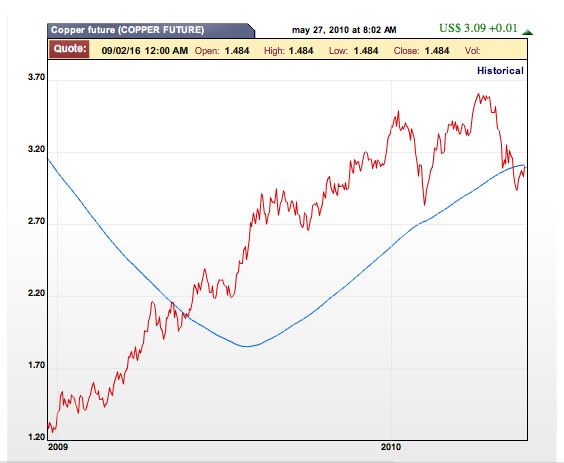
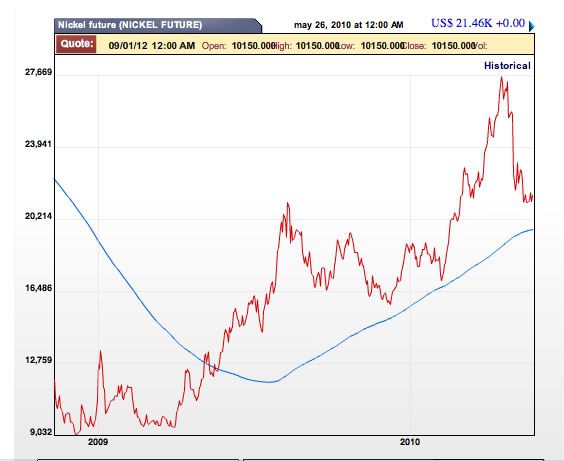
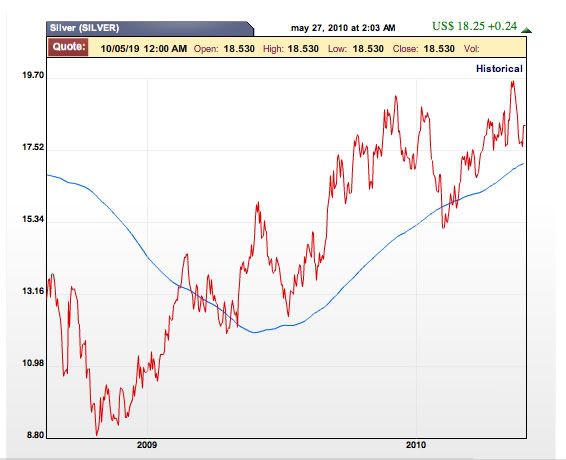
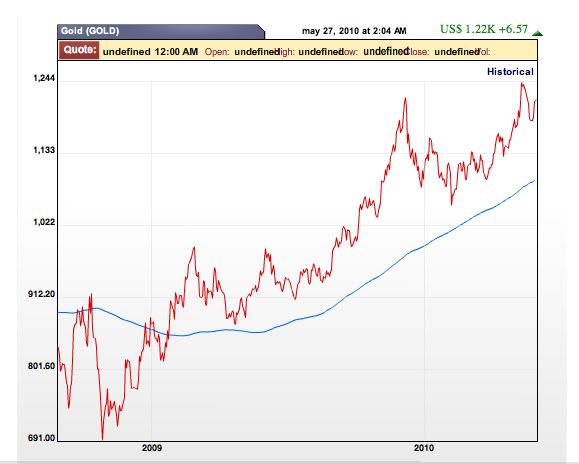
Prices of real physical assets (and of theoretical shares in such, like equities) have been in a decline since the crisis began. Generally speaking.what does that say about fiat currencies, and the inversed debt/money pyramid it says that real physical assets are appreciating and bullshit money is depreciating
"Did Your Momma Tell You That?"
The Greek Crisis
May 5, 2010
By DEAN BAKER
Keynes quipped in the General Theory that the world is ruled by the ideas of long dead economists. I was reminded of this comment when I heard a member of Germany’s parliament scornfully dismiss the suggestion that the European Central Bank should target a somewhat higher rate of inflation. This suggestion had been put forward by Oliver Blanchard, one of the world’s leading macroeconomists. Furthermore, he had proposed a higher inflation target in his role as the chief economist for the International Monetary Fund.
There is nothing wrong with disagreeing with an economist, no matter how prominent they are or where they work. But what was striking was the nature of the dismissal. The parliamentarian just asserted that: “inflation never solved anything.”
That’s a strong statement. Did he get that information from his parents? Or, as we used to say growing up in Chicago, “Did your momma tell you that?”
Blanchard and others arguing for a higher inflation target actually have very good reasons as to why higher inflation might be very helpful in solving the world economic crisis. First, a higher inflation rate will erode the real value of debt. This will benefit all debtors, households, businesses and countries.
Except that inflation will erode the real value of debt only because it erodes the real value of money, which is addressed briefly in the author's following paragraph with a mighty big IF statement. Secondly, that list of people who will benefit is flawed in that it imagines four categories instead of the actual one - debtors - in order to exaggerate the supposed benefit. The three latter categories all fall within the first. Countries are debtors, businesses are debtors and households are debtors. The residents of those countries, owners of the businesses and members of the households are debtors.
In the case of households, tens of millions of homeowners in the United States and elsewhere have seen much or all of their equity disappear with the collapse of the housing bubble. A modest rate of inflation should begin to lift house prices, restoring equity to these families. It will also reduce the burden of their monthly mortgage payments if wages rise in step with inflation. This will not only be beneficial to these families; a lower debt burden will allow families to spend more, helping to drive the economy.
Show of hands - whose wages have been rising at a rate equal to or exceeding inflation? Not mine.
The same story applies to many businesses that are now facing crushing debt burdens. Furthermore the knowledge the prices of the items they sell will be rising 3-4 percent a year will make investment more attractive to businesses.
The business owners I know, though they are capitalists, tend to be happy with their established profit margins and only raise prices out of necessity due to increased cost. When they raise prices, they risk losing business, and there is nothing attractive about that.
Furthermore - "Did your Momma tell you that?" Seriously, Baker? You're a fucking "economics expert?"
Did your Momma teach you any manners?
Is she proud that you're bravely carrying the flag of sophistry and insults posing as intellectualism in order to better serve Mammon?
And since when was a live economist better than a long dead one? There are lots of arguments against both, but not so many in favor.
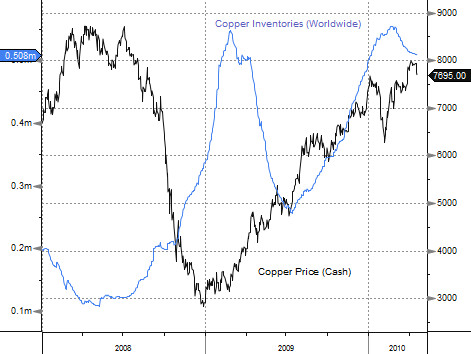
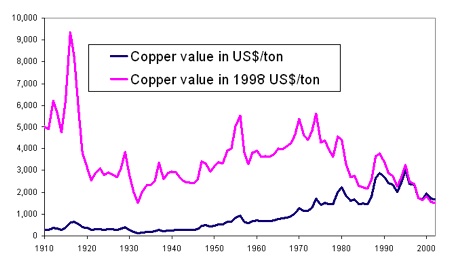
From http://www.bearishbull.com/Betting on inflation has been the winning strategy since the bottom of the last [1930s] depression, but a financial accident could change all that overnight. The inflationists will certainly be right in the long run, but they may get wiped out in the short run. In any event, the moment of truth is approaching, and there likely will be a titanic struggle between the forces of inflation and the forces of deflation. Each will probably win, but in different areas of the economy. As a result, we’re likely to see all kinds of prices going up and down like an elevator with a lunatic at the controls. It will not be a mellow experience.
from jesse at http://jessescrossroadscafe.blogspot.com/As a reminder I do not subscribe to the pure hyperinflationary outcome yet, which I think is not likely in the US at least. For my way of thinking, organic hyperinflation is a function of a currency with an external reference point. At the moment, the US dollar has no legitimate external standard as a reference point, except something soft, indicative, like gold. This is a truly fascinating and almost unprecedented historical development. I cannot think of a comparable economic example.
I suspect we will see powerful deflationary forces that will be countered by monetary inflation and devaluation that is not quite sufficient to break it, because quite frankly Bernanke is no Volcker, and the monied interests will resist a deterioration of their inordinate share of the dollar wealth of the world. That is not to say that various countries and even regions will not be economically 'trashed' in the process by a predatory financial sector based largely in New York, Zurich, and London.
Within eight years I would see the US dollar financial system resolving into a currency collapse and the issuance of a new dollar with a few zeros, two or three, knocked off as was seen with the rouble. It will look somewhat similar to the collapse of the former Soviet Union, not with a bang, but a whimper.
personally i think most of the big money is now short on china, whether china will deflate in the next 6 months or six years is anyones guess,Prices of real physical assets (and of theoretical shares in such, like equities) have been in a decline since the crisis began. Generally speaking.