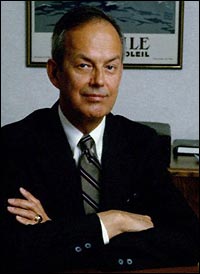
Profile: Bobby Ray Inman
Bobby Ray Inman was a participant or observer in the following events:
1945-1975: NSA’s Operation Shamrock Secretly Monitors US Citizens’ Overseas Communications
The NSA, working with British intelligence, begins secretly intercepting and reading millions of telegraph messages between US citizens and international senders and recipients. The clandestine program, called Operation Shamrock and part of a larger global surveillance network collectively known as Echelon (see April 4, 2001 and Before September 11, 2001), begins shortly after the end of World War II, and continues through 1975, when it is exposed by the “Church Committee,” the Senate investigation of illegal activities by US intelligence organizations (see April, 1976). [TELEPOLIS, 7/25/2000] The program actually predates the NSA, originating with the Armed Forces Security Agency (AFSA) then continuing when that turned into NSA (see 1952). [PENSITO REVIEW, 5/13/2006] The program operates in tandem with Project Minaret (see 1967-1975). Together, the two programs spy on both foreign sources and US citizens, especially those considered “unreliable,” such as civil rights leaders and antiwar protesters, and opposition figures such as politicians, diplomats, businessmen, trades union leaders, non-government organizations like Amnesty International, and senior officials of the Catholic Church. The NSA receives the cooperation of such telecommunications firms as Western Union, RCA, and ITT. [TELEPOLIS, 7/25/2000] (Those companies are never required to reveal the extent of their involvement with Shamrock; on the recommendations of Defense Secretary Donald Rumsfeld and presidential chief of staff Dick Cheney, in 1975 President Ford extends executive privilege to those companies, precluding them from testifying before Congress.) [PENSITO REVIEW, 5/13/2006] In the 1960s, technological advances make it possible for computers to search for keywords in monitored messages instead of having human analysts read through all communications. In fact, the first global wide-area network, or WAN, is not the Internet, but the international network connecting signals intelligence stations and processing centers for US and British intelligence organizations, including the NSA, and making use of sophisticated satellite systems such as Milstar and Skynet. (The NSA also builds and maintains one of the world’s first e-mail networks, completely separate from public e-mail networks, and highly secret.) At the program’s height, it operates out of a front company in Lower Manhattan code-named LPMEDLEY, and intercepts 150,000 messages a month. In August 1975, NSA director Lieutenant General Lew Allen testifies to the House of Representatives’ investigation of US intelligence activities, the Pike Committee (see January 29, 1976), that “NSA systematically intercepts international communications, both voice and cable.” He also admits that “messages to and from American citizens have been picked up in the course of gathering foreign intelligence,” and acknowledges that the NSA uses “watch lists” of US citizens “to watch for foreign activity of reportable intelligence interest.” [TELEPOLIS, 7/25/2000] The Church Committee’s final report will will call Shamrock “probably the largest government interception program affecting Americans ever undertaken.” [CHURCH COMMITTEE, 4/23/1976] Shortly after the committee issues its report, the NSA terminates the program. Since 1978, the NSA and other US intelligence agencies have been restrained in their wiretapping and surveillance of US citizens by the Foreign Intelligence Surveillance Act (see 1978). Admiral Bobby Ray Inman, who will become the NSA’s director in 1977, and who testifies before the Church Committee as director of Naval Intelligence, will later say that he worked actively to help pass FISA: “I became convinced that for almost anything the country needed to do, you could get legislation to put it on a solid foundation. There was the comfort of going out and saying in speeches, ‘We don’t target US citizens, and what we do is authorized by a court.’” [PENSITO REVIEW, 5/13/2006] Shamrock is considered unconstitutional by many US lawmakers, and in 1976 the Justice Department investigates potential criminal offenses by the NSA surrounding Shamrock. Part of the report will be released in 1980; that report will confirm that the Shamrock data was used to further the illegal surveillance activities of US citizens as part of Minaret. [TELEPOLIS, 7/25/2000]
After 9/11, the NSA will once again escalate its warrantless surveillance of US citizens, this time monitoring and tracking citizens’ phone calls and e-mails (see After September 11, 2001). It will also begin compiling an enormous database of citizens’ phone activities, creating a “data mine” of information on US citizens, ostensibly for anti-terrorism purposes (see October 2001).
Entity Tags: Western Union, Pike Committee, National Security Agency, Bobby Ray Inman, Church Committee, International Telephone and Telegraph, Radio Corporation of America
Timeline Tags: Civil Liberties
Late 2001: NSA Domestic Wiretapping Ties Up FBI with Bad Leads
The National Security Agency begins sending data—consisting of telephone numbers, e-mail addresses, and names—to the FBI that was obtained through surveillance of international communications originating within the US (see After September 11, 2001 and October 2001). The NSA sends so much data, in fact, that hundreds of agents are needed to investigate the thousands of tips per month that the data is generating. However, virtually all of this information leads to dead ends and/or innocent people. FBI officials repeatedly complain that the unfiltered information is bogging down the bureau: according to over a dozen current and former law enforcement and counterterrorism officials, the flood of tips provide them and their colleagues with very few real leads against terrorism suspect. Instead, the NSA data diverts agents from more productive work. Some FBI officials view the NSA data as pointless and likely illegal intrusions on citizens’ privacy. Initially, FBI director Robert Mueller asks senior administration officials “whether the program had a proper legal foundation,” but eventually defers to Justice Department legal opinions. One former FBI agent will later recall, “We’d chase a number, find it’s a schoolteacher with no indication they’ve ever been involved in international terrorism—case closed. After you get a thousand numbers and not one is turning up anything, you get some frustration.” A former senior prosecutor will add, “It affected the FBI in the sense that they had to devote so many resources to tracking every single one of these leads, and, in my experience, they were all dry leads. A trained investigator never would have devoted the resources to take those leads to the next level, but after 9/11, you had to.” Former NSA director Bobby Ray Inman says that the problem between the FBI and the NSA may stem in part from their very different approaches. Signals intelligence, the technical term for the NSA’s communications intercepts, rarely produces “the complete information you’re going to get from a document or a witness” in a traditional FBI investigation, he says. And many FBI officials are uncomfortable with the NSA’s domestic operations, since by law the NSA is precluded from operating inside US borders except under very specific circumstances. [NEW YORK TIMES, 1/17/2006]
Entity Tags: Federal Bureau of Investigation, National Security Agency, Bobby Ray Inman, Robert S. Mueller III
Timeline Tags: Complete 911 Timeline, Civil Liberties
March 2004: Former Intelligence Chief: No Ties between Iraq and 9/11
Retired Admiral Bobby Ray Inman, formerly the deputy director of the CIA, head of the National Security Agency, and the former director of naval intelligence, says: “There was no tie between Iraq and 9/11, even though some people tried to postulate one.… Iraq did support terror in Israel, but I know of no instance in which Iraq funded direct, deliberate terrorist attacks on the United States.” [TEXAS MONTHLY, 3/2004; MIDDLE EAST POLICY COUNCIL, 6/2004]
Entity Tags: Bobby Ray Inman
Timeline Tags: Events Leading to Iraq Invasion
May 12, 2006: Former NSA Director Says NSA Wiretapping Program ‘Not Authorized’
Bobby Ray Inman. [Source: DefenseTech.org]
Former NSA director Bobby Ray Inman says that the secret NSA program to wiretap US citizens’ phone and e-mail conversations without court warrants (see After September 11, 2001) “is not authorized.” President Bush authorized the secret wiretapping over four years ago (see Early 2002), a program only revealed at the end of 2005 (see December 15, 2005). Since the program was revealed, it has created tremendous controversy over its possible illegality and its encroachment on fundamental American civil liberties. Bush and other White House officials have repeatedly asserted that the program is legal, mainly because Bush and his officials assert that the president has the authority to implement such a program (see December 15, 2005); Bush also insists, as recently as the day before Inman’s statement, that the program is only being used to spy on terrorists and the privacy of US citizens is being “fiercely protected,” a statement that does not jibe with the facts. [DEMOCRACY NOW!, 5/12/2006]