Re: Zionism’s Lost Shine
Posted: Mon Aug 12, 2013 2:04 pm
The Absurdities of Life in Palestine
The life and art of Khaled Jarrar
CULTURAL CONNECTION blog: “Art has to be the best way to build trust between countries.” —Issa Touma, Syrian photographer. ‘Cultural Connection’ provides updates on the Arab and Iranian arts scene from writers across the Middle East and the Western world.
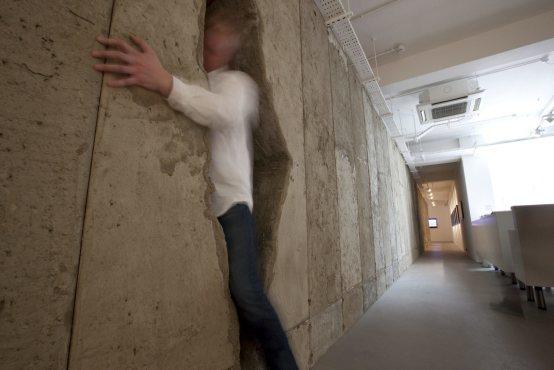
Still image from video Concrete, 2012 (Khaled Jarrar)
“I am not a political artist,” insists Khaled Jarrar, the Palestinian artist who recently exhibited his work in London. “I don’t do political art; I’m simply reflecting my own experiences,” Jarrar told The Majalla. Although he does not want to be cast in the role of the rebellious Palestinian artist, he throws his vitriol with devastating eloquence. He literally seeks to break down the wall that separates Israelis and Palestinians, and yet, at the same time, his art takes the viewer on a journey of the absurd.
Jarrar’s art—a combination of sculpture, film, photography and painting—is born out a life throwing stones in the intifada, working as a carpenter while dreaming of art, and serving in Yasser Arafat’s presidential guard. “It was art,” he says “that [turned] me into a soldier.” As a young man, Jarrar wanted to attend art college, but his financial circumstances meant that he was instead compelled to join the police force in order to pursue that dream. During the training period, he was persuaded to join Yasser Arafat’s presidential guard. His ego was sufficiently pumped, and it was a well-paid job. Jarrar accepted the offer in 1997, when he was twenty-one years old.
Jarrar makes clear that serving Arafat was both an honor and a labor of love. Despite Arafat’s many shortcomings, real or perceived, Jarrar feels an intense attachment to the man. It was the personal relationship and appreciation that Arafat had for Jarrar’s services that endeared him to the artist. “When the Israelis were besieging us in 2003, Arafat was right next to us with his revolver. When many were afraid, he was there not caring for his own safety,” said Jarrar. He was injured in the siege, hit by two dum-dum bullets that shattered his leg: “These bullets are illegal and are used to shoot elephants and explode inside your body.” The injury put him out of action for a year. “When Arafat learned that we were well enough, he interrupted a press conference and went to us and kissed our hands.”
Khaled Jarrar (Ayyam Gallery)
Khaled Jarrar (Ayyam Gallery)
The incident forced Jarrar reassess his life, and take a back seat with the presidential guard. He began to work as a part-time graphic designer and also started to work with film. “The filming changed my life,” he says, “because I saw myself when I was filming these new recruits to the presidential guard, and it became the story about human beings in general.” It set Jarrar off on a journey that eventually saw him leave the presidential guard, in 2007.
His exploration of the absurdity of the Palestinian situation brought him international acclaim. Jarrar’s work depicting the humiliation of the checkpoints—which he displayed at the checkpoints themselves—allowed some Palestinians to experience an art exhibition for the first time, while Israeli soldiers, tourists and the international community came face-to-face with the uncomfortable reality of occupation. For some, the truth was hard to take, and there were attempts to suppress his exhibition. “It was intensely empowering,” he says.
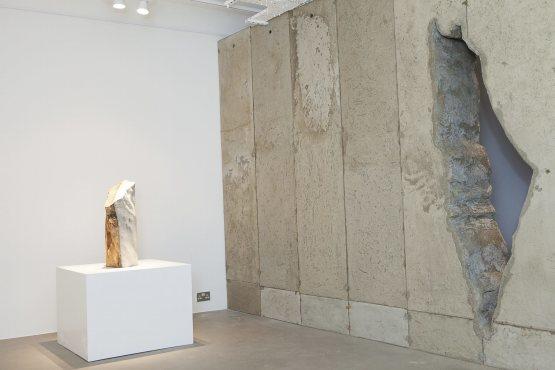
His work with film allowed him to produce Infiltrators, a documentary about Palestinians entering Israel by evading Israeli security measures. In his most recent exhibition, Whole in the Wall, displayed at London’s Ayyam Gallery, Jarrar erected a concrete wall with a Palestine shaped hole in it. The wall forced the visitors to climb through the hole in order reach the other side, allowing them to experience how Palestinians deal with occupation. There were also statues sculpted out of the wall itself. Jarrar says the best possible result would be if “an Israeli art collector buys it and displays it in Israel.”
But his art is not just about making us feel uncomfortable; it is also about the sheer absurdity of occupation. Jarrar draws inspiration from his own experiences: his recollection of a visit to his sister in Nablus is particularly moving. He recalls how he took his two boys with him—Adam, who was an infant at the time, and Muhammad, who was six years old. When they reached a checkpoint, Israeli Defense Force soldiers became enamored with his baby boy and loved the fact that he was called Adam, a name shared by both Jews and Muslims.
Once they crossed the checkpoint, Muhammad needed to go to the bathroom. They returned to the checkpoint and he asked the same soldiers if his six-year-old could use the bathroom, but they refused because of security issues. The artist protested and asked if they had been so kind to his other son, why not to Muhammad? “They wouldn’t even listen, and they threatened to shoot,” he said. In the end, his son defecated in his trousers on the bus: “The whole bus smelled and I had to blame my infant boy. I didn’t have any means to clean him. . . . My heart was breaking up inside, while I was being strong for my six-year-old.” It is exactly this absurdity that Jarrar wants all of us to experience, and the reason why his work is so interesting—so much so that he was invited to showcase his work at the Edinburgh International Film Festival in June.
Remarkably, Jarrar is not bitter about the conflict, and his solution is not about revenge but rather about finding a common ground to share space. “First and foremost,” he insists, “in order for there to be reconciliation there has to be recognition that a wrong has occurred, that the British made a huge mistake with the Balfour Declaration [and] that, in actual fact, this was a land with people.” He believes that once this hurdle is crossed and adequate reparations are made to those who lost out, then the healing process can begin.

Tear down this wall: Khaled Jarrar at the Ayyam Gallery
Khaled Jarrar has made playful sculptures from fragments chipped from the eight metre high wall which runs through the West Bank. Is this trivialising or accepting the wall's existence?
By Aisha Gani Published 23 July 2013 15:30
Khaled Jarrar
Palestinian artist Khaled Jarrar with a football sculpted from pieces of the Israeli separation wall in Qalandia. Photograph: Abbas Momani/AFP/Getty Images.
The looming grey wall confronts you as soon as you step into the gallery. It is claustrophobic and you have two options: walk all the way around the length of the wall, or squeeze through the chiselled opening in the shape of historic Palestine.
Khaled Jarrar’s provocative installation is a piece of the West Bank in the heart of London. Earlier this year I travelled to Israel and the Occupied Palestinian Territories, and was intrigued to see how the wall, a symbol of division, would be integrated to express freedom and unity. The Jenin-born artist combines video, photography and sculpture to reflect life in the shadow of the separation wall.
We are introduced to Jarrar in a short film, as he chips away at the eight metre high wall, working quickly with a chisel, hammer and red plastic bag. As you walk along the installed barrier, you come across a heap of concrete rocks in a corner of the gallery. It is the crushed and recycled sediment of the wall that acts as a base and links all of the sculptures in the gallery.
A football, table tennis rackets and a basketball are seated on plinths. They are sculptures made of concrete. The heaviness of the items contrasts with their usual lightness. Jarrar also makes international parallels, and a concrete figure of Buddy Bear, which was first exhibited at the site of the fallen Berlin Wall, stands in the gallery’s shadows.
We also encounter a short film featuring a surreal badminton match over the wall, in which a split screen shows the Israeli side of the wall painted bright, and the Palestinian side grey and dusty. The only thing unifying the uncanny scene is the blue sky and the ball going from one side to the other. It is a reflection that dark humour can be found in the most absurd situations.
Then there is the poignant film of an elderly woman who travels to the wall to talk through the gaps to her daughter, who was forced to live on the other side when the village was divided. It is heartrending to see her searching for her daughter’s voice, seeking her eyes through the gaps, touching her daughter’s fingers under the wall with her frail hands. “What can I tell you. It’s hard,” she says to the camera. You can feel the love they have for each other, but at the same time you feel helpless.
Jarrar’s sculpture of a halved olive tree, with a half-concrete branch is particularly powerful. The traditional significance of the olive tree to Palestinians, as a symbol of peace, resistance, life and growth, contrasts with the dead concrete. Yet at the same time, both sides are needed to make the branch whole. The lighting in the gallery creates a sombre mood, and all is still and quiet in the shadows aside from the distant sound of chiselling.
Eleven years have passed since the first slabs were erected separating the West Bank from the rest of Israel. Referred to as the ‘Apartheid Wall’ or ‘Security Wall’ depending on which side of the fence you are on, is it right that this Wall is already being memorialised in a bourgeois gallery space, moving from active resistance to the realm of grieving, of history and acceptance of the status quo?
Jarrar is clear that his art is not an attempt to beautify the separation wall. Far from it – especially as he moulds his sculptures from its destruction and emphasises how the concrete could be used for a much better cause. But this debate has been raised before: there is a story that an old man confronted Banksy as was putting up his street art in Bethlehem, telling him to go home and not make the wall he hates beautiful.
Whether it is the old woman who communicates with her daughter through a crevice in the wall, a student who feels like she is living in an open-air prison, or a farmer separated from his olive groves by an electric fence, Khaled Jarrar’s work is fresh and at times eccentric. Although he could be bolder in exploring some themes in greater depth, Jarrar doesn’t use clichéd images and certainly helps to unpack and re-contextualise the wall. He is keeping the issue on our conscience.