Resistance to fascism has so far sought only a return to liberalism. Instead, a new workers’ movement must fight for the world we want.
Fight to Win
Erik Forman
The question of the labor movement under fascism is the question of what to do when it is already too late. Racist vigilante attacks are intensifying, comrades are being indicted, workers are being deported, bosses are breaking labor law with even greater impunity, the press is under threat, civil liberties are disappearing, politicians are attempting to rule by diktat, police are even more out of control, war is on the horizon. Everywhere, the threadbare niceties of the state under liberalism have vanished.
We are not ready for this. The general strike seems like the only reasonable response, but the existing left and labor organizations are hard-pressed to mobilize for one. The working class is self-organizing, but success remains far from certain. What is this hell we are entering? How did we get here, and what role can the working class play in helping us find a way out?
ORIGINS OF FASCISM
Fascism did not start out as a pejorative term. The word originates from the Latin fasces, a term for a bundle of sticks bound together around an axe so that they could not be broken, a symbol of unity and power. In ancient Rome, the fasces were carried by lictors, the bodyguards of magistrates and other state officials. The sticks could be unbundled to mete out beatings as prescribed by magistrates. The axe was used for the death penalty.
Fasci first appeared in social movement usage not on the right, but on the Italian left in the late-nineteenth century as a symbol or term for “league” or “group” for various socialist and syndicalist organizations. It was in fact a former socialist who indelibly stamped fascist as an adjective for the far right: Benito Mussolini. His politics were shaped by the conflicts of modernity: violent class struggle, a bourgeoisie attempting to build a nation and a national market, and war. For a young Mussolini, working-class power seemed to be the way forward. But after beginning his political career in the Italian Socialist Party, the failure of the socialist movement to prevent World War I, as well as the outpouring of patriotic feeling released by the war, catalyzed Mussolini’s conversion from class politics to a new brand of nationalism.
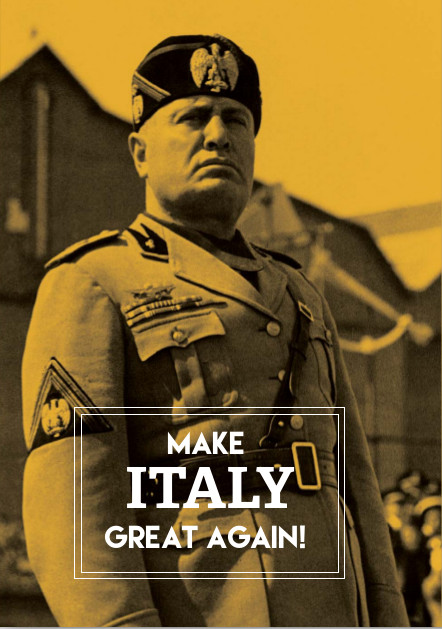
Mussolini promised to make Italy great again, to return to the golden age of the Roman Empire. In his view, this could only happen through a new cross-class national unity, a powerful state under the tutelage of a new elite of Übermenschen, and a march toward war. The first task of Mussolini’s fascism was the violent repression of workers’ and peasants’ movements in the wave of strikes and occupations after World War I, followed by the destruction of independent labor organizations once state power was attained.
The conditions of crisis that had led to Italian fascism soon gave rise to parallel movements in other countries. Perhaps because of the visibility of Nazism, in particular in US popular culture, the fascism of the 1930 serves as the primary reference point for analysis of the right-wing authoritarianism we face today. The fascists of Italy, Falangists of Spain, Nazis of Germany and their less well-known counterparts across the Western world believed their elite were destined to rule as autocrats because they had won out in the war of all against all — or must do so. The new elite would lead the nation in an imperialist project of gaining more spazio vitale (living space, or as the Nazis would call it, Lebensraum), seeking to displace British or American hegemony over the capitalist world-system and gain their people’s place under the sun.
Fascism cast culture as nature. It enforced and strengthened hierarchies based on ethnic or gender identities, claiming that some are meant to be masters and others to be slaves. Fascist governments replaced liberal guarantees of civil liberties and independent civil society organizations with a reimagining of the nation as a patriarchal family based on a racist conception of self and other, and corporatist organizations subordinated to the state. Corporatism here does not refer to corporations in the sense of a private company — it actually referred to the incorporation of bosses, workers and state bureaucrats in a single overarching organization that would supposedly reflect their common nationalist interests.
Fascists paid lip service to “socialism” for the Volksgemeinschaft (the Nazi concept of a racially pure “people’s community”), but they found their most willing partners in the project of rationalizing social, political and economic life in the bourgeoisie. Fascists in league with big capital subjected the working class to a redoubled divide-and-conquer strategy. Some sections of workers were included in the Volkgemeinschaft, bound up in corporatist schemes of labor-management compromise in exchange for loyalty necessary for war-making. But those who were not thought to belong to the “master race” were excluded from any form of representation or organization, and subjected to hyper-exploitation. Millions of Jews, Roma, eastern Europeans and others deemed Untermenschen were subjected to persecution, forced labor and genocide.
For the working class, fascism is the bloody assertion of heteronormative, patriarchal capitalism without democracy. The mythologization of hierarchy and the nation, intensified oppression based on ethnic and gender identities, glorification of war, and violent repression of worker and social movement organizations were hallmarks of all the historical regimes we call fascism — Hitler’s National Socialists, Franco’s Falangists and others. Today, most of these characteristics are also present in the new wave of right-wing regimes taking power in the West, as well as in India, Russia, Turkey and other authoritarian capitalist states of the periphery.
CONTINUITIES WITH LIBERALISM
As participants in this unfolding catastrophe, we tend to emphasize its discontinuities with the postwar liberal order that preceded the current unraveling. But the continuities are in fact more alarming, and more important to understand if we want to eradicate fascism root and branch, once and for all. Fascism is possible not in spite of liberal capitalism, but because of it. Both historically and philosophically, fascism is rooted in the same Western tradition as liberalism. Fascism continually reemerges because its seeds are incubated in the contradictions of capitalism.
The capital-F Fascism of authoritarian government is possible because of the lower case-f fascism that thrives in everyday life under capitalism. The centralized state was an invention of the bourgeoisie, a business innovation necessary to manage its affairs. Its bureaucracy stands ready-made for takeover by fascist thugs. Eichmann-like obedience necessary for the Fascist political project is inculcated by the state and corporate bureaucracy built by the bourgeoisie. Fascists march to war down roads that were paved by centuries of European colonialism and imperialism. The fascist discourse of national greatness is nothing more than a continuation of the nationalism of the imagined community constructed by the bourgeoisie.
The fascist enforcement of gender norms is a grotesque exaggeration of the patriarchal division of labor engendered by one form of capitalism. Fascism’s celebration of hierarchy and legitimation of class society is an extreme form of the twin lies of liberalism: “meritocracy” (barely distinguishable as a concept from Social Darwinism) and racist essentialism. Racism itself was born of the Western project of colonialism, and given a stamp of legitimacy by Enlightenment science that sought to taxonomize all things, plants, animals and people.
Liberalism promises to keep its Id in check with guarantees of the rights of man, but this was always a promise more often broken than kept. The majority of our planet’s inhabitants have already been living under a permanent state of exception. The test runs for the Nazi Holocaust were the late-Victorian holocausts of mass murder in Africa, and the genocidal colonization of the Americas and uncounted colonial massacres.
In the capitalist core, millions have long lived their lives as what Giorgio Agamben termed homo sacer — a term from ancient Rome signifying those who are deprived of rights by the state, and subject to extra-judicial violence by the George Zimmermans of the world. Across the capitalist core, immigrants and refugees live without the promise of any kind of liberal human rights, facing possible deportation in any interaction with the authorities.
Clintonite cosmopolitan liberalism claims that these oppressions are atavisms of the past, even though they are renewed every day. It promises to unite the world Benetton-like in a multicultural global market, where everyone is equally free to exploit and be exploited. Liberalism will occasionally apologize for its racism, sexism and colonial massacres, and may make affirmative action reforms to stabilize its rule and rationalize production, or in the case of the US government’s eventual concessions to the civil rights movement, to compete ideologically with the Soviet Union. But there is one place where it can never acknowledge illegitimate hierarchy: the workplace. And it is precisely here that the contradictions that propel the world toward fascism are rooted.