Page 63 of 99

Re: 'Not for public': the oil spill may be getting much worse

Posted: Thu Jun 24, 2010 5:51 pm
by Nordic
justdrew wrote:I don't know, was that filmed by someone who was used to being around that beach? if that was around tide coming in time, it could just be air bubbling up from the previously exposed dry sand and just the crashing of the wave mixes in a lot of air that can bubble around. not necessarily strange.


I agree, I don't see anything going on there. I don't get it.

Re: 'Not for public': the oil spill may be getting much worse

Posted: Thu Jun 24, 2010 6:40 pm
by brekin
http://act.credoaction.com/campaign/bp_turtles/?rc=lte

BP is burning endangered sea turtles alive.

News has just emerged from the Gulf Coast that BP is burning endangered sea turtles alive. 1

A boat captain who has been leading efforts to rescue the endangered turtles says BP has blocked his crews from entering the areas where the animals are trapped, effectively shutting down the rescue operation.

BP is using "controlled burns" to contain the oil spill. Shrimp boats create a corral of oil by dragging together fire-resistant booms and then lighting the enclosed "burn box" on fire. If turtles are not removed from the area before the fire is lit, they are literally burned alive.

The sea turtle most affected by the Gulf of Mexico oil spill is the Kemp's Ridley2 which is listed as endangered under the Endangered Species Act. Parties responsible for killing the endangered turtles are liable for criminal penalties that include prison and civil fines of up to $25,000 per violation.

As a result, BP perversely has a financial incentive to allow the endangered turtles to burn rather than allow rescue crews to cull them from the burn boxes before the containment fires are lit.

"They ran us out of there and then they shut us down, they would not let us get back in there," said turtle rescuer Mike Ellis in an interview with conservation biologist Catherine Craig that was posted on YouTube.com. 3

Tell BP: Stop burning endangered sea turtles alive. And spread the word.

Re: 'Not for public': the oil spill may be getting much worse

Posted: Thu Jun 24, 2010 6:58 pm
by happenstance

Re: 'Not for public': the oil spill may be getting much worse

Posted: Thu Jun 24, 2010 7:09 pm
by Laodicean
Nordic wrote:
justdrew wrote:I don't know, was that filmed by someone who was used to being around that beach? if that was around tide coming in time, it could just be air bubbling up from the previously exposed dry sand and just the crashing of the wave mixes in a lot of air that can bubble around. not necessarily strange.


I agree, I don't see anything going on there. I don't get it.


Man uses iPhone to record oil's havoc

Christina Leavenworth
Jun 24, 2010 5:16 p.m.

A Pensacola man has taken it upon himself to show the world what's really going on in Florida. He's had thousands of hits on his YouTube links.

Gregg Hall is a regular guy, born and raised in Pensacola. Now, he's using his cell phone to show the world Pensacola's beaches. Every morning and night he's recording what's out there.

"For me, it sickens me, it's like watching someone you love die. All I can do is tell people what's going on, I can't change it," said Hall.

Hall said it kills him how the beach is already so different than it was just a few days ago. His bare feet were covered in tarballs as everything washed in. He's been getting in the water to make sure he captures exactly what he sees.

"Its bubbling, fizzling. Definitely something in it. Who knows if its methane or whatever, something unnatural in it. You're not going to get those shots way up on the beach. You have to be in the water for people to see the fizzing and hear the popping," said Hall.

He hopes enough people watch the videos and it makes a difference.

Hall said he hopes it ultimately will help get more crews out to get the beach cleaned up.

http://wala.m0bl.net/w/main/story/11921582/

Re: 'Not for public': the oil spill may be getting much worse

Posted: Thu Jun 24, 2010 7:30 pm
by 82_28
"...we are expendable to these people..."

"...the gulf coast must be evacuated..."

Watch this guys! Excellent, infuriating speech here by Venice LA resident, Kindra Arnesen.


You thought it was unimaginably bad yesterday and the day before that and the day before that ad infinitum? It sounds even worse than that.

:shock: :shock: :shock: :shock:

Re: 'Not for public': the oil spill may be getting much worse

Posted: Thu Jun 24, 2010 7:39 pm
by 82_28
brekin wrote:http://act.credoaction.com/campaign/bp_turtles/?rc=lte

BP is burning endangered sea turtles alive.

News has just emerged from the Gulf Coast that BP is burning endangered sea turtles alive. 1

A boat captain who has been leading efforts to rescue the endangered turtles says BP has blocked his crews from entering the areas where the animals are trapped, effectively shutting down the rescue operation.

BP is using "controlled burns" to contain the oil spill. Shrimp boats create a corral of oil by dragging together fire-resistant booms and then lighting the enclosed "burn box" on fire. If turtles are not removed from the area before the fire is lit, they are literally burned alive.

The sea turtle most affected by the Gulf of Mexico oil spill is the Kemp's Ridley2 which is listed as endangered under the Endangered Species Act. Parties responsible for killing the endangered turtles are liable for criminal penalties that include prison and civil fines of up to $25,000 per violation.

As a result, BP perversely has a financial incentive to allow the endangered turtles to burn rather than allow rescue crews to cull them from the burn boxes before the containment fires are lit.

"They ran us out of there and then they shut us down, they would not let us get back in there," said turtle rescuer Mike Ellis in an interview with conservation biologist Catherine Craig that was posted on YouTube.com. 3

Tell BP: Stop burning endangered sea turtles alive. And spread the word.


Re: 'Not for public': the oil spill may be getting much worse

Posted: Thu Jun 24, 2010 8:10 pm
by 82_28
Anybody up for some good old fashioned logorreah? As someone who fancies himself as a writer every once in awhile, the audacity of this "BP writer's" soaring, thesaurus fused, embarrassingly arrogant prose will blow you away. This guy sucks so bad that I have no doubt were BP to hire about a million of these idiots and dropped them all into the GoM, the slick and leak would be over within a day. Two max. Behold:

Flying higher to get closer to spill response

Tom Seslar - 15 June 2010
In this new article in his series from the Gulf, Planet BP reporter Tom Seslar flies with an oil-spotting crew over the Gulf of Mexico and sees a deeper appreciation of the relationship between coast and sea and energy and nature than can be had on the ground or in a boat. It's an experience that he wishes everyone concerned about the crisis could have.
My appreciation for the enormity of the oil industry as an economic contributor in the Gulf of Mexico climbed sharply within minutes after I hitched a ride aboard a helicopter that BP had chartered for a couple of oil hunters.


Those hunters - armed with binoculars and a camera with a large telephoto lens - are women from a global emergency response company hired by BP. Their job is to spot oil that has escaped from the deepwater spill at the MC252 oil well off Louisiana.

A petty officer from the US Coast Guard is along too, his lap piled with maps and instruments to chart any patches of oil that the two women spot on the surface of the Gulf. Then, after we return to shore in a couple of hours, sea vessels will be dispatched to the charted locations to deal with the errant oil.
Two pilots and I make up the rest of the travelers on this early morning flight aboard a 14-seat Sikorsky 76. One of the pilots tells me the trip will be limited to about two hours because the copter carries only enough fuel for about 30 minutes beyond that point.

The panoramic flight above the Gulf is old hat for the pilots, the two oil spotters and the Coast Guard officer. They've been doing this again and again as part of the mammoth response to the April 20 oil spill.

But it's been years since I last visited an offshore oil platform, and that was in the Danish North Sea.

I'm filled with the wonderment of what's happening below our chopper only moments after it lifts off from an airport in Houma, La.

Because we're all wearing headgear to protect our hearing from the roar of long blades whirling overhead, it's strangely peaceful up here - just right for surrendering to some meditation.

For a while, the most noticeable aspect of the scenes below is the presence of huge onshore facilities to supply and support the offshore oilfields. These facilities alone employ thousands, just in this one region of the coast.

Soon the scenes below begin changing, almost as if there's a growing competition between land and water to dominate the landscape. Eventually, the marshes and swamps prevail - wetlands stridently pierced by canals, channels, harbors and causeways and even the last traces of roads that are gradually disappearing into the no-man's land between terra firma and the sea.

From high above, I can clearly see the importance and fragility of sandy wetlands held together by a delicate mesh of vegetation.
Finally, all traces of land recede behind us. But I now have a much better understanding of why the vast wetlands are so important to wildlife and as barriers against hurricanes. These natural fortifications are the shore's last line of defense.

Out here, flying at a height of up to 1,400 feet, the clouds are puffy white and brilliantly lighted but cast dark shadows on the wave-capped water below. We can see to the curvature of the earth (from 1400 feet?!?! Sorry bro .ed) and eventually pass over dozens of the more than 6,000 platforms that the oil and gas industry has built in US Gulf Coast waters during the past 60 some years.

That relatively brief span of development is remarkable. Although there were some primitive attempts at offshore production as far back as the 1890s off Ohio and California, the really big oil boom for the Gulf of Mexico didn't begin until after World War II.

Yet the Gulf now supplies roughly one-fourth of the US oil production and one-fifth of its natural gas.
It's likely there will be no alternative to the Gulf as a key source of American energy for decades to come. That's why it is so essential to protect it. Even the most severe critics of the oil industry tend to accept that reality.

It wasn't always so clear. In the early years, there were lots of questions about drilling in the Gulf - often about how revenues would be divided among the federal and state governments.

Back in 1953, screen actor James Stewart starred in Thunder Bay, the first Hollywood look at the offshore oil business. It basically was an updated twist on the plot that had served up hundreds of western movies. Instead of cowboys vs. sheepherders or grain farmers, now it was Louisiana shrimpers vs. oilmen fighting over the same watery territory.

Stewart, playing an outsider, shows up in town determined to build a storm-proof oil platform. Initially, he is distrusted and opposed by tradition-bound locals who think he will destroy their shrimping businesses and cultural traditions.

After lots of fighting, romancing and hurricane survival, the Stewart character delivers a very happy ending by both striking oil and discovering an abundant new shrimp bed.

In real life, acceptance and accommodation require longer than a two-hour movie.

Thunder Bay was filmed in and near Morgan City, La., where an annual shrimp festival had begun in 1936.

Thirty-one years later, in 1967, the by-then huge festival at last adopted a new name - the Louisiana Shrimp & Petroleum Festival - in recognition of the fact that oil had become a major, permanent part of the region's culture and economy.

The festival, slated this year for Sept. 6-10, says it symbolizes "the unique way in which these two seemingly different industries work hand-in-hand culturally and environmentally."

Not surprisingly, oil's immense role in that big picture seems easier to grasp up here during two hours in a helicopter at 1,400 feet. I wish everyone could share the experience.

Reporter's note: For allowing me to hitch a ride on the helicopter, my thanks go to Brian Verret, aviation coordinator for BP at Lafayette, La.


I mean, who the fuck writes like that and under these circumstances and for this company?!?!?! Words don't even begin to describe how badly I now hate a man I have never met -- he used all the good words up to describe the beauty of the Gulf of Mexico he's being paid to write, by the company that destroyed the very thing he says "oh boy, you just can't imagine the beauty from up here. I have never read anything more caustically absurd in my entire life. Along with BP's prosecution, this vapid writer must be sentenced to gargling 6oz of crude for the rest of his miserable life. FUCK!

In my class, kid gets a big fat fucking F.

http://www.bp.com/genericarticle.do?cat ... Id=7063021

Re: 'Not for public': the oil spill may be getting much worse

Posted: Thu Jun 24, 2010 8:21 pm
by Nordic
The things people do in the name of "having a job with a major corporation" never ceases to astound me.

Pure amorality.

As far as the turtles, I wish somebody would gang up and use some force to rescue those damn things. BP isn't God. BP isn't even America. BP is just a criminal bunch of corporate fucktards who have destroyed OUR gulf of Mexico. The turtles belong to the world, they are NOT BP's to slaughter so they can save five minutes a day in their oil burning.

When it comes to saving our environment so we all don't fucking DIE, I think using force is entirely justified.

Because it actually is about self-preservation.

Re: 'Not for public': the oil spill may be getting much worse

Posted: Thu Jun 24, 2010 8:33 pm
by 2012 Countdown
re: oil rain video- That location is about 10-20 miles away, and no oil rain here. I can confirm it rained that afternoon, but thats about it. I didn't see any here.
Did some looking, and did find this article-
Raining oil in Louisiana? Video suggests Gulf oil spill causing crude rain
Raining oil? A video purports to show the aftermath of an oily rain that has left a rainbow sheen on the streets of River Ridge, Louisiana. The EPA says that an oily rain is highly unlikely.

Raining oil in Louisiana? An unsettling – and unverified – amateur video shows what appears to be the aftermath of an oily rain in Louisiana, some 45 miles inland from the Gulf of Mexico.
It's unclear from the video whether the oily sheen seen on the ground really fell from the sky. Crude oil normally doesn't evaporate, but some are speculating that oil mixed with Corexit 9500, the dispersant that BP is using on the ever-growing slick, could take to the air.

The US Environmental Protection Agency has issued statements saying that the agency "has no data, information or scientific basis that suggests that oil mixed with dispersant could possibly evaporate from the Gulf into the water cycle."

The auto blog Jalopnik dug up a 2003 study that shows that oil on the open ocean could evaporate under the right conditions. And it's unclear how the Corexit 9500 dispersant affects evaporation.

If it were raining Corexit 9500 in River Ridge, that would be very bad news. Calling the dispersant unnecessarily toxic, the EPA has ordered BP to stop spraying it on the slick, an order that the oil company has so far ignored.

Is the video for real? For now, skepticism is warranted. Have a look for yourself:

http://www.csmonitor.com/Science/2010/0 ... Stories%29

======

Second video, I found this explanation believable:

Normally, when the tide recedes, the sand dries out and water is replaced by air. When the tide comes back in, each wave displaces a little bit of the air in the sand, soaking it as the water rises. Tides on Earth have been repeating this process twice daily every day for the past 4 billion years.

When you inject oil into the sand, the oil acts as both a glue and a water repellent. The oil comes in on one tide and soaks the beaches. The tide recedes, and the water slowly drains out of the sand, replaced by air. The tide comes back in again, BUT the oil changes things. The oil holds the sand together and repels some of the water, trapping much of that newly introduced air beneath the water line. Water pressure will eventually force it all out and start the process over again, but it causes this "bubbling" or "boiling" action behind the water line.


=====

America Can't Solve Crises Because It's a Company-Owned Town
by BAR executive editor Glen Ford
“The overlapping American mega-crises of Katrina, the Crash of 2008, the Great Gusher in the Gulf are 'both the products and the illuminators of the wholly corrupt relationship' between Capital and government.”
---
The United States can no longer engage effectively in “nation-building” in the one place on Earth it has a right and duty to do so: at home. These are the lessons of the 2010 Gulf oil catastrophe, the 2008 financial meltdown and the 2005 Katrina horror – disasters that history will rightfully conflate as symptomatic of the fundamental crisis of the rule of Capital. The U.S. has become a company town of speculative and extraction enterprises whose social and physical geography the rulers relentlessly appropriate, monetize and despoil - all with obscene abandon.
--
We are living in the late stages of overwhelming dominance (hegemony) of finance capital – and, secondarily, the oil and gas money-machines. It is a period characterized by destruction of the domestic manufacturing base and frenzied predation of the public sector. The mission of Capital’s servants in government is, therefore, to assist Wall Street and the energy sector in the fastest possible conversion of natural and social resources to private exploitation.
Those among the public and media that still harbor the illusion that government is there to serve the people, despite seeing so much evidence to the contrary, speak of a national “malaise,” a loss of purpose, a temporary failure or flaw in the national character. What nonsense! What we are witnessing is the destructive behavior of a predatory class that sees its future in trillion-dollar derivative bets; commodification of every conceivable resource (food, water, air?) and manipulation of every commodity market; privatization of every possible state function (schools, safety nets); constant expansion of the “market” in the maintenance of empire; and the “primitive accumulation” of the spoils of war.
--
FULL-
http://blackagendareport.com/?q=content ... owned-town

======

Galleries and museums face summer of protest over BP arts sponsorship
Prestigious institutions defend links with oil firm as artists and green activists plan action
John Vidal and Owen Bowcott
guardian.co.uk, Thursday 24 June 2010 20.38 BST
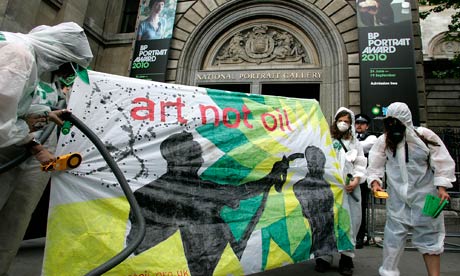
Image
‘Greenwash Guerrillas’ protesting outside the National Portrait Gallery. They want the gallery to stop accepting sponsorship money from BP. Photograph: Akira Suemori/AP

The summer season of events at Britain's most prestigious galleries and museums will be picketed by artists and green groups intent on portraying BP's arts sponsorship as a toxic brand.

Protests are planned next Monday by an eco-alliance styling itself "Good Crude Britannia" at Tate Britain's celebration of its 20-year association with the international oil conglomerate.

Climate change activists, artists and musicians opposed to the fossil fuel industry are determined to highlight BP's link to the arts in the context of the company's international embarrassment over the continuing oil spill in the Gulf of Mexico.

But the main recipients of BP's corporate largesse – the Royal Opera House, Tate Galleries, British Museum and the National Portrait Gallery – today issued a joint statement defending the connection and signalling their determination to preserve the commercial relationship.

The calls for cultural institutions to distance themselves from the oil industry comes at a time when government spending on the arts is about to be slashed amid efforts to cut public debt.

Many of Europe's leading artists, donors and cultural supporters are expected to be greeted at the glittering annual Tate summer party by Lord Brown of Madingley, chair of the Tate and former head of BP.

The planned demonstration next Monday follows protests this week by a group of artists calling themselves the Greenwash Guerrillas, who distributed leaflets outside the National Portrait Gallery at a BP-sponsored arts event. Greenpeace campaigners followed up with an "alternative exhibition" at a private viewing at the gallery.

----

In a separate development, musicians including Lady Gaga, Korn, Disturbed, Godsmack, Creed, and the Backstreet Boys said they planned to boycott BP on their national tours this year.

"It is absurd that the Tate should be sponsored by a company that is as irresponsible and polluting as BP," said Matthew Herbert, an electronic artist and composer who will headline the jazz stage at Glastonbury this weekend.

The oil industry has been a target for artists and activists for many years. Shell was widely boycotted in the 1990s for its involvement in the Nigerian government's decision to hang the writer Ken Saro-Wiwa.

Last month a group called Liberate Tate entered the gallery's main turbine hall and released dozens of black balloons attached to dead fish in protest against the Gulf oil spill. Gallery staff had to shoot the balloons down with air rifles.

The press opening of the BP Portrait Awards was gatecrashed this week by a film crew from the Don't Panic collective who distributed wine glasses filled with thick black liquid symbolising the spill.

---

Maurice Davies, of the Museums Association, which represents UK galleries and museums, doubted that any institution would immediately disown BP given the firm's record of sustained commitment to the arts. "Museums make judgements about who is a suitable sponsor," he said. "No one would take [money] from tobacco firms or arms companies. BP has a long and distinguished record of sponsorship. No one will rush to judgment on a company that has been a loyal supporter for such a long time. I don't hear a national clamour for BP petrol stations to be shut down."


ENTIRE-
http://www.guardian.co.uk/environment/2 ... ponsorship
====

Note on above, last paragraph posted- The right or wrong of funding aside, the man is spinning with BP talking points. The new operations mgr. for BP used that exact term 'rush to judgement' in regard to BP. Second point, in regard to gas stations. He obviously hasn't been stateside lately.

Re: 'Not for public': the oil spill may be getting much worse

Posted: Thu Jun 24, 2010 8:56 pm
by 2012 Countdown
82_28 wrote:"...we are expendable to these people..."

"...the gulf coast must be evacuated..."

Watch this guys! Excellent, infuriating speech here by Venice LA resident, Kindra Arnesen.


You thought it was unimaginably bad yesterday and the day before that and the day before that ad infinitum? It sounds even worse than that.

:shock: :shock: :shock: :shock:


Thank you for that. This is a very brave woman. I agree, excellent.
If I were in lower coastal areas, I would be making my way north, no doubt.
I recommend a watch as well.

Re: 'Not for public': the oil spill may be getting much worse

Posted: Thu Jun 24, 2010 9:12 pm
by Simulist
Thanks for posting that 82_28.

There might just be an armed insurrection down there before the end of the summer.

Re: 'Not for public': the oil spill may be getting much worse

Posted: Thu Jun 24, 2010 9:14 pm
by Laodicean
I certainly hope so.

Re: 'Not for public': the oil spill may be getting much worse

Posted: Thu Jun 24, 2010 10:29 pm
by Jeff

Re: 'Not for public': the oil spill may be getting much worse

Posted: Thu Jun 24, 2010 11:00 pm
by justdrew
Dereliction of Duty
Why is the National Guard MIA in the Gulf? Blame governors Jindal, Barbour, Riley and Crist.

By Tim Dickinson
Jun 24, 2010 7:27 PM EDT

Nearly 16,000 highly trained, well-equipped war fighters are sitting on the sidelines in the battle for the Gulf Coast — and the fault lies not with the federal government but with the governors of the affected states.

Bobby Jindal, Haley Barbour, Bob Riley and Charlie Crist are respectively the commanders in chief for the National Guard in Louisiana, Mississippi, Alabama and Florida. It is their responsibility to direct the troops at their disposal. And quite an army it is: As of May 3rd, the Pentagon has authorized 17,500 guardsmen to respond to the BP spill — free of charge to the states. The federal government will front the costs, which will ultimately be passed on to the oil giant.

But more than six weeks later, the region's governors have deployed just 1,585 guardsmen — less than ten percent of this oil-fighting force — to the frontlines. And they are sorely needed: More than 160 miles of coastline in these four states are currently inundated with BP crude. If all of these soldiers were deployed, it would represent a nearly 50 percent surge over the 35,000 disaster responders currently in the Gulf.

According to National Incident Commander Admiral Thad Allen, the responsibility for the delay rests directly with the Gulf governors: "It’s pretty much up to the governors, and how they want to deploy the National Guard," Allen said in response to a question from Rolling Stone during a press conference on June 23. The governors, he said, have to pre-clear the work they're assigning to the National Guard with the federal response team, but this is a formality. "We have not turned down any requests thus far," said Allen.

In comments that received little notice at the time, President Obama appealed directly to the region's governors to avail themselves of the troops at their disposal during his Oval Office address on June 15: "These servicemen and women are ready to help stop the oil from coming ashore, they’re ready to help clean the beaches, train response workers, or even help with processing claims — and I urge the governors in the affected states to activate these troops as soon as possible."

The ongoing failure to deploy the National Guard is particularly striking in the case Jindal, a likely contender for the GOP's 2012 presidential nomination who has emerged as one of the most strident critics of the Obama administration's cleanup response. The Louisiana governor has repeatedly railed against the administration for not providing enough resources to adequately wage what the governor is calling a War Against Oil. "We need the federal government to understand that we are in a war to protect our way of life," Jindal said on June 16. "What we want is results."

But as commander in chief of Louisiana, Jindal has only himself to blame for leaving more than 80 percent of the troops available to the state idle. As of June 23rd, only 1,045 Louisiana guardsmen out of an authorized force of 6,000 had been activated, according to data provided to Rolling Stone by the Department of Homeland Security.

Perhaps more shocking, Jindal's record is actually the best in the region. In Alabama, where Riley recently called on his state's residents to join him in a Day of Prayer for a solution to the Gulf disaster, the GOP governor has activated just 439 of the 3,000 National Guard troops authorized to assist in the cleanup effort. In Mississippi, where Republican Haley Barbour has repeatedly downplayed the scope of the disaster — calling the presence of tar balls on the state's beaches "no big deal" — the governor has deployed just 64 out of 6,000 troops at his disposal. In Florida, meanwhile, independent governor Crist has 2,500 troops available. He's activated only 37.

Calls to each of the governors' press secretaries seeking explanation for the delay in deployment were not returned.

"Mommy get the oil off!"

Posted: Fri Jun 25, 2010 11:46 am
by winsomecowboy2
Exposure to crude oil may irritate the eyes, skin, and respiratory system. It may cause dizziness, rapid heart rate, headaches, confusion, and anemia. Prolonged skin contact with crude oil may cause skin reddening, edema, and burning of the skin. Children should not come in contact with crude oil.

http://www.youtube.com/watch?v=1QwsCHd7Lcg