Moderators: Elvis, DrVolin, Jeff
 by anotherdrew » Wed Mar 22, 2006 10:04 pm
by Rigorous Intuition » Thu Mar 23, 2006 1:32 am
by isachar » Thu Mar 23, 2006 2:02 am
by anotherdrew » Thu Mar 23, 2006 2:07 am
by MinM » Sat Mar 28, 2009 8:18 pm
Rigorous Intuition wrote:A CBS reporter testified he'd seen a security guard firing shots in the pantry. Kennedy pulled off Caesar's clip-on tie as he fell.<br><br>Caesar's said, "Just because I don’t like the Democrats, that doesn’t mean I go around shooting them." <p></p><i></i>


by MinM » Thu Oct 27, 2011 1:11 pm
John Simkin wrote:Jim Yoder, a former work colleague, claimed that Cesar appeared to have no specific job at Lockheed and had “floating” assignments and often worked in off-limits areas which only special personnel had access to. According to Yoder, these areas were under the control of the CIA.
Yoder also gave Turner and Christian details about the selling of the gun. Although he did not mention the assassination of Robert Kennedy he did say “something about going to the assistance of an officer and firing his gun.” He added that “there might be a little problem over that.” (96)
William Klaber and Philip H. Melanson point out in their book, Shadow Play: The Untold Story of the Robert F. Kennedy Assassination that the LAPD “failed to clear up even elementary contradictions in the security guard’s story”. This included “inconsistencies regarding his actions during the shooting”. Nor did they check his gun the night of the murder to see if it had been fired or even what calibre it was.” Even more remarkable was that he was never called as a witness at the trial of Sirhan. (97)
An article by Dave Smith in the Los Angeles Times in 1971 explained why Cesar was not put on the stand. Smith quoted an unnamed “official” who stated that the reason why he was not used in court was because of inconsistencies in his story: “He told conflicting accounts and it seemed obvious he had nothing to tell us.” Smith went on to argue that the official thought that “he was trying to inject himself into a sensational case he knew little about.” Of course it is ridiculous to claim that Cesar was trying to “inject himself” into the story. He was at the scene of the crime and given his close proximity to Kennedy he was a vital witness that should have appeared in court. (98)
Jamie Scott Enyart was another witness who was not called to testify in court. Enyart, a high-school student, was taking photographs of Robert Kennedy as he was walking from the ballroom of the Ambassador Hotel to the Colonial Room where the press conference was due to take place. Enyart was standing slightly behind Kennedy when the shooting began and snapped as fast as he could. As Enyart was leaving the pantry, two LAPD officers accosted him at gunpoint and seized his film. Later, he was told by Detective Dudley Varney that the photographs were needed as evidence in the Sirhan trial. The photographs were not presented as evidence but the court ordered that all evidential materials had to be sealed for twenty years.
In 1988 Enyart requested that his photographs should be returned. At first the State Archives claimed they could not find them and that they must have been destroyed by mistake. Enyart filed a lawsuit which finally came to trial in 1996. During the trial the Los Angeles city attorney announced that the photos had been found in its Sacramento office and would be brought to the courthouse by the courier retained by the State Archives. The following day it was announced that the courier’s briefcase, that contained the photographs, had been stolen from the car he rented at the airport. The photographs have never been recovered and the jury subsequently awarded Scott Enyart $450,000 in damages. (99)
One possible connection between the deaths of John Kennedy, Martin Luther King and Robert Kennedy is that they were all involved in a campaign to bring an end to the Vietnam War. One man who does believe there might be a connection is Edward Kennedy. NBC television correspondent Sander Vanocur, travelled with Edward Kennedy on the aircraft that brought back his Robert’s body to New York. Vanocur reported Kennedy as saying that “faceless men” (Lee Harvey Oswald, James Earl Ray and Sirhan Sirhan) had been charged with the killing of his brothers and Dr. Martin Luther King. Kennedy added: “Always faceless men with no apparent motive. There has to be more to it.” (100)
Richard N. Goodwin is another who refuses to believe the lone-gunman theory. Goodwin was John Kennedy’s special counsel. In a review of Edward J. Epstein’s book, Inquest: The Warren Commission and the Establishment of Truth, Goodwin called for the setting up of an “independent group” to look again at the Kennedy assassination. (101) The following day the New York Times commented that “Mr. Goodwin is the first member of the President’s inner circle to suggest publicly than an official re-examination be made of the Warren Report.” (102)
In his book, Remembering America: A Voice From the Sixties, Goodwin explained the significance of the deaths of John Kennedy, Martin Luther King and Robert Kennedy. “The sixties… was a time when most Americans felt the future could be bent to their wills. The large public events of the time cut deeply into our personal lives: the civil rights movement, the sit-ins, the beginnings of the women’s movement, the War on Poverty. It was the time of the New Frontier and the Great Society and the dream of Martin Luther King. And then, the experiment barely begun, it collapsed in the voracious terrain of Vietnam. The sixties, so filled with promise, came to an end. Not a failure, but abandoned. Never given a chance.” (103)
The Vietnam War continued after the deaths of Martin Luther King and Robert Kennedy. In December, 1968, Shackley became Chief of Station in Vietnam and took over Phung Hoang (Operation Phoenix). In his autobiography, Shackley denied he was the “godfather of Phung Hoang”. In fact, Shackley claims he did not approve of this program that involved the killing of non-combatant Vietnamese civilians suspected of collaborating with the National Liberation Front. However, according to Shackley, the Director of the CIA, Richard Helms, insisted that “we are not free agents” and that the CIA rather than the United States Army had to run Operation Phoenix. (104) Other members of Operation 40 in Vietnam at this time included Thomas Clines, David Morales, Carl Jenkins, Rip Robertson and Félix Rodríguez. Two other members of the “Secret Team” in Vietnam with Shackley were John Singlaub and Richard Secord.
Shackley claims that Phoenix was set up in November 1966. This was over two years before Shackley arrived in Vietnam. This is true. However, it was Shackley who turned it into an “assassination unit”. Tucker Gouglemann and William Buckley supervised the program. (105) Edith Holleman and Andrew Love claimed that it was Shackley and Clines who played the most important role in Operation Phoenix. The purposely targeted “South Vietnamese town mayors, clerks, teachers, business professionals and educated persons” who they considered were contributing to the “actual or potential civilian infrastructure of the NLF.” (106)
Fred Branfman quotes a U.S. State Department document in July, 1969, that said: “The target for 1969 calls for the elimination of 1800 VCI per month.” K. Barton Osborn, a U.S. Phoenix agent, testified to Congress, that in a year and a half of active service, “I never knew an individual to be detained as a VC suspect who ever lived through the interrogation”. He added: “This was the mentality… It became a sterile depersonalized murder program.” He described of how he inserted a “six-inch dowel into the ear canal of one of my detainee’s ears and the tapping through the brain until he died.” (107)
The Saigon Ministry of Information admitted that 40,994 were murdered as part of Operation Phoenix. (108) William Colby disagrees, when he testified before Congress he claimed that Phoenix was only responsible for the death of 20,587 persons. (109) Although he admitted to some “illegal killings”, Colby rejected a suggestion by Senator J. William Fulbright that it was “a program for the assassination of civilian leaders”. (110) As Branfman has pointed out: “This number, proportionate to population, would total over a three-year period, were Phoenix in practice in the United States. (111)
Notes
1. Gaeton Fonzi, The Last Investigation, 1993 (pages 366-371)
2. Warren Hinckle & William Turner, Deadly Secrets, 1992 (page 53)
3. Senate Report, Alleged Assassination Plots Involving Foreign Leaders, 1975 (page 92)
4. Fabian Escalante, CIA Covert Operations 1959-1962: The Cuba Project, 2004 (pages 42 and 43)
5. Common Cause Magazine (4th March, 1990)
6. The Nation magazine (13th August, 1988)
7. Reinaldo Taladrid and Lazaro Baredo, Granma (16th January, 2006)
8. Daniel Hopsicker, Barry and the Boys: The CIA, the Mob and America’s Secret History, 2001 (page 170)
9. Webster Griffin Tarpley and Anton Chaitkin, George Bush: The Unauthorized Biography, 2004 (page 173)
10. Reinaldo Taladrid and Lazaro Baredo, Granma (16th January, 2006).
11. Deposition of Gene Wheaton (1-3, 7-8 March, 1988). Wheaton gave evidence against Chi Chi Quintero during the Iran-Contra investigation.
12. Fabian Escalante, CIA Covert Operations 1959-1962: The Cuba Project, 2004 (pages 42 and 43)
13. Daniel Hopsicker, Mad Cow Morning News (24th August, 2004)
14. Jean-Guy Allard, Granma (22nd May, 2005)
15. Arthur Schlesinger, memo to Richard Goodwin (9th June, 1961)
16. Jean-Guy Allard, Granma (22nd May, 2005)
17. Fabian Escalante, Centre for International Policy, Nassau, Bahamas (7th December, 1995)
18. Larry Hancock, Someone Would Have Talked, 2003 (page 17)
19. Anthony Summers, The Kennedy Conspiracy, 2002 (page 328)
20. Anthony and Robbyn Summers, The Ghosts of November, Vanity Fair (December, 1994)
21. Anthony Summers, The Kennedy Conspiracy, 2002 (page 326)
22. Gaeton Fonzi, The Last Investigation, 1993 (pages 380-390)
23. Anne Buttimer, Assassination Records Review Board Report (12th July, 1995)
24. Gaeton Fonzi, The Last Investigation, 1993 (pages 83-100)
25. Paul Meskil, New York Daily News (3rd November, 1977)
26. Gaeton Fonzi, The Last Investigation, 1993 (pages 101-107)
27. Victor Marchetti, Spotlight (14th August, 1978)
28. Mark Lane, Plausible Denial, 1991 (pages 289-310)
29. Anthony Summers, The Kennedy Conspiracy, 2002 (page 371)
30. Evan Thomas, The Very Best Men, 1995 (page 28)
31. Ted Shackley, Spymaster: My Life in the CIA, 2005 (page 103)
32. David Kaiser, American Tragedy: Kennedy, Johnson and the Origins of the Vietnam War, 2000 (page 198)
33. David Corn, Blond Ghost: Ted Shackley and the CIA Crusades, 1994 (page 129)
34. Alfred W. McCoy, The Politics of Heroin: CIA Complicity in the Global Drug Trade, 1991 (page 19)
35. Christopher Robbins, The Ravens: The Men Who Flew in America’s Secret War in Laos, 1987 (page 125)
36. David Corn, Blond Ghost: Ted Shackley and the CIA Crusades, 1994 (page 138)
37. Joel Bainerman, The Crimes of a President, 1992 (page 67)
38. Edith Holleman and Andrew Love, Inside the Shadow Government, 1988 (pages 14-15)
39. Felix I. Rodriguez and John Weisman, Shadow Warrior: The CIA Hero of a Hundred Unknown Battles, 1989 (pages 9-10)
40. Alfred W. McCoy, The Politics of Heroin in Southeast Asia, 1972 (page 278)
41. Edith Holleman and Andrew Love, Inside the Shadow Government, 1988 (page 13)
42. John Prados, Presidents’ Secret Wars, 1986 (page 282)
43. Joel Bainerman, The Crimes of a President, 1992 (page 68)
44. Martin Luther King, speech in New York (4th April, 1967)
45. William F. Pepper, The Children of Vietnam, Ramparts Magazine (January, 1967)
46. Clayborne Carson (editor), Autobiography of Martin Luther King (1998)
47. William F. Pepper, Orders to Kill, 1995 (page 4)
48. William F. Pepper, An Act of State: The Execution of Martin Luther King, 2003 (page 4)
49. William C. Sullivan, The Bureau: My Thirty Years in Hoover’s FBI, 1979 (page 147)
50. William F. Pepper, Orders to Kill, 1995 (page 4)
51. Anthony Summers, The Secret Life of J. Edgar Hoover, 1993 (page 352)
52. William C. Sullivan, The Bureau: My Thirty Years in Hoover’s FBI, 1979 (pages 135-137)
53. William C. Sullivan, memo ‘King’ (December, 1963)
54. William F. Pepper, Orders to Kill, 1995 (pages 464)
55. Anthony Summers, The Secret Life of J. Edgar Hoover, 1993 (page 355)
56. Jeff Shesol, Mutual Contempt: Lyndon Johnson, Robert Kennedy and the Feud That Defined a Decade, 1997 (page 351)
57. Robert Kennedy, speech in the Senate (2nd March, 1967)
58. Robert Kennedy, interview with Tom Wicker, Face the Nation (26th November, 1967)
59. William F. Pepper, Orders to Kill, 1995 (pages 412-413)
60. Edwin O. Guthman, We Band of Brothers: A Memoir of Robert F. Kennedy, 1971 (page 326)
61. William F. Pepper, An Act of State: The Execution of Martin Luther King, 2003 (page 7)
62. Robert Kennedy, speech, Washington (16th March, 1968)
63. Richard D. Mahoney, Sons & Brothers: The Days of Jack and Bobby Kennedy, 1999 (page 342)
64. Arthur Schlesinger, Robert Kennedy and His Times, 1980 (page 921)
65. William Turner, Rearview Mirror, 2001 (page 233)
66. William F. Pepper, Orders to Kill, 1995 (pages 11-16)
67. James W. Douglass, The King Conspiracy Exposed in Memphis, included in The Assassinations, 2003 (page 494-95)
68. William F. Pepper, Orders to Kill, 1995 (page 21)
69. Richard D. Mahoney, Sons & Brothers: The Days of Jack and Bobby Kennedy, 1999 (page 357)
70. Martin Luther King, speech at the Mason Temple, Memphis (3rd April, 1964)
71. Anthony Summers, The Secret Life of J. Edgar Hoover, 1993 (page 363)
72. James W. Douglass, The King Conspiracy Exposed in Memphis, included in The Assassinations, 2003 (page 495)
73. William F. Pepper, Orders to Kill, 1995 (pages 311-492)
74. William C. Sullivan, The Bureau: My Thirty Years in Hoover’s FBI, 1979 (pages 145)
75. Anthony Summers, The Secret Life of J. Edgar Hoover, 1993 (page 363)
76. Senate Report, Military Surveillance of Civilian Politics, 1972 (page 21)
77. William F. Pepper, An Act of State: The Execution of Martin Luther King, 2003 (page 205-06)
78. Senate Report, Military Surveillance of Civilian Politics, 1972 (page 111)
79. Robert F. Kennedy, speech in Indianapolis (4th April, 1968)
80. Robert F. Kennedy, speech at the Indiana University Medical Center (26th April, 1968)
81. Richard D. Mahoney, Sons & Brothers: The Days of Jack and Bobby Kennedy, 1999 (page 368)
82. Robert Blair Kaiser, RFK Must Die! A History of the Robert Kennedy Association and Its Aftermath, 1970 (page 469)
83. Jean Stein and George Plimpton, American Journey: The Times of Robert Kennedy, 1970 (page 334)
84. Lisa Pease, Sirhan Says “I Am Innocent”, included in The Assassinations, 2003 (page 535)
85. Robert F. Kennedy, speech at the Ambassador Hotel, Los Angeles (4th June, 1968)
86. William Turner and Jonn Christian, The Assassination of Robert F. Kennedy: The Conspiracy and Coverup, 1993 (page 162)
87. Dan Moldea, Regardie’s Magazine, June, 1987
88. Dan E. Moldea, The Killing of Robert F. Kennedy, 1995 (page 146)
89. Karl Uecker, written statement given to Allard K. Lowenstein in Dusseldorf, Germany (20th February, 1975)
90. William Turner, Rearview Mirror, 2001 (page 244)
91. William Turner and Jonn Christian, The Assassination of Robert F. Kennedy: The Conspiracy and Coverup, 1993 (page 166)
92. Robert Blair Kaiser, RFK Must Die, 1970 (page 25)
93. Lisa Pease, Sirhan Says “I Am Innocent”, included in The Assassinations, 2003 (page 534)
94. William Turner, Rearview Mirror, 2001 (page 244)
95. William Klaber and Philip H. Melanson, Shadow Play: The Untold Story of the Robert F. Kennedy Assassination, 1997 (page 132)
96. William Turner and Jonn Christian, The Assassination of Robert F. Kennedy: The Conspiracy and Coverup, 1993 (page 166)
97. William Klaber and Philip H. Melanson, Shadow Play: The Untold Story of the Robert F. Kennedy Assassination, 1997 (page 132)
98. Dave Smith, Los Angeles Times (16th August, 1971)
99. William Turner, Rearview Mirror, 2001 (page 246)
100. William Turner and Jonn Christian, The Assassination of Robert F. Kennedy: The Conspiracy and Coverup, 1993 (page xxxiii)
101. Richard N. Goodwin, Book Week (23rd July, 1966)
102. New York Times (24th July, 1966)
103. Richard N. Goodwin, Remembering America: A Voice from the Sixties, 1988 (page 543)
104. Ted Shackley, Spymaster: My Life in the CIA, 2005 (pages 233-234)
105. David Corn, Blond Ghost: Ted Shackley and the CIA Crusades, 1994 (page 194)
106. Edith Holleman and Andrew Love, Inside the Shadow Government, 1988 (page 13)
107. Fred Branfman, South Vietnam’s Police and Prison System, included in Uncloaking the CIA, edited by Howard Frazier, 1978 (page 113)
108. House Committee on Government Operations, 1971 (page 321)
109. Republic of Vietnam, Ministry of Information, Vietnam 1967-71: Towards Peace and Prosperity, 1971 (page 52)
110. House Committee on Government Operations, 1971 (page 183)
111. Alfred W. McCoy, A Question of Torture, 2006 (page 67)
112. Fred Branfman, South Vietnam’s Police and Prison System, 1978 (page 114)
http://educationforum.ipbhost.com/index ... topic=5799
by sunny » Sun Oct 30, 2011 1:11 pm
by MinM » Wed Feb 01, 2012 5:21 pm
49. William C. Sullivan, The Bureau: My Thirty Years in Hoover’s FBI, 1979 (page 147)
52. William C. Sullivan, The Bureau: My Thirty Years in Hoover’s FBI, 1979 (pages 135-137)
53. William C. Sullivan, memo ‘King’ (December, 1963)
74. William C. Sullivan, The Bureau: My Thirty Years in Hoover’s FBI, 1979 (pages 145)
http://www.rigorousintuition.ca/board2/viewtopic.php?p=398804#p398804Pottersville wrote:FBI Agents who knew a great deal about JFK's assassination/coup, and were scheduled to testify before the House Select Committee on Assassinations in 1977:
William Sullivan, third in command at FBI, died in "hunting accident"
Louis Nicholas, special assistant to J. Edgar Hoover and Hoover's liaison with the Warren Commission;
Alan H. Belmont, special assistant to Hoover;
James Cadigan, document expert with access to documents that related to death of John F. Kennedy;
J. M. English, former head of FBI Forensic Sciences Laboratory where Oswald's rifle and pistol were tested;
Donald Kaylor, FBI fingerprint chemist who examined prints found at the assassination scene.
Hale Boggs, Warren Commission member who did not agree with the findings, died in small plane "crash"
John Lennon who, as his son Sean said in New Yorker magazine, was a “counter-cultural revolutionary” who the American government could not ignore. He said: “He was dangerous to the government. If he had said, ‘Bomb the White House tomorrow’, there would have been 10,000 people who would have done it. These pacifist revolutionaries are historically killed by the government. Anybody who thinks that Mark Chapman (who shot Lennon outside his New York apartment in 1980) was just some crazy guy who killed my dad for his personal interests, is insane. Or very naive. Or hasn’t thought about it clearly. It was in the best interests of the United States to have my dad killed. Definitely. And, you know, that worked against them because, once he died, his powers grew . . . They didn’t get what they wanted.”
Bob Marley, definite political assassination (by "cancer") who survived one previous assassination attempt when gunmen invaded his home and shot everyone
^^^Edited to add links to podcasts and other relevant articles^^^
rigorousintuition.ca :: I Have a DreamWorksClint Eastwood’s Dishonest ‘J. Edgar’ | Consortiumnews
November 30, 2011
Much of the controversy around Clint Eastwood’s J. Edgar has swirled around screenwriter Lance Black’s depiction of the late FBI Director J. Edgar Hoover as a closeted gay man, since Black is a gay writer-director and most of his previous projects featured gay themes.
But even more important in any critical analysis of the movie is Eastwood’s work as director. Because that informs us about why the American film business has come to a point when a mediocre, compromised and dishonest production like this much ballyhooed film gets praised for “being candid” about one of the worst Americans of the 20th Century...
Director of Domestic Intelligence William Sullivan was the only man in the executive offices who ever stood up to Hoover. About a year or two before Hoover died, Sullivan wrote a series of memos criticizing Hoover’s performance as Director on issues like his gross exaggeration of the Communist threat inside the USA, his failure to hire African-American agents, and his failure to enforce civil rights laws. Sullivan also had tired of Hoover’s blackmail surveillance on presidents and began to think the Director was not of sound mind. [Summers, pgs. 397-99]
This culminated in a meeting in Hoover’s office where Sullivan said Hoover should retire. Hoover refused, and it was Sullivan who was forced out of the Bureau. Sullivan later testified before the Church Committee and gave Congress much inside information about Hoover’s illegal operations.
Sullivan once told columnist Robert Novak that if one day he would read about his death in some kind of accident, Novak should not believe it; it would be murder.
In 1977, during the re-investigations of the killings of John Kennedy and Martin Luther King, Sullivan died in New Hampshire as he was meeting with friends to go deer hunting. Another hunter, with a telescopic sight, mistook Sullivan for a deer and killed him with his rifle.
The book that Sullivan was working on about his 30 years in the FBI was then posthumously published, but reportedly in much expurgated form. He was one of six current or former FBI officials who died in a six-month period in 1977, the season of inquiry into FBI dirty deeds and FBI cover-ups of political assassinations.
If this film had ended with the Sullivan-Hoover feud, it would have told us something about both America and about Hoover. But it would have been dark and truthful. Evidently, Black and Eastwood were not interested in that.
Black’s agenda is pretty clear. Why Eastwood went along with this pastel-colored romance about a man who was a blackmailing monster is difficult to understand. But it proves again, as Pauline Kael explained decades ago, why Clint Eastwood is no artist. Artists don’t compromise. And they don’t falsify.
http://consortiumnews.com/2011/11/30/cl ... t-j-edgar/
http://www.blackopradio.com/pod/black554a.mp3
viewtopic.php?p=399983#p399983
by MinM » Mon Feb 06, 2012 1:16 am
Sunday, February 5, 2012
Major New Development in RFK case
Buried a few paragraphs into the story is this little gem, "Harris, who is asking a federal court in Los Angeles to dismiss Sirhan's request, conceded in court papers filed Wednesday that his lawyers may be able to show two guns were involved in Kennedy's assassination." Wow...
http://justiceforkennedy.blogspot.com/2 ... -case.html
by harry ashburn » Mon Dec 31, 2012 2:43 pm
by MinM » Thu Jun 05, 2014 11:28 am
harry ashburn » Mon Dec 31, 2012 1:43 pm wrote:re; where is thane eugene cesar? Last I heard he was alive, living in the Philipines
Show #682
Original airdate: May 12, 2014
Guests: William Pepper / Lisa Pease
Topics: Sirhan Sirhan / RFK assassination research
Play Lisa Pease (1:42:41) Real Media orMP3 download
Len explains why he sent Lisa a dozen red roses...
People have different theories, McAdams attacks other people
Expect a slew of disinformation on the RFK case as we approach 2018
Sandy Serrano, a young man in a gold sweater, the girl in the polka-dot dress
This case from the start was a cover up
Lisa read Plausible Denial (Lane 1991) and On The Trail Of The Assassins (Garrison 1988)
She volunteered to work on a Jerry Brown election campaign
She got involved FAIR - Fairness and Accuracy in Reporting
Pay attention to the bylines, different prejudices and agendas
Lisa'a very first internet search was "JFK Assassination"
She found a group McAdams was ruling over, a five year argument
He would lie to shut down talk of conspiracy
CIA needs to shut down any investigation into conspiracy
TIME was invited to attend and review the Wecht conference
Their main story was about one of the attendees
Lisa found the LAPD RFK assassination investigation microfilms
She started reading witness interviews
The real story has not been told yet, Lisa has amazing new things
Our system is incredibly corrupt, they all protect each other's crimes
Drone assassinations, a horribly wrong turn morally
9/11 Memorial Museum opening, a journalist escorted out for asking a question
Robert Kennedy really wanted to make the world a better place
In a five year period we lost JFK, Malcom X, MLK, and RFK
All Presidents have been cowed, there's a pattern here
Read Reclaiming Parkland (DiEugenio 2013) and Operation Hollywood (Robb 2004)
CIA, used loosely, killed both JFK and RFK, Allen Dulles seems very much a part
Lisa read The Assassination of Robert F. Kennedy (Turner/Christian 1978)
Lisa met Lynn Mangan, Sirhan's Researcher, the bullets had been switched
Noguchi wrote "TN 31" on the base of the bullet removed from RFK's neck
Photos of bullet holes in the pantry door frame
Thane Eugene Cesar was standing in exactly the right position
Lisa believes he lives in Simi Valley in a very nice house
John Meier , Hoover on the RFK case, "That was a Maheu operation"
Hoover was opposed to the creation of CIA
CIA and the mob had blackmail information on Hoover
Gordon Novel was hired by Garrison to de-bug his office
Gordon himself bugged the office, and he doctored the tapes
Michael Wayne looked like Sirhan, he ran out of the pantry
Sirhan had no memory of or explanation for the crime
He was highly susceptible to hypnosis, reality that is not true
He was in the company of a girl in a polka-dot dress and a guy in a gold sweater
Sirhan remembered shooting at targets, not at Kennedy
There are impossibilities that cannot be explained by the official story
The Dulles brothers ran American foreign policy
Eisenhower's farewell speech is a bit hypocritical
CIA was trying to kill Castro, and not even telling the President
Be suspicious, but look for facts, deal with the facts that you find
We have to call for justice, empower people with information
The good guys are generally in the minority
The world can be and is already a better place, we've made a lot of progress
http://www.blackopradio.com/archives2014.html
@DanMoldea: "Sirhan did it, and he did it alone." Dan Moldea, the author of "The Killing of Robert F. Kennedy," in 1995 on KNBC:
https://twitter.com/DanMoldea/status/474567925718720512
MinM » Mon Apr 29, 2013 7:54 pm wrote:@Zap2it: J.J. Abrams wants rights to Stephen King's '11/22/63'; 'Zero Hour' and 'Do No Harm' get… http://goo.gl/fb/wabZK
https://twitter.com/Zap2it/status/329006754488799232IanEye wrote:This is on the heels of Stephen King's latest novel "11/22/63" , which also espouses the lone gunman meme.
It is starting to annoy me.
So, I figured I would start a thread to keep track of these mentions in any of the various media I take in, and see if this trend snowballs as we approach the 50th anniversary of the events in Dallas.
I did end up reading that King book by the way, it is awful. Even the parts that mainly deal with the concept of time travel suck.
This is interesting to me because lately my facebook page is riddled with my friends comments thanking Mr. King for making statements against Mitt Romney. So, King is seen as a hero to the Left, even as he spreads the lone gunman meme.
Perhaps that fits in with 8bit's "Why Is It Right Wing To Think The Media is Brainwashing?" thread.
Perhaps not.
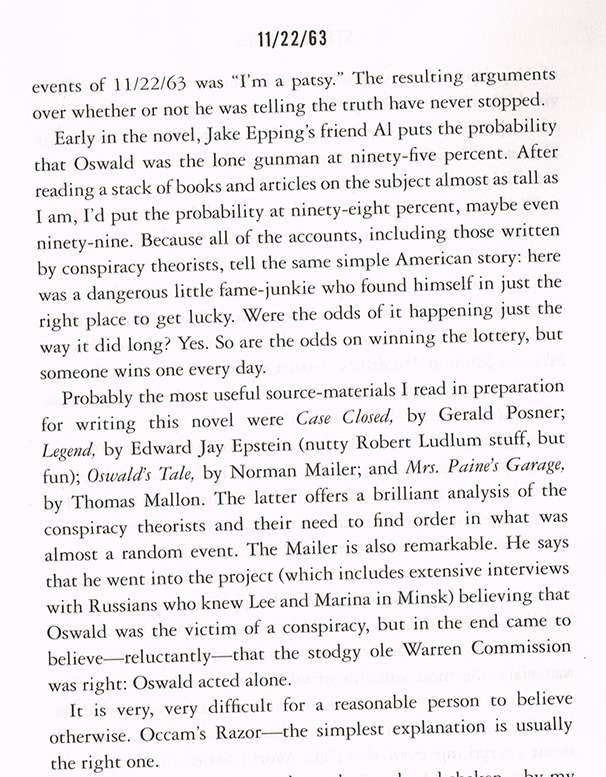
It might be interesting to those who have no intention of reading the novel to see who King thanks first for their "useful source-materials" :
"Useful source-materials"? It would be tempting to label these guys with the Orwellian term "Useful Idiots", but it obviously goes beyond that. Before he was exposed as a plagiarist, Gerald Posner inadvertently revealed his CIA-ties. As for those others...In that Education Forum link there also happens to be a debate about the merits of NY Times book review of Dan Moldea's book by Gerald Posner:Ron Ecker wrote:Posted Yesterday, 07:36 PM
http://www.moldea.com/RFKReviews.html
Impressive! Includes excerpt from a New York Times Book Review by Gerald Posner. Leave it to the NYT to choose Posner to write a review of a Kennedy assassination book. These people are beyond any decent description.
Actually, as I recall, Moldea's book did a good job of proving a conspiracy, then on the last page he strangely concludes that Sirhan did it alone. I wonder if someone had a gun to his head as he wrapped up his manuscript.
http://educationforum.ipbhost.com/index ... ntry251248
Of course the evidence suggests that Moldea was blackmailed into concluding that Sirhan acted alone:
http://cannonfire.blogspot.com/2007/08/ ... trust.htmlI know from a first-hand source -- whom I will name, if legally pressed -- that Dan Moldea had privately complained that the major publishers had "blackballed" him after he wrote a book called Interference: How Organized Crime Influences Professional Football. The blackballing stopped the moment he agreed to write a book about the Robert F. Kennedy assassination pushing the "lone nut" hypothesis...
viewtopic.php?p=282075#p282075
Much the same way Norman Mailer was blackmailed into supporting the lone nutters...
http://educationforum.ipbhost.com/index ... ntry218745Jim DiEugenio wrote:Posted 31 January 2011 - 03:26 AM
In 1973, Mailer published a book, Marilyn, (really a photo essay) with the assistance of longtime FBI asset on the Kennedy assassination Larry Schiller. He recirculated the tale again, inserting a new twist. He added the possibility that the FBI and/or the CIA might have been involved in the murder in order to blackmail Bobby ( p. 242). In 1973, pre-Rupert Murdoch, the media had some standards. Mailer was excoriated for his baseless ruminations. In private, he admitted he did what he did to help pay off a tax debt. He also made a similar confession in public. When Mike Wallace asked him on 60 Minutes (7/13/73) why he had to trash Bobby Kennedy, Mailer replied “I needed money very badly.” ...
http://educationforum.ipbhost.com/index ... ntry218745
viewtopic.php?p=459270#p459270
Who knows what Stephen King's excuse was?
viewtopic.php?p=459417#p459417Hugh Manatee Wins wrote:http://www.spartacus.schoolnet.co.uk/JFKpaineM.htmJim Garrison later suggested that Ruth Paine might have been involved in setting Oswald up as the "patsy". Garrison points out that Paine's father " had been employed by the Agency for International Development, regarded by many as a source of cover for the C.I.A. Her brother-in-law was employed by the same agency in the Washington, D.C. area." He also claims that he had tried to "examine the income tax returns of Ruth and Michael Paine, but I was told that they had been classified as secret.... What was so special about this particular family that made the federal government so protective of it?"
In 2002 Thomas Mallon wrote a book about Ruth Paine's involvement in the case, Mrs. Paine's Garage and the Murder of John F. Kennedy. Unlike Jim Garrison Mallon took the view that Paine was completely innocent of any involvement in the Kennedy assassination conspiracy.
Ruth Paine is currently working for a Nicaraguan relief group in St. Petersburg, Florida.
Nicaraguan 'relief group?' Funny. That's the kind of cover that Oliver North's fronts used to help with the Reagan Wars in Central America...
viewtopic.php?p=120202#p120202
One decade after his literary attempt to mitigate Ruth Paine's role in the JFK assassination. Thomas Mallon is back to reinforce the Bob Woodward - Carl Bernstein - Seymour Hersh myth that is "Watergate".
Mallon has been all over NPR the last few days to reindoctrinate the unwashed masses:'Watergate' Revisited: Inside The Criminal Minds
February 25, 2012
This is WEEKEND EDITION from NPR News. I'm Scott Psymon.
Almost any scandal in the world these days is described as a something-gate. The phrase dates back to the summer of 1972, when five men were arrested in the middle of the night during a break-in at Democratic Party headquarters in the Watergate Office Building in Washington, D.C.
The subsequent scandal brought down Richard Nixon's administration, made him one of the most notorious men in American history. Anytime someone observes: what did they know, and when did they know it; it's not the crime, it's the cover-up; follow the money, or third-rate burglary, it's a Watergate reference - whether they know it or not.
The Watergate crime and scandal have been exhaustively documented. But now, a great historical novelist has run it through his imagination. Thomas Mallon's new book is called "Watergate: A Novel." Tom Mallon joins us in our studios.
Thanks for being with us.
THOMAS MALLON: Thanks for having me.
SIMON: With so much on the record, what's left to be imagined by a novelist?
MALLON: Mostly how it felt, I think. I thought if you were going to do this as a novel, you had to get inside the people who were there. And so, I tried to tell the story from essentially seven different points of view and see what it felt like. And I avoid most of the big events that people - they certainly occur. But I don't tell the story the way you would tell it in nonfiction. I tell it more as a series of private dramas and try to give certain intimacy.
SIMON: As you will learn on tour, there are Watergate buffs...
MALLON: Oh, yes.
(SOUNDBITE OF LAUGHTER)
SIMON: ...like there are Civil War buffs and jazz buffs who will catch you on the smallest bit of misinformation, or imagined information. How important was historical accuracy to you?
MALLON: I refer in the acknowledgements of the book to the always sliding scale of historical fiction. And I think you really have to make these decisions book-by-book and almost scene-by-scene. I don't violate any of the big historical moments, dates. You know, Richard Nixon still resigns at the end of this book.
(SOUNDBITE OF LAUGHTER)...
http://www.npr.org/2012/02/25/147262946 ... inal-minds
http://www.npr.org/2012/02/23/147063867 ... rnate-take
viewtopic.php?p=449737#p449737
Thanks for the heads-up on this phenomenon, IanEye.
by MinM » Sat Dec 30, 2017 10:42 pm
Nathaniel Heidenheim @DoItForMaMa Dec 28
Gee.. can't imagine why this 1994 A &E documentary on the Assassination of RFK and CIA involvement was shown only once...
Return to Assassinations and Suspicious Deaths
Users browsing this forum: No registered users and 0 guests