Yes- and on possible underground connections to IRA, SItuationist, Angry Brigade, Red Brigades, Operation Julie, Howard Marks, etc.hiddenite wrote:Acid : A new secret history of LSD by David Black
has a lot on Stark .
Tantra-Induced Delusional Syndrome ("TIDS")
Moderators: Elvis, DrVolin, Jeff
-
American Dream
- Posts: 19946
- Joined: Sat Sep 15, 2007 4:56 pm
- Location: Planet Earth
Re: Tantra-Induced Delusional Syndrome ("TIDS")
-
American Dream
- Posts: 19946
- Joined: Sat Sep 15, 2007 4:56 pm
- Location: Planet Earth

-
American Dream
- Posts: 19946
- Joined: Sat Sep 15, 2007 4:56 pm
- Location: Planet Earth
Re: Tantra-Induced Delusional Syndrome ("TIDS")
http://www.levity.com/aciddreams/timeline.html
1938 - Dr. Albert Hofmann synthesizes LSD-25
Spring 1942 - The Office of Strategic Services convenes a committee to oversee the search for a truth drug
April 16, 1943 - Hofmann accidentally discovers the hallucinogenic effects of LSD
April 19, 1943 - Hofmann undertakes the first self-experiment with LSD
September 1945 - OSS disbanded
October 1945 - US Navy Technical Mission reports on Nazi mescaline experiments at the Dachau concentration camp
1947 - CIA formed; U.S. Navy initiates mescaline studies under the auspices of Project Chatter
1947 - First report on LSD appears in a Swiss pharmacological journal
1948 - CIA authorized to undertake covert operations
1949 - Dr. Max Rinkel brings LSD to the United States from Sandoz Pharmaceuticals in Switzerland and initiates work with LSD in Boston; Nick Bercel commences LSD study in Los Angeles
1950 - CIA launches Project Bluebird
May 1950 - First article about LSD appears in the American Psychiatric Journal
1951 - Captain Al Hubbard turns on to LSD
August 1951 - The CIA's Inspection & Security Staff initiates the Artichoke Project
October 21, 1951 - First documented evidence of CIA experimentation with LSD
1952 - Dr. Humphry Osmond discloses similarity between mescaline and adrenaline molecule; begins experiments with hallucinogenic at a hospital in Saskatchewan
December 1952 - George Hunter White, on loan from the Federal Narcotics Bureau, begins administering LSD to unwitting U.S. citizens at a CIA safehouse in Greenwich Village
January 1953 - Harold Blauer dies of an overdose of MDA during an Army-sponsored drug experiment
April 13, 1953 - The CIA's Technical Services Staff initiates the MK-ULTRA Project
1953 - Dr. Humphry Osmond begins treating alcoholics with LSD
May 1953 - Aldous Huxley's first mescaline experience
November 1953 - Army biochemist Frank Olsen commits suicide after CIA doses him with LSD
1954 - CIA begins Operation MK-PILOT at Lexingon Narcotics Hospital
1954 - Aldous Huxley's Doors of Perception published
mid-1954 - Eli Lilly synthesizes LSD at the CIA's behest
1955 - Aldous Huxley's first LSD trip; the publication of Huxley's Heaven and Hell
1955- Army begins testing LSD at Edgewood arsenal
1956? - Dr. Humphry Osmond coins the word "psychedelic"
May 1957 - Life magazine published R. Gordon Wasson's account of his magic mushroom experience
1958 - Army begins BZ experiments
1959 - Josiah Macy Foundation sponsors major scientific congress on LSD
1959 - Allen Ginsberg tries LSD for the first time
1960 - American Indians granted sanctioned use of peyote as a religious matter
Summer 1960 - Timothy Leary turns on to magic mushrooms in Mexico
1961 - US Army initiates LSD interrogations under Operation Third Chance in Western Europe
1962 - U.S. Army launches Operation Derby Hat in Asia
1962 - The Gamblers, a California surfing band, release a song "LSD-25"; underground LSD appears on both coasts; FDA makes first LSD bust
1962 - Dr. Alexander Shulgin records the effects of MMDA ("ecstasy")
1962 - The superhallucinogen BZ becomes part of the US Army's standardized chemical warfare arsenal
1962 - The CIA withdraws support for above-ground LSD research studies
1962 - Congress passes new drug safety regulations and the FDA designates LSD an experimental drug and restricts research
1963 - Williams Burroughs and Allen Ginsberg publish The Yage Letters
May 1963 - Timothy Leary and Richard Alpert fired from Harvard
November 22, 1963 - Aldous Huxley dies shortly after JFK assassination
1964 - Army begins using BZ gas in Vietnam
Summer 1964 - Ken Kesey and the Merry Pranksters' cross-country bus trip
Fall 1964 - Berkeley Free Speech Movement
February 1965 - First big surge of street acid; the assassination of Malcolm X; US begins sustained bombing of North Vietnam
April 1965 - First big SDS march on Washington
1965 - Drug Abuse Control Amendment; LSD research further restricted
1965 - Bob Dylan's Bringing It All Back Home and Highway 61 Revisited
October 16, 1965 - First Family Dog acid rock dance in San Francisco
1965 - CIA phases out MK-ULTRA, begins MK-SEARCH
January 1966 - The Trips Festival in San Francisco
March 1966 - Life magazine publishes "LSD: The Mind Drug That Got Out of Control"
April 1966 - Sandoz stops supplying LSD to research scientists
April 1966 - G. Gordon Liddy raids the Millbrook estate
Spring 1966 - Senate Hearings about LSD
1966 - Black Panther Party formed
October 6, 1966 - California bans LSD, Love Pageant Rally in the Haight
January 14, 1967 - Human Be-In in Golden Gate Park
1967 - Joint FDA/NIMH Psychotomimetic Advisory Committee formed with strong input from CIA-linked doctors
June 1967 - Monterey Pop Festival
June 1967 - The Beatles' Sgt. Pepper's Lonely Hearts Club Band
Summer 1967 - "Summer of Love"; STP appears on the blackmarket
October 21, 1967 - March on the Pentagon
1967 - Joint CIA-Army drug research program codenamed OFTEN/MK-CHICKWIT
January 1, 1968 - Yippie!
1968 - LSD possession declared a misdemeanor, sale a felony; the British Wootton Report declares marijuana to be relatively harmless
Spring 1968 - Student unrest at Columbia University
March 31, 1968 - LBJ announces he won't seek re-election
April 4, 1968 - Martin Luther King, Jr. assassinated
May 1968 - The Sorbonne uprising in Paris
June 5, 1968 - Senator Robert Kennedy assassinated
June 1969 - SDS unravels
Summer of 1969 - Orange sunshine debuts; Ronald Stark moves in on the illicit acid trade
August 1969 - Woodstock rock festival
Fall 1969 - Operation Intercept; huge antiwar demonstrations around the country
December 1969 - Altamont rock concert; the Manson killings
February 1970 - Leary convicted and jailed
September 12, 1970 - Leary escapes from prison
Spring 1970 - Jackson State and Kent State killings
1970 - LSD becomes a Schedule I drug
1971 - Windowpane acid first appears
August 1972 - Operation BEL
January 17, 1973 - Leary arrested in Afghanistan
November 1973 - Hitchcock turns state evidence to convict Tim Scully and Nick Sand
1973 - MK-SEARCH terminated; OFTEN/MK-CHICKWIT phased out
September 18, 1974 - PILL (People Investigating Leary's Lies) conference
1975 - Rockefeller Commission reports on CIA hallucinogenic drug experiments
February 1975 - Ronald Stark arrested in Bologna, Italy
1976 - Church Committee reports on CIA and Army drug experiments
1976 - Leary released from jail
Spring 1977 - Operation Julie bust in England
Fall 1977 - Senate hearings on MK-ULTRA
February 1979 - LSD reunion in Los Angeles
1938 - Dr. Albert Hofmann synthesizes LSD-25
Spring 1942 - The Office of Strategic Services convenes a committee to oversee the search for a truth drug
April 16, 1943 - Hofmann accidentally discovers the hallucinogenic effects of LSD
April 19, 1943 - Hofmann undertakes the first self-experiment with LSD
September 1945 - OSS disbanded
October 1945 - US Navy Technical Mission reports on Nazi mescaline experiments at the Dachau concentration camp
1947 - CIA formed; U.S. Navy initiates mescaline studies under the auspices of Project Chatter
1947 - First report on LSD appears in a Swiss pharmacological journal
1948 - CIA authorized to undertake covert operations
1949 - Dr. Max Rinkel brings LSD to the United States from Sandoz Pharmaceuticals in Switzerland and initiates work with LSD in Boston; Nick Bercel commences LSD study in Los Angeles
1950 - CIA launches Project Bluebird
May 1950 - First article about LSD appears in the American Psychiatric Journal
1951 - Captain Al Hubbard turns on to LSD
August 1951 - The CIA's Inspection & Security Staff initiates the Artichoke Project
October 21, 1951 - First documented evidence of CIA experimentation with LSD
1952 - Dr. Humphry Osmond discloses similarity between mescaline and adrenaline molecule; begins experiments with hallucinogenic at a hospital in Saskatchewan
December 1952 - George Hunter White, on loan from the Federal Narcotics Bureau, begins administering LSD to unwitting U.S. citizens at a CIA safehouse in Greenwich Village
January 1953 - Harold Blauer dies of an overdose of MDA during an Army-sponsored drug experiment
April 13, 1953 - The CIA's Technical Services Staff initiates the MK-ULTRA Project
1953 - Dr. Humphry Osmond begins treating alcoholics with LSD
May 1953 - Aldous Huxley's first mescaline experience
November 1953 - Army biochemist Frank Olsen commits suicide after CIA doses him with LSD
1954 - CIA begins Operation MK-PILOT at Lexingon Narcotics Hospital
1954 - Aldous Huxley's Doors of Perception published
mid-1954 - Eli Lilly synthesizes LSD at the CIA's behest
1955 - Aldous Huxley's first LSD trip; the publication of Huxley's Heaven and Hell
1955- Army begins testing LSD at Edgewood arsenal
1956? - Dr. Humphry Osmond coins the word "psychedelic"
May 1957 - Life magazine published R. Gordon Wasson's account of his magic mushroom experience
1958 - Army begins BZ experiments
1959 - Josiah Macy Foundation sponsors major scientific congress on LSD
1959 - Allen Ginsberg tries LSD for the first time
1960 - American Indians granted sanctioned use of peyote as a religious matter
Summer 1960 - Timothy Leary turns on to magic mushrooms in Mexico
1961 - US Army initiates LSD interrogations under Operation Third Chance in Western Europe
1962 - U.S. Army launches Operation Derby Hat in Asia
1962 - The Gamblers, a California surfing band, release a song "LSD-25"; underground LSD appears on both coasts; FDA makes first LSD bust
1962 - Dr. Alexander Shulgin records the effects of MMDA ("ecstasy")
1962 - The superhallucinogen BZ becomes part of the US Army's standardized chemical warfare arsenal
1962 - The CIA withdraws support for above-ground LSD research studies
1962 - Congress passes new drug safety regulations and the FDA designates LSD an experimental drug and restricts research
1963 - Williams Burroughs and Allen Ginsberg publish The Yage Letters
May 1963 - Timothy Leary and Richard Alpert fired from Harvard
November 22, 1963 - Aldous Huxley dies shortly after JFK assassination
1964 - Army begins using BZ gas in Vietnam
Summer 1964 - Ken Kesey and the Merry Pranksters' cross-country bus trip
Fall 1964 - Berkeley Free Speech Movement
February 1965 - First big surge of street acid; the assassination of Malcolm X; US begins sustained bombing of North Vietnam
April 1965 - First big SDS march on Washington
1965 - Drug Abuse Control Amendment; LSD research further restricted
1965 - Bob Dylan's Bringing It All Back Home and Highway 61 Revisited
October 16, 1965 - First Family Dog acid rock dance in San Francisco
1965 - CIA phases out MK-ULTRA, begins MK-SEARCH
January 1966 - The Trips Festival in San Francisco
March 1966 - Life magazine publishes "LSD: The Mind Drug That Got Out of Control"
April 1966 - Sandoz stops supplying LSD to research scientists
April 1966 - G. Gordon Liddy raids the Millbrook estate
Spring 1966 - Senate Hearings about LSD
1966 - Black Panther Party formed
October 6, 1966 - California bans LSD, Love Pageant Rally in the Haight
January 14, 1967 - Human Be-In in Golden Gate Park
1967 - Joint FDA/NIMH Psychotomimetic Advisory Committee formed with strong input from CIA-linked doctors
June 1967 - Monterey Pop Festival
June 1967 - The Beatles' Sgt. Pepper's Lonely Hearts Club Band
Summer 1967 - "Summer of Love"; STP appears on the blackmarket
October 21, 1967 - March on the Pentagon
1967 - Joint CIA-Army drug research program codenamed OFTEN/MK-CHICKWIT
January 1, 1968 - Yippie!
1968 - LSD possession declared a misdemeanor, sale a felony; the British Wootton Report declares marijuana to be relatively harmless
Spring 1968 - Student unrest at Columbia University
March 31, 1968 - LBJ announces he won't seek re-election
April 4, 1968 - Martin Luther King, Jr. assassinated
May 1968 - The Sorbonne uprising in Paris
June 5, 1968 - Senator Robert Kennedy assassinated
June 1969 - SDS unravels
Summer of 1969 - Orange sunshine debuts; Ronald Stark moves in on the illicit acid trade
August 1969 - Woodstock rock festival
Fall 1969 - Operation Intercept; huge antiwar demonstrations around the country
December 1969 - Altamont rock concert; the Manson killings
February 1970 - Leary convicted and jailed
September 12, 1970 - Leary escapes from prison
Spring 1970 - Jackson State and Kent State killings
1970 - LSD becomes a Schedule I drug
1971 - Windowpane acid first appears
August 1972 - Operation BEL
January 17, 1973 - Leary arrested in Afghanistan
November 1973 - Hitchcock turns state evidence to convict Tim Scully and Nick Sand
1973 - MK-SEARCH terminated; OFTEN/MK-CHICKWIT phased out
September 18, 1974 - PILL (People Investigating Leary's Lies) conference
1975 - Rockefeller Commission reports on CIA hallucinogenic drug experiments
February 1975 - Ronald Stark arrested in Bologna, Italy
1976 - Church Committee reports on CIA and Army drug experiments
1976 - Leary released from jail
Spring 1977 - Operation Julie bust in England
Fall 1977 - Senate hearings on MK-ULTRA
February 1979 - LSD reunion in Los Angeles
-
American Dream
- Posts: 19946
- Joined: Sat Sep 15, 2007 4:56 pm
- Location: Planet Earth
Re: Tantra-Induced Delusional Syndrome ("TIDS")
http://psychedelic-information-theory.com/Aum-Shinrikyo
References
Aum Shinrikyo
WikiPedia.org; Internet Reference, 2010.
References
Aum Shinrikyo
WikiPedia.org; Internet Reference, 2010.
The religion's practices remained shrouded in secrecy. Initiation rituals often involved the use of hallucinogens, such as LSD. Religious practices often involved extreme ascetic practices referred to as "yoga" These included everything from renunciants being hung upside down to being given shock therapy.
--
At the cult's headquarters in Kamikuishiki on the foot of Mount Fuji, police found explosives, chemical weapons and biological warfare agents, such as anthrax and Ebola cultures... Police also found laboratories to manufacture drugs such as LSD, methamphetamine, and a crude form of truth serum, a safe containing millions of dollars worth in cash and gold, and cells, many still containing prisoners.
-
American Dream
- Posts: 19946
- Joined: Sat Sep 15, 2007 4:56 pm
- Location: Planet Earth
Re: Tantra-Induced Delusional Syndrome ("TIDS")


BRAZIL: PAINTING: BRUNO9LI
I’m instantly entranced by the paintings of São Paulo artist Bruno 9li. The combination of color, texture and vivid imagination has me in awe.
According to his website, Bruno’s most recent pieces, some of which are pictured above, “[evoke] infinite narratives in an unknown universe of excess and frenzy.” However, there is something familiar in his aesthetic, and it’s possibly due to his “deep interest in Amazonian rituals” and the history of painting.
Bruno 9li’s website. Mango Popsicle on Facebook.
http://kalisherni.tumblr.com/post/49971 ... runo9li-im
-
American Dream
- Posts: 19946
- Joined: Sat Sep 15, 2007 4:56 pm
- Location: Planet Earth
Re: Tantra-Induced Delusional Syndrome ("TIDS")
The strength of the wolf: the secret history of America's war on drugs
Douglas Valentine - 2004
Douglas Valentine - 2004
A CIA proprietary company,ANDCO's stated purpose was to "explore the commercial ... yage, a potent psychedelic called "the final fix" by William Burroughs.15 ... and may have helped George White set up the MKULTRA pad in San Francisco...
-
American Dream
- Posts: 19946
- Joined: Sat Sep 15, 2007 4:56 pm
- Location: Planet Earth
Re: Tantra-Induced Delusional Syndrome ("TIDS")
Facets of Metta
by Sharon Salzberg
A pearl goes up for auction
No one has enough,
so the pearl buys itself
-- Rumi
Love exists in itself, not relying on owning or being owned. Like the pearl, love can only buy itself, because love is not a matter of currency or exchange. No one has enough to buy it but everyone has enough to cultivate it. Metta reunites us with what it means to be alive and unbound.
Researchers once gave a plant to every resident of a nursing home. They told half of these elderly people that the plants were theirs to care for -- they had to pay close attention to their plants' needs for water and sunlight, and they had to respond carefully to those needs. The researchers told the other half of the residents that their plants were theirs to enjoy but that they did not have to take any responsibility for them; the nursing staff would care for the plants.
At the end of a year, the researchers compared the two groups of elders. The residents who had been asked to care for their plants were living considerably longer than the norm, were much healthier, and were more oriented towards and connected to their world. The other residents, those who had plants but did not have to stay responsive to them, simply reflected the norms for people their age in longevity, health, alertness, and engagement with the world.
This study shows, among other things, the enlivening power of connection, of love, of intimacy. This is the effect that metta can have on our lives. But when I heard about the study, I also reflected on how often we regard intimacy as a force between ourselves and something outside ourselves -- another person, or even a plant -- and how rarely we consider the force of being intimate with ourselves, with our own inner experience. How rarely do we lay claim to our own lives and feel connected to ourselves!
A way to discover intimacy with ourselves and all of life is to live with integrity, basing our lives on a vision of compassionate nonharming. When we dedicate ourselves to actions that do not hurt ourselves or others, our lives become all of one piece, a "seamless garment" with nothing separate or disconnected in the spiritual reality we discover.
In order to live with integrity, we must stop fragmenting and compartmentalizing our lives. Telling lies at work and expecting great truths in meditation is nonsensical. Using our sexual energy in a way that harms ourselves or others, and then expecting to know transcendent love in another arena, is mindless. Every aspect of our lives is connected to every other aspect of our lives. This truth is the basis for an awakened life. When we live with integrity, we further enhance intimacy with ourselves by being able to rejoice, taking active delight in our actions. Rejoicing opens us tremendously, dissolving our barriers, thereby enabling intimacy to extend to all of life. Joy has so much capacity to eliminate separation that the Buddha said, "Rapture is the gateway to nirvana."
The enlivening force itself is rapture. It brightens our vitality, our gratitude, and our love. We begin to develop rapture by rejoicing in our own goodness. We reflect on the good things we have done, recollecting times when we have been generous, or times when we have been caring. Perhaps we can think of a time when it would have been easy to hurt somebody, or to tell a lie, or to be dismissive, yet we made the effort not to do that. Perhaps we can think of a time when we gave something up in a way that freed our mind and helped someone else. Or perhaps we can think of a time when we have overcome some fear and reached out to someone. These reflections open us to a wellspring of happiness that may have been hidden from us before.
Contemplating the goodness within ourselves is a classical meditation, done to bring light, joy, and rapture to the mind. In contemporary times this practice might be considered rather embarrassing, because so often the emphasis is on all the unfortunate things we have done, all the disturbing mistakes we have made. Yet this classical reflection is not a way of increasing conceit. It is rather a commitment to our own happiness, seeing our happiness as the basis for intimacy with all of life. It fills us with joy and love for ourselves and a great deal of self-respect.
Significantly, when we do metta practice, we begin by directing metta toward ourselves. This is the essential foundation for being able to offer genuine love to others. When we truly love ourselves, we want to take care of others, because that is what is most enriching, or nourishing, for us. When we have a genuine inner life, we are intimate with ourselves and intimate with others. The insight into our inner world allows us to connect to everything around us, so that we can see quite clearly the oneness of all that lives. We see that all beings want to be happy, and that this impulse unites us. We can recognize the rightness and beauty of our common urge towards happiness, and realize intimacy in this shared urge.
If we are practicing metta and we cannot see the goodness in ourselves or in someone else, then we reflect on that fundamental wish to be happy that underlies all action. "Just as I want to be happy, all beings want to be happy." This reflection gives rise to openness, awareness, and love. As we commit to these values, we become embodiments of a lineage that stretches back through beginningless time. All good people of all time have wanted to express openness, awareness, and love. With every phrase of metta, we are declaring our alignment with these values.
From this beginning, metta practice proceeds in a very structured way and specific way. After we have spent some time directing metta to ourselves, we then move on to someone who has been very good to us, for whom we feel gratitude and respect. In the traditional terminology, this person is known as a "benefactor." Later we move to someone who is a beloved friend. It is relatively easy to direct lovingkindness to these categories of beings (we say beings rather than people to include the possibility of animals in these categories.) After we have established this state of connection, we move on to those that it may be harder to direct lovingkindness toward. In this way we open up our limits and extend our capacity for benevolence.
Thus, next we direct lovingkindness to someone whom we feel neutral toward, someone for whom we feel neither great liking nor disliking. This is often an interesting time in the practice, because it may be difficult to find somebody for whom we have no instantaneous judgment. If we can find such a neutral person, we direct metta toward them.
After this, we are ready for the next step -- directing metta toward someone with whom we have experienced conflict, someone toward whom we feel lack of forgiveness, or anger, or fear. In the Buddhist scriptures this person is somewhat dramatically known as "the enemy." This is a very powerful stage in the practice, because the enemy, or the person with whom we have difficulty stands right at the division between the finite and the infinite radiance of love. At this point, conditional love unfolds into unconditional love. Here dependent love can turn to the flowering of an independent love that is not based upon getting what we want or having our expectations met. Here we learn that the inherent happiness of love is not compromised by likes and dislikes, and thus, like the sun, it can shine on everything. This love is truly boundless. It is born out of freedom, and it is offered freely.
Through the power of this practice, we cultivate an equality of loving feeling toward ourselves and all beings. There was a time in Burma when I was practicing metta intensively. I had taken about six weeks to go through all the different categories: myself, benefactor, friend, neutral person, and enemy. After I had spent these six weeks doing the metta meditation all day long, my teacher, U Pandita, called me into his room and said, "Say you were walking in the forest with your benefactor, your friend, your neutral person, and your enemy. Bandits come up and demand that you choose one person in your group to be sacrificed. Which one would you choose to die?"
I was shocked at U Pandita's question. I sat there and looked deep into my heart, trying to find a basis from which I could choose. I saw that I could not feel any distinction between any of those people, including myself. Finally I looked at U Pandita and replied, "I couldn't choose; everyone seems the same to me."
U Pandita then asked, "You wouldn't choose your enemy?" I thought a minute and then answered, "No, I couldn't."
Finally U Pandita asked me, "Don't you think you should be able to sacrifice yourself to save the others?" He asked the question as if more than anything else in the world he wanted me to say, "Yes, I'd sacrifice myself." A lot of conditioning rose up in me -- an urge to please him, to be "right" and to win approval. But there was no way I could honestly say "yes," so I said, "No, I can't see any difference between myself and any of the others." He simply nodded in response, and I left.
Later I was reading the Visuddhi Magga, one of the great commentarial works of Buddhist literature which describes different meditation techniques and the experiences of practicing these techniques. In the section on metta meditation, I came to that very question about the bandits. The answer I had given was indeed considered the correct one for the intensive practice of metta.
Of course, in different life situations many different courses of action might be appropriate. But the point here is that metta does not mean that we denigrate ourselves in any situation in order to uphold other people's happiness. Authentic intimacy is not brought about by denying our own desire to be happy in unhappy deference to others, nor by denying others in narcissistic deference to ourselves. Metta means equality, oneness, wholeness. To truly walk the Middle Way of the Buddha, to avoid the extremes of addiction and self-hatred, we must walk in friendship with ourselves as well as with all beings.
When we have insight into our inner world and what brings us happiness, then wordlessly, intuitively, we understand others. As though there were no longer a barrier defining the boundaries of our caring, we can feel close to others' experience of life. We see that when we are angry, there is an element of pain in the anger that is not different from the pain that others feel when they are angry. When we feel love there is a distinct and special joy in that feeling. We come to know that this is the nature of love itself, and that other beings filled with love experience of this same joy.
In practicing metta we do not have to make a certain feeling happen. In fact, during the practice we see that we feel differently at different times. Any momentary emotional tone is far less relevant than considerable power of intention we harness as we say these phrases. As we repeat, "May I be happy; may all beings be happy," we are planting seeds by forming this powerful intention in the mind. The seed will bear fruit in its own time.
When I was practicing metta intensively in Burma, at times when I repeated the metta phrases, I would picture myself in a wide open field planting seeds. Doing metta we plant the seeds of love, knowing that nature will take its course and in time those seeds will bear fruit. Some seeds will come to fruition quickly, some slowly, but our work is simply to plant the seeds. Every time we form the intention in the mind for our own happiness or for the happiness of others, we are doing our work; we are channeling the powerful energies of our own minds. Beyond that, we can trust the laws of nature to continually support the flowering of our love. As Pablo Neruda says:
Perhaps the earth can teach us, as when everything seems dead in winter and later proves to be alive.
When we started our retreat center, Insight Meditation Society, in 1975, many of us there decided to do a self-retreat for a month to inaugurate the center. I planned to do metta for the entire month. This was before I'd been to Burma, and it would be my first opportunity to do intensive and systematic metta meditation. I had heard how it was done in extended practice, and I planned to follow that schedule. So the first week I spent directing lovingkindness towards myself. I felt absolutely nothing. It was the dreariest, most boring week I had known in some time. I sat there saying, "May I be happy, may I be peaceful," over and over again with no obvious result.
Then, as it happened, someone we knew in the community had a problem, and a few of us had to leave the retreat suddenly. I felt even worse, thinking, "Not only did I spend this week doing metta and getting nothing from it, but I also never even got beyond directing metta towards myself. So on top of everything else, I was really selfish."
I was in a frenzy getting ready to leave. As I was hurriedly getting everything together in my bathroom, I dropped a jar. It shattered all over the floor. I still remember my immediate response: "You are really a klutz, but I love you." And then I thought, "Wow! Look at that. Something did happen in this week of practice."
So the intention is enough. We form the intention in our mind for our happiness and the happiness of all. This is different from struggling to fabricate a certain feeling, to create it out of our will, to make it happen. We just settle back and plant the seeds without worrying about the immediate result. That is our work. If we do our work, then manifold benefits will surely come.
http://www.vipassana.com/meditation/facets_of_metta.php
Black Uhuru - Peace and Love
Oh as I sit under this weeping willow tree
Pain and sorrow is all I feel, oh
And as I wipe the tears from my eyes, oh Father,
I realize
I and I should be free, yes..
Peace and love in the north,
Peace and love in the south,
Peace and love in the east,
Peace and love in the universe..
Oh as I sit under this weeping willow tree
Penetrating the vibes of this ca'm breeze, oh,
And as I wipe the tears from my eyes, oh Father,
I realize
I and I should be free, yes.
Peace and love in the north,
Peace and love in the south,
Peace and love in the east,
Peace and love in the universe..
Oh as I sit under this weeping willow tree
Pain and sorrow are on to me,
And as I wipe the tears from my eyes, oh Father,
I realize
I and I should be free....
Peace and love in the north,
Peace and love in the south,
Peace and love in the east,
Peace and love in the universe..
-
American Dream
- Posts: 19946
- Joined: Sat Sep 15, 2007 4:56 pm
- Location: Planet Earth
Re: Tantra-Induced Delusional Syndrome ("TIDS")
Sweet Chaos: The Grateful Dead's American Adventure
Carol Brightman
...a San Francisco safe house that MK-ULTRA had run since 1956... Now that the Haight furnished the CIA with what one agent referred to as "a human guinea pig farm"... which included the superpotent DMT when they could get it...

Carol Brightman
...a San Francisco safe house that MK-ULTRA had run since 1956... Now that the Haight furnished the CIA with what one agent referred to as "a human guinea pig farm"... which included the superpotent DMT when they could get it...
-
American Dream
- Posts: 19946
- Joined: Sat Sep 15, 2007 4:56 pm
- Location: Planet Earth
Re: Tantra-Induced Delusional Syndrome ("TIDS")
http://cabinetmagazine.org/issues/30/taussig.php
Getting High with Benjamin and Burroughs
Michael Taussig

Jean Selz (left), Paul Gauguin (the painter’s grandson), Benjamin, and fisherman
Tomás Varó (with hat) sailing in the bay of San Antonio, May 1933.
In the spring of 1932, Walter Benjamin bumped into his old friend Felix Noeggerath in Berlin. Noeggerath was packing to go to Ibiza to join his only son, Hans Jakob, who was studying the language and stories of the island, and invited Benjamin to join him. Ibiza was not only beautiful, unknown, and far from Berlin, but extremely cheap—welcome news for Benjamin, who had by then been reduced to abject poverty despite having been born into a rich Jewish family in Berlin in 1892. Thanks to Nazification, he would lose his apartment in Berlin in three months’ time for “code violations,” and his work for German newspapers, as well as his radio stories for children, would be terminated. His brother Georg, an ardent communist, would be placed in a concentration camp in 1933. Without hesitation, Benjamin accepted Noeggerath’s invitation, thus beginning an exile that lasted until his death from what appears to have been a self-administered overdose of morphine on the Spanish-French border in 1940 as he fled the Gestapo.
Drugs were doubtless important to Benjamin, who had first smoked hashish in Berlin in 1927. They confirmed his approach to reality and revolution, to art and politics—an approach shaped and sharpened by his experience of Ibiza. He stayed on the island two months, returning for another six in the summer of 1933. Wretchedly sad, he buried himself in his remote past, writing of his Berlin childhood. Yet he also wrote in lascivious detail of his surroundings, that other “remote past,” or so it seemed to him, this “outpost of Europe” apparently untouched by modernity. Here, he could face head-on his central idea that modernity atrophied the capacity to experience the world and tell stories. This is why the Ibizan poet Vicente Valero has titled his as-yet-untranslated book on Benjamin in Ibiza Experiencia y probreza (Experience and Poverty), after the title of a little-known essay Benjamin wrote under the spell of the island. In the hallucinatory splendor of Ibiza, with his future cast to the winds, Benjamin formulated what I would count as his major texts—on the storyteller and on the mimetic faculty—as well as inventing new forms for the essay as a crossover genre that linked dreams, ethnography, thought-figures, and story-telling.
Indeed, it is when one turns to this crossover genre that Benjamin’s better-known writings lose much of their obscurity. To read his famous essay “The Storyteller,” for example, is to experience what literary theorist Ross Chambers once confessed to me: “When I read Benjamin I think it is the most brilliant stuff I have ever read. When I finish reading, I can’t remember a thing.” But if you read Benjamin’s own stories, like “The Handkerchief” or his fictionalized account of taking hashish in Marseilles, then in a flash we understand “The Storyteller.”
Valero’s book unhurriedly presents us with Benjamin’s development of a tecnica de viaje (a technique of travel), which involved collecting and creating stories through a mix of “thought figures” governed by a galloping interest in mimesis, a hypertrophied sensitivity to similarities. This is not dissimilar to what Proust was getting at with mémoire involontaire, but this tecnica de viaje was historical and cosmic as well as personal. This Ibizan Benjamin, this storytelling Benjamin, finds himself beached like a whale, a storyteller out of history, practicing what he himself said was dead.
To read Benjamin’s own forays into storytelling is to engage with the excitement of crossing genres and seeing the critic become a practitioner—as with the tales he absorbed traveling third class on the ship Catania for eleven days from Hamburg to Barcelona en route to Ibiza in 1932; tales fertilized by the monotony of ship life, then recreated in another form by Benjamin. There are also the story-like ethnographic episodes that appear in his letters from Ibiza to Gretel Adorno and to his heartthrob, the sculptor Jula Cohn. One letter to Cohn, written on Benjamin’s fortieth birthday and entitled “In the Sun,” was singled out by his friend Gershom Scholem, a life-long student of the Jewish Kabbalah, for its “mysticism” and “poetry”:
It was evident that the man walking along deep in thought was not from here; and if, when he was at home, thoughts came to him in the open air, it was always night. With astonishment he would recall that entire nations—Jews, Indians, Moors—had built their schools beneath a sun that seemed to make all thinking impossible for him. This sun was burning into his back. Resin and thyme impregnated the air in which he felt he was struggling for breath. A bumble-bee brushed his ear. Hardly had he registered its presence than it was already sucked away in a vortex of silence.
This stranger walking along deep in thought was the man who had earlier recruited “intoxication” for the revolutionary cause on the grounds that it could open up the “long-sought image sphere” and thereby innervate the “collective body.” This was the man who in that same essay (“Surrealism: The Last Snapshot of the European Intelligentsia”), published in 1929, two years after he first tried hashish, had warned against the spell of mysticism and drugs, arguing instead for a “profane illumination” that recognized the mysteriousness of the everyday, the everydayness of the mystery. Does “In the Sun” pull this off? Was it actually written on drugs, as Valero suggests, or is it a metaphorical and not an actual intoxication—and does this distinction matter?
The counterpoint to the sun was the moonlight, as in Benjamin’s 1932 note “On Astrology”:
In principle, events in the heavens could be imitated by people in former ages, whether as individuals or groups. ... Modern man can be touched by a pale shadow of this on southern moonlit nights in which he feels, alive within himself, mimetic forces that he had thought long since dead, while nature, which possesses them all, transforms itself to resemble the moon.
Mimesis was fundamental to Benjamin’s theory of language, just as it was, I believe, to his theory of history. In Ibiza, Benjamin fought cat-and-dog with his new friend, the painter Jean Selz, about certain aspects of this theory. Benjamin had recruited Selz to help him translate his Berlin childhood essay into French, despite Selz’s not knowing any German. When Benjamin claimed that the shape of a word was connected to its meaning, Selz exploded: “If the word saucepan looked like a cat in a given language, you would say it was cat.” “You could be right,” demurred Benjamin, “but it would only resemble a cat insofar as a cat resembled a saucepan.”
Even in our time, when according to Benjamin we have lost so much of the capacity to perceive similarity, the mimetic faculty survives vigorously as “the most consummate expression of cosmic meaning,” given to the newborn infant “who even today in the early years of his life will evidence the utmost mimetic genius by learning language.” Mimesis is no less crucial to history itself, as testified in his oracular “Theses on the Philosophy of History,” written shortly before his death in 1940, which combined an anarchist spin on Marxism with Jewish mysticism: “The past can be seized only as an image which flashes up at the instant when it can be recognized and is never seen again.” The trick is to “retain that image of the past which unexpectedly appears to man singled out by history at a moment of danger.”
In his two essays on the experience of (just) one night smoking opium with Benjamin high above the port of Ibiza, Selz recalls that Benjamin even coined a special term—the French mêmite—for all of this and points out that for Benjamin this was linked to “a feeling of happiness that he savored with particular care.” (Such jouissance is a significant, no less than puzzling, facet of Proust’s mémoire involontaire, and we might note that Benjamin co-translated two volumes of Proust in the late 1920s.)
What is important about reading Benjamin’s texts written under the influence of drugs is how you can then read back into all his work much of this same “drug” mind-set; in his university student days, wrangling with Kant’s philosophy at great length, he famously stated, according to Scholem, that “a philosophy that does not include the possibility of soothsaying from coffee grounds and cannot explicate it cannot be a true philosophy.” That was in 1913, and Scholem adds that such an approach must be “recognized as possible from the connection of things.” Scholem recalled seeing on Benjamin’s desk a few years later a copy of Baudelaire’s Les paradis artificiels, and that long before Benjamin took any drugs, he spoke of “the expansion of human experience in hallucinations,” by no means to be confused with “illusions.” Kant, Benjamin said, “motivated an inferior experience.”
Benjamin’s signature idea of colportage, implying a unity between film montage, walking the city in the style of the flâneur, and drug experiences, was exactly this hallucinatory sense of space-time travel so enthusiastically worked up by Sergei Einsenstein as “plasma” and by William Burroughs as a style of writerly decomposition. For Burroughs, this idea owed much to taking the hallucinogen yagé (pronounced ya-heh; also called ayahuasca in Quechua) administered to him on some seven occasions in 1953 by Indian shamans in the Putumayo of southwest Colombia and in Pucallpa in the Peruvian Amazon. “It is the most powerful drug I have experienced, ” he wrote Ginsberg. “That is, it produces the most complete derangement of the senses.” Yagé provided the seed for Naked Lunch, explained Allen Ginsberg in 1975 in what must be one of the most spirited and generous invocations of Modernism as montage, Burroughs-style, ever made. (see Burroughs Live, Semitotext(e), 2001)
In the fall of 1953, Burroughs, who had recently returned from South America, stayed with Ginsberg on East 7th Street in New York City. Looking out the back window onto courtyards and back windows of apartments, criss-crossed by fire escapes and clothes lines, Burroughs suddenly saw those amazing “composite cities” he had seen when taking yagé, cities that leap at you from all angles and heights throughout his life’s work, as in Cities of the Red Night. What is wonderful is that Ginsberg opens the shutter on that moment when it all came together: New York, yagé, and the wild imagination of William Seward Burroughs, performance artist. “He acted it out completely,” said Ginsberg, “which he always did with his routines.”
As Ginsberg recalls, there on East 7th Street, Burroughs “suddenly had a vision of the racks, the great city of iron racks rising hundreds of feet into the air with hammocks swinging and people climbing from one level onto the other. Over-populated city of racks, where people are stored, just making a living, like they are now in the megalopolis of streets covered with garbage, blocks of ruined buildings, bums living in motorcycle gangs, muggers and policemen and junkies and the CIA stealing out of hallways and blackmailing each other.”
Looking out the window, Burroughs was transformed into a woman reaching out from the upper balconies for her laundry, which became a flayed corpse. Burroughs lunged. “Sometimes he fell on the floor,” Ginsberg continued, “he was so possessed with the total slapstick humor of his imagination, the images that were coming to him almost as a movie picture, automatically.”
In the recent The Yage Letters Redux (Yage spelled without an accent in the title) by Burroughs and Ginsberg (first published by City Lights in 1963 and now meticulously set in time and place by editor Oliver Harris), we find a parallel to Benjamin’s exploration of drugs and Ibiza. How incredibly exciting it must have been to chase down this awe-inspiring medicine, prepared, sung over, and administered by Indian shamans in the Putumayo forests of South America where, unknown to Burroughs, that other famous homosexual, Roger Casement (later hanged for treason in the Tower of London), had in 1912 gathered testimony as British Consul for his blistering reports on the rubber boom atrocities partially funded by British business. Ginsberg, whose trip occurred in 1960, some seven years after Burroughs’s, comes across as dewy-eyed, naïve, and loving, with tender feeling for his shaman, Ramón, while Burroughs, as American as he is anti-American, is always catty, defensive, offensive, laconic, and absolute master of the put-down. What a pair!
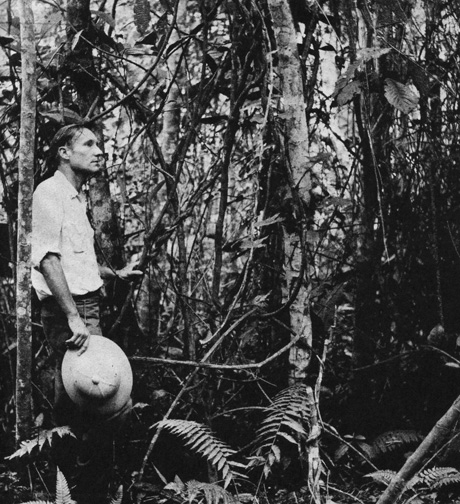
William Burroughs surrounded by yagé vine in the jungle outside Mocoa, Colombia, 1953.
How profoundly different was the courage of this crazy couple compared with today, when yagé, then virtually unknown outside of its forest locale, has become commercialized and tourists are flown in to spend a few days with a “shaman.” The terrible irony, of course, is that The Yage Letters no doubt contributed to the mystique of yagé and its consequent fate at the hands of peddlers of kitsch experience (a substitute for precisely the kind of genuine “experience” that Benjamin saw as imperiled by modern life).
The first edition of The Yage Letters came out of the blue with no explanatory notes whatsoever. What fantasies the reader had to project into it! And now all that has been reversed as the secrets of its origin are revealed when Oliver Harris tells us that these famous letters were not letters at all, but largely made up, except for a knockout piece of writing by big-hearted Allen Ginsberg, discovered miraculously by City Lights editor Lawrence Ferlinghetti in London in 1960. In many ways the “anchor” to the collection, this letter includes Ginsberg’s drawing of the demon Death, and another of the eye of God transforming through Nietzschean Becoming into a holy vagina into which Ginsberg is Dionysically sinking. “Help, Bill! Help!” the un-cool letter from Peru cries out. To which Bill coolly responds from London (in a surprisingly short time) that the way out is the cut-up method and remembering that “‘Nothing is true. Everything is permitted.’ Last words of Hassan Sabbah. The Old Man of the Mountain.”
But what does “made-up”—as in not real but made-up letters—mean for the writer, the cutter-upper, the drug-taker, or the shaman administering yagé, if reality itself is conceived of as really made up? Isn’t “reality” what these writers love to tease? And on the other hand, don’t real letters provide the voice and intimacy, casualness and realness, that the fiction writer thrives upon?
The yagé letters (like Benjamin’s letters to Gretel Adorno and Jula Cohn, which use the form to compose ethnographic sketches) owe something vital to Burroughs’s real letters to Ginsberg from Mexico, Panama, Colombia, Ecuador, and Peru. As any ethnographer has to admit, the letter form offers powerful advantages in making the strange less strange, thereby turning attention to the strangeness of the known. Burroughs himself insisted elsewhere that the task of the writer is to make readers aware of what they already knew without being aware of it.
In contrast to Benjamin’s drug experiences, the body and death are strikingly present in The Yage Letters. Yet it was Benjamin who was to die in Port Bou, probably by his own hand. It was Benjamin who often contemplated suicide, that “old friend” with whom he was to take a glass of wine in Nice for his fortieth birthday, the same birthday for which he wrote about the Ibizan sun to Jula Cohn.
As with Benjamin’s images of Arabs and Ethiopian hands in his hashish memories, there is in Burroughs “orientalism” galore, conducive to, or at least mixed in with, violent bodily transformations. “Blue flashes passed in front of my eyes,” wrote Burroughs to Ginsberg regarding his first effective yagé trip. “The hut took on an archaic far-Pacific look with Easter Island heads,” while the shaman’s assistant was sneaking around to kill him. Hit by nausea, he rushed to the door but could barely walk. He had no coordination. His feet were like blocks of wood. He vomited violently and then felt numb as if covered with layers of cotton. “Larval beings passed before my eyes in a blue haze, each one giving an obscene, mocking, squawk. … I must have vomited six times. I was on all fours convulsed with spasms of nausea. I could hear retching and groaning as if I was someone else.” On a later trip, he reports to Ginsberg that his body changed into that of a Negress “complete with all female facilities. … Now I am a Negro fucking a Negress.” (This did not make it into The Yage Letters.)
Ginsberg strikes a different note, closer to what I understand to be Benjamin’s “profane illumination,” where he actually celebrates the biting of mosquitoes and the horror of uncontrollable vomiting that yagé induces. At first irritated, he later accepts being bitten as it enables him to feel his body extending into the universe. Along with the barking of dogs and the croaking of frogs, the whine of the mosquitoes becomes part of the song of the Great Being, announcing that Ginsberg, too, will have to become a mosquito as meanwhile the universe vomits itself out.
In his last “letter” from the field to Ginsberg, Burroughs has gotten on top of things and found the necessary concepts—“space-time travel” and “the composite city,” along with yagé-inspired fragmentation, all of which, like money in the bank, shall serve him in his highly original but repetitive writings until the end of his long life. Dated 10 July 1953, this three-and-a-half-page letter pretty much gets it all down, including the last paragraph where he evokes a “place where the unknown past and the emergent future meet in a vibrating soundless hum. Larval entities waiting for a live one.”
This vibrating, soundless hum made me think back to Benjamin’s philosophy of history in which he wrote that “the tradition of the oppressed teaches us that the ‘state of emergency’ in which we live is not the exception but the rule. We must attain to a conception of history that is in keeping with this insight.” The more poetic Burroughs puts the tension of the state of emergency in another mode, that of the vibrating soundless hum.
Both Benjamin and Burroughs wrote from this “state of emergency,” yet as far as I know, Burroughs never read a word of Benjamin. In fact, it would be hard to imagine two more dissimilar people, the one so cultured and polite, so quintessentially European, the other an irascible, sarcastic, hip, and quintessentially American bad boy. But then both WB’s dressed in suits and were massively curious about drugs, mysticism, revolution, film, and cut-up as a method for producing literature no less than for writing history. And then there was color, in which they reveled. Barely a page in Burroughs is not saturated in color, which for Benjamin was what took the child into the image, exactly where Burroughs wanted to be. There was so much they seem to have agreed upon.
Yet it makes you laugh and roll your eyes to think of them having a conversation, perhaps on one of Burroughs’s “color walks” starting off from the Beat Hotel in Paris in the early 1960s. I can see them both now, Benjamin and Burroughs, momentarily stilled, half-way between black-and-white and color in those photographs in my imagination taken by the likes of Giselle Freund and Man Ray. Whoa! The hourglass has not yet run out. Jean Selz has turned up just as we are saying goodbye. For yes, I am there too! I can see myself with an idiotic grin as time and memory pull me this way and that through the different color slides. Such a pleasure to be here with them as they emerge from my pages that, like illustrations in a child’s book, draw me into the scene I depict.
Now Selz has our attention. It is getting dark. The day is fading, as is Benjamin. Time is running out. Selz wants us to remember his friend from Ibiza. He wants us to remember Benjamin’s prose as that truly unique medium, he says, in which poetry and the science of history merge as the truth of the world. What medium is that? I ask. Is it hashish? Is it opium? Is it yagé?
But it is getting dark. There is no reply.
As Benjamin disappears into twilight and Burroughs wanders back to the Beat Hotel, Selz answers my question indirectly, saying that of all the people he knew, Benjamin was perhaps the only one who gave him the impression that there does indeed exist a depth of thought where historic and scientific facts coexist with their poetic counterparts, where “poetry is no longer simply a form of literary thought, but reveals itself as an expression of the truth that illuminates the most intimate correspondences between man and the world.” I like to think that Allen Ginsberg and William Burroughs would, as they say, dig that.
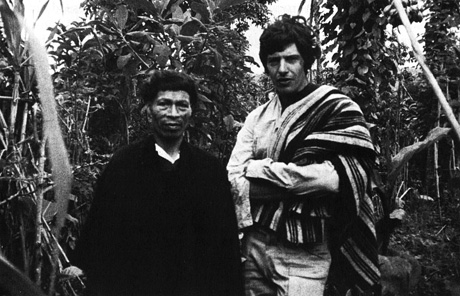
Michael Taussig in a garden with yagé vines with Don Pedro, an Indian healer. Colombia, 1977.
Michael Taussig is the author of numerous books, including Shamanism, Colonialism, and the Wild Man: A Study in Terror and Healing (University of Chicago Press, 1987); The Nervous System (Routledge, 1992); Mimesis and Alterity: A Particular History of the Senses (Routledge, 1993); Defacement: Public Secrecy and the Labor of the Negative (Stanford University Press, 1999); Law in a Lawless Land (The New Press, 2003); and My Cocaine Museum (University of Chicago Press, 2004). He is a professor of anthropology at Columbia University.
Getting High with Benjamin and Burroughs
Michael Taussig
Jean Selz (left), Paul Gauguin (the painter’s grandson), Benjamin, and fisherman
Tomás Varó (with hat) sailing in the bay of San Antonio, May 1933.
In the spring of 1932, Walter Benjamin bumped into his old friend Felix Noeggerath in Berlin. Noeggerath was packing to go to Ibiza to join his only son, Hans Jakob, who was studying the language and stories of the island, and invited Benjamin to join him. Ibiza was not only beautiful, unknown, and far from Berlin, but extremely cheap—welcome news for Benjamin, who had by then been reduced to abject poverty despite having been born into a rich Jewish family in Berlin in 1892. Thanks to Nazification, he would lose his apartment in Berlin in three months’ time for “code violations,” and his work for German newspapers, as well as his radio stories for children, would be terminated. His brother Georg, an ardent communist, would be placed in a concentration camp in 1933. Without hesitation, Benjamin accepted Noeggerath’s invitation, thus beginning an exile that lasted until his death from what appears to have been a self-administered overdose of morphine on the Spanish-French border in 1940 as he fled the Gestapo.
Drugs were doubtless important to Benjamin, who had first smoked hashish in Berlin in 1927. They confirmed his approach to reality and revolution, to art and politics—an approach shaped and sharpened by his experience of Ibiza. He stayed on the island two months, returning for another six in the summer of 1933. Wretchedly sad, he buried himself in his remote past, writing of his Berlin childhood. Yet he also wrote in lascivious detail of his surroundings, that other “remote past,” or so it seemed to him, this “outpost of Europe” apparently untouched by modernity. Here, he could face head-on his central idea that modernity atrophied the capacity to experience the world and tell stories. This is why the Ibizan poet Vicente Valero has titled his as-yet-untranslated book on Benjamin in Ibiza Experiencia y probreza (Experience and Poverty), after the title of a little-known essay Benjamin wrote under the spell of the island. In the hallucinatory splendor of Ibiza, with his future cast to the winds, Benjamin formulated what I would count as his major texts—on the storyteller and on the mimetic faculty—as well as inventing new forms for the essay as a crossover genre that linked dreams, ethnography, thought-figures, and story-telling.
Indeed, it is when one turns to this crossover genre that Benjamin’s better-known writings lose much of their obscurity. To read his famous essay “The Storyteller,” for example, is to experience what literary theorist Ross Chambers once confessed to me: “When I read Benjamin I think it is the most brilliant stuff I have ever read. When I finish reading, I can’t remember a thing.” But if you read Benjamin’s own stories, like “The Handkerchief” or his fictionalized account of taking hashish in Marseilles, then in a flash we understand “The Storyteller.”
Valero’s book unhurriedly presents us with Benjamin’s development of a tecnica de viaje (a technique of travel), which involved collecting and creating stories through a mix of “thought figures” governed by a galloping interest in mimesis, a hypertrophied sensitivity to similarities. This is not dissimilar to what Proust was getting at with mémoire involontaire, but this tecnica de viaje was historical and cosmic as well as personal. This Ibizan Benjamin, this storytelling Benjamin, finds himself beached like a whale, a storyteller out of history, practicing what he himself said was dead.
To read Benjamin’s own forays into storytelling is to engage with the excitement of crossing genres and seeing the critic become a practitioner—as with the tales he absorbed traveling third class on the ship Catania for eleven days from Hamburg to Barcelona en route to Ibiza in 1932; tales fertilized by the monotony of ship life, then recreated in another form by Benjamin. There are also the story-like ethnographic episodes that appear in his letters from Ibiza to Gretel Adorno and to his heartthrob, the sculptor Jula Cohn. One letter to Cohn, written on Benjamin’s fortieth birthday and entitled “In the Sun,” was singled out by his friend Gershom Scholem, a life-long student of the Jewish Kabbalah, for its “mysticism” and “poetry”:
It was evident that the man walking along deep in thought was not from here; and if, when he was at home, thoughts came to him in the open air, it was always night. With astonishment he would recall that entire nations—Jews, Indians, Moors—had built their schools beneath a sun that seemed to make all thinking impossible for him. This sun was burning into his back. Resin and thyme impregnated the air in which he felt he was struggling for breath. A bumble-bee brushed his ear. Hardly had he registered its presence than it was already sucked away in a vortex of silence.
This stranger walking along deep in thought was the man who had earlier recruited “intoxication” for the revolutionary cause on the grounds that it could open up the “long-sought image sphere” and thereby innervate the “collective body.” This was the man who in that same essay (“Surrealism: The Last Snapshot of the European Intelligentsia”), published in 1929, two years after he first tried hashish, had warned against the spell of mysticism and drugs, arguing instead for a “profane illumination” that recognized the mysteriousness of the everyday, the everydayness of the mystery. Does “In the Sun” pull this off? Was it actually written on drugs, as Valero suggests, or is it a metaphorical and not an actual intoxication—and does this distinction matter?
The counterpoint to the sun was the moonlight, as in Benjamin’s 1932 note “On Astrology”:
In principle, events in the heavens could be imitated by people in former ages, whether as individuals or groups. ... Modern man can be touched by a pale shadow of this on southern moonlit nights in which he feels, alive within himself, mimetic forces that he had thought long since dead, while nature, which possesses them all, transforms itself to resemble the moon.
Mimesis was fundamental to Benjamin’s theory of language, just as it was, I believe, to his theory of history. In Ibiza, Benjamin fought cat-and-dog with his new friend, the painter Jean Selz, about certain aspects of this theory. Benjamin had recruited Selz to help him translate his Berlin childhood essay into French, despite Selz’s not knowing any German. When Benjamin claimed that the shape of a word was connected to its meaning, Selz exploded: “If the word saucepan looked like a cat in a given language, you would say it was cat.” “You could be right,” demurred Benjamin, “but it would only resemble a cat insofar as a cat resembled a saucepan.”
Even in our time, when according to Benjamin we have lost so much of the capacity to perceive similarity, the mimetic faculty survives vigorously as “the most consummate expression of cosmic meaning,” given to the newborn infant “who even today in the early years of his life will evidence the utmost mimetic genius by learning language.” Mimesis is no less crucial to history itself, as testified in his oracular “Theses on the Philosophy of History,” written shortly before his death in 1940, which combined an anarchist spin on Marxism with Jewish mysticism: “The past can be seized only as an image which flashes up at the instant when it can be recognized and is never seen again.” The trick is to “retain that image of the past which unexpectedly appears to man singled out by history at a moment of danger.”
In his two essays on the experience of (just) one night smoking opium with Benjamin high above the port of Ibiza, Selz recalls that Benjamin even coined a special term—the French mêmite—for all of this and points out that for Benjamin this was linked to “a feeling of happiness that he savored with particular care.” (Such jouissance is a significant, no less than puzzling, facet of Proust’s mémoire involontaire, and we might note that Benjamin co-translated two volumes of Proust in the late 1920s.)
What is important about reading Benjamin’s texts written under the influence of drugs is how you can then read back into all his work much of this same “drug” mind-set; in his university student days, wrangling with Kant’s philosophy at great length, he famously stated, according to Scholem, that “a philosophy that does not include the possibility of soothsaying from coffee grounds and cannot explicate it cannot be a true philosophy.” That was in 1913, and Scholem adds that such an approach must be “recognized as possible from the connection of things.” Scholem recalled seeing on Benjamin’s desk a few years later a copy of Baudelaire’s Les paradis artificiels, and that long before Benjamin took any drugs, he spoke of “the expansion of human experience in hallucinations,” by no means to be confused with “illusions.” Kant, Benjamin said, “motivated an inferior experience.”
Benjamin’s signature idea of colportage, implying a unity between film montage, walking the city in the style of the flâneur, and drug experiences, was exactly this hallucinatory sense of space-time travel so enthusiastically worked up by Sergei Einsenstein as “plasma” and by William Burroughs as a style of writerly decomposition. For Burroughs, this idea owed much to taking the hallucinogen yagé (pronounced ya-heh; also called ayahuasca in Quechua) administered to him on some seven occasions in 1953 by Indian shamans in the Putumayo of southwest Colombia and in Pucallpa in the Peruvian Amazon. “It is the most powerful drug I have experienced, ” he wrote Ginsberg. “That is, it produces the most complete derangement of the senses.” Yagé provided the seed for Naked Lunch, explained Allen Ginsberg in 1975 in what must be one of the most spirited and generous invocations of Modernism as montage, Burroughs-style, ever made. (see Burroughs Live, Semitotext(e), 2001)
In the fall of 1953, Burroughs, who had recently returned from South America, stayed with Ginsberg on East 7th Street in New York City. Looking out the back window onto courtyards and back windows of apartments, criss-crossed by fire escapes and clothes lines, Burroughs suddenly saw those amazing “composite cities” he had seen when taking yagé, cities that leap at you from all angles and heights throughout his life’s work, as in Cities of the Red Night. What is wonderful is that Ginsberg opens the shutter on that moment when it all came together: New York, yagé, and the wild imagination of William Seward Burroughs, performance artist. “He acted it out completely,” said Ginsberg, “which he always did with his routines.”
As Ginsberg recalls, there on East 7th Street, Burroughs “suddenly had a vision of the racks, the great city of iron racks rising hundreds of feet into the air with hammocks swinging and people climbing from one level onto the other. Over-populated city of racks, where people are stored, just making a living, like they are now in the megalopolis of streets covered with garbage, blocks of ruined buildings, bums living in motorcycle gangs, muggers and policemen and junkies and the CIA stealing out of hallways and blackmailing each other.”
Looking out the window, Burroughs was transformed into a woman reaching out from the upper balconies for her laundry, which became a flayed corpse. Burroughs lunged. “Sometimes he fell on the floor,” Ginsberg continued, “he was so possessed with the total slapstick humor of his imagination, the images that were coming to him almost as a movie picture, automatically.”
In the recent The Yage Letters Redux (Yage spelled without an accent in the title) by Burroughs and Ginsberg (first published by City Lights in 1963 and now meticulously set in time and place by editor Oliver Harris), we find a parallel to Benjamin’s exploration of drugs and Ibiza. How incredibly exciting it must have been to chase down this awe-inspiring medicine, prepared, sung over, and administered by Indian shamans in the Putumayo forests of South America where, unknown to Burroughs, that other famous homosexual, Roger Casement (later hanged for treason in the Tower of London), had in 1912 gathered testimony as British Consul for his blistering reports on the rubber boom atrocities partially funded by British business. Ginsberg, whose trip occurred in 1960, some seven years after Burroughs’s, comes across as dewy-eyed, naïve, and loving, with tender feeling for his shaman, Ramón, while Burroughs, as American as he is anti-American, is always catty, defensive, offensive, laconic, and absolute master of the put-down. What a pair!
William Burroughs surrounded by yagé vine in the jungle outside Mocoa, Colombia, 1953.
How profoundly different was the courage of this crazy couple compared with today, when yagé, then virtually unknown outside of its forest locale, has become commercialized and tourists are flown in to spend a few days with a “shaman.” The terrible irony, of course, is that The Yage Letters no doubt contributed to the mystique of yagé and its consequent fate at the hands of peddlers of kitsch experience (a substitute for precisely the kind of genuine “experience” that Benjamin saw as imperiled by modern life).
The first edition of The Yage Letters came out of the blue with no explanatory notes whatsoever. What fantasies the reader had to project into it! And now all that has been reversed as the secrets of its origin are revealed when Oliver Harris tells us that these famous letters were not letters at all, but largely made up, except for a knockout piece of writing by big-hearted Allen Ginsberg, discovered miraculously by City Lights editor Lawrence Ferlinghetti in London in 1960. In many ways the “anchor” to the collection, this letter includes Ginsberg’s drawing of the demon Death, and another of the eye of God transforming through Nietzschean Becoming into a holy vagina into which Ginsberg is Dionysically sinking. “Help, Bill! Help!” the un-cool letter from Peru cries out. To which Bill coolly responds from London (in a surprisingly short time) that the way out is the cut-up method and remembering that “‘Nothing is true. Everything is permitted.’ Last words of Hassan Sabbah. The Old Man of the Mountain.”
But what does “made-up”—as in not real but made-up letters—mean for the writer, the cutter-upper, the drug-taker, or the shaman administering yagé, if reality itself is conceived of as really made up? Isn’t “reality” what these writers love to tease? And on the other hand, don’t real letters provide the voice and intimacy, casualness and realness, that the fiction writer thrives upon?
The yagé letters (like Benjamin’s letters to Gretel Adorno and Jula Cohn, which use the form to compose ethnographic sketches) owe something vital to Burroughs’s real letters to Ginsberg from Mexico, Panama, Colombia, Ecuador, and Peru. As any ethnographer has to admit, the letter form offers powerful advantages in making the strange less strange, thereby turning attention to the strangeness of the known. Burroughs himself insisted elsewhere that the task of the writer is to make readers aware of what they already knew without being aware of it.
In contrast to Benjamin’s drug experiences, the body and death are strikingly present in The Yage Letters. Yet it was Benjamin who was to die in Port Bou, probably by his own hand. It was Benjamin who often contemplated suicide, that “old friend” with whom he was to take a glass of wine in Nice for his fortieth birthday, the same birthday for which he wrote about the Ibizan sun to Jula Cohn.
As with Benjamin’s images of Arabs and Ethiopian hands in his hashish memories, there is in Burroughs “orientalism” galore, conducive to, or at least mixed in with, violent bodily transformations. “Blue flashes passed in front of my eyes,” wrote Burroughs to Ginsberg regarding his first effective yagé trip. “The hut took on an archaic far-Pacific look with Easter Island heads,” while the shaman’s assistant was sneaking around to kill him. Hit by nausea, he rushed to the door but could barely walk. He had no coordination. His feet were like blocks of wood. He vomited violently and then felt numb as if covered with layers of cotton. “Larval beings passed before my eyes in a blue haze, each one giving an obscene, mocking, squawk. … I must have vomited six times. I was on all fours convulsed with spasms of nausea. I could hear retching and groaning as if I was someone else.” On a later trip, he reports to Ginsberg that his body changed into that of a Negress “complete with all female facilities. … Now I am a Negro fucking a Negress.” (This did not make it into The Yage Letters.)
Ginsberg strikes a different note, closer to what I understand to be Benjamin’s “profane illumination,” where he actually celebrates the biting of mosquitoes and the horror of uncontrollable vomiting that yagé induces. At first irritated, he later accepts being bitten as it enables him to feel his body extending into the universe. Along with the barking of dogs and the croaking of frogs, the whine of the mosquitoes becomes part of the song of the Great Being, announcing that Ginsberg, too, will have to become a mosquito as meanwhile the universe vomits itself out.
In his last “letter” from the field to Ginsberg, Burroughs has gotten on top of things and found the necessary concepts—“space-time travel” and “the composite city,” along with yagé-inspired fragmentation, all of which, like money in the bank, shall serve him in his highly original but repetitive writings until the end of his long life. Dated 10 July 1953, this three-and-a-half-page letter pretty much gets it all down, including the last paragraph where he evokes a “place where the unknown past and the emergent future meet in a vibrating soundless hum. Larval entities waiting for a live one.”
This vibrating, soundless hum made me think back to Benjamin’s philosophy of history in which he wrote that “the tradition of the oppressed teaches us that the ‘state of emergency’ in which we live is not the exception but the rule. We must attain to a conception of history that is in keeping with this insight.” The more poetic Burroughs puts the tension of the state of emergency in another mode, that of the vibrating soundless hum.
Both Benjamin and Burroughs wrote from this “state of emergency,” yet as far as I know, Burroughs never read a word of Benjamin. In fact, it would be hard to imagine two more dissimilar people, the one so cultured and polite, so quintessentially European, the other an irascible, sarcastic, hip, and quintessentially American bad boy. But then both WB’s dressed in suits and were massively curious about drugs, mysticism, revolution, film, and cut-up as a method for producing literature no less than for writing history. And then there was color, in which they reveled. Barely a page in Burroughs is not saturated in color, which for Benjamin was what took the child into the image, exactly where Burroughs wanted to be. There was so much they seem to have agreed upon.
Yet it makes you laugh and roll your eyes to think of them having a conversation, perhaps on one of Burroughs’s “color walks” starting off from the Beat Hotel in Paris in the early 1960s. I can see them both now, Benjamin and Burroughs, momentarily stilled, half-way between black-and-white and color in those photographs in my imagination taken by the likes of Giselle Freund and Man Ray. Whoa! The hourglass has not yet run out. Jean Selz has turned up just as we are saying goodbye. For yes, I am there too! I can see myself with an idiotic grin as time and memory pull me this way and that through the different color slides. Such a pleasure to be here with them as they emerge from my pages that, like illustrations in a child’s book, draw me into the scene I depict.
Now Selz has our attention. It is getting dark. The day is fading, as is Benjamin. Time is running out. Selz wants us to remember his friend from Ibiza. He wants us to remember Benjamin’s prose as that truly unique medium, he says, in which poetry and the science of history merge as the truth of the world. What medium is that? I ask. Is it hashish? Is it opium? Is it yagé?
But it is getting dark. There is no reply.
As Benjamin disappears into twilight and Burroughs wanders back to the Beat Hotel, Selz answers my question indirectly, saying that of all the people he knew, Benjamin was perhaps the only one who gave him the impression that there does indeed exist a depth of thought where historic and scientific facts coexist with their poetic counterparts, where “poetry is no longer simply a form of literary thought, but reveals itself as an expression of the truth that illuminates the most intimate correspondences between man and the world.” I like to think that Allen Ginsberg and William Burroughs would, as they say, dig that.
Michael Taussig in a garden with yagé vines with Don Pedro, an Indian healer. Colombia, 1977.
Michael Taussig is the author of numerous books, including Shamanism, Colonialism, and the Wild Man: A Study in Terror and Healing (University of Chicago Press, 1987); The Nervous System (Routledge, 1992); Mimesis and Alterity: A Particular History of the Senses (Routledge, 1993); Defacement: Public Secrecy and the Labor of the Negative (Stanford University Press, 1999); Law in a Lawless Land (The New Press, 2003); and My Cocaine Museum (University of Chicago Press, 2004). He is a professor of anthropology at Columbia University.
-
American Dream
- Posts: 19946
- Joined: Sat Sep 15, 2007 4:56 pm
- Location: Planet Earth

-
Hammer of Los
- Posts: 3309
- Joined: Sat Dec 23, 2006 4:48 pm
Re: Tantra-Induced Delusional Syndrome ("TIDS")
...
Can you tell the difference between the draught that heals and the cup that poisons?
...
Can you tell the difference between the draught that heals and the cup that poisons?
...
-
Joe Hillshoist
- Posts: 10626
- Joined: Mon Jun 12, 2006 10:45 pm
Re: Tantra-Induced Delusional Syndrome ("TIDS")
That is the question this thread asks isn't it?Hammer of Los wrote:...
Can you tell the difference between the draught that heals and the cup that poisons?
...
-
American Dream
- Posts: 19946
- Joined: Sat Sep 15, 2007 4:56 pm
- Location: Planet Earth

-
American Dream
- Posts: 19946
- Joined: Sat Sep 15, 2007 4:56 pm
- Location: Planet Earth
-
American Dream
- Posts: 19946
- Joined: Sat Sep 15, 2007 4:56 pm
- Location: Planet Earth
Re: Tantra-Induced Delusional Syndrome ("TIDS")
The Death of Joan Vollmer Burroughs: What Really Happened?
...present with Burroughs and Vollmer at the moment of the shooting. ..... penal and mental institutions utilized by the CIA in its super-secret drug ... his ten days at Lexington, but he did not become aware of Isbell's weird secret experiments until ...
...present with Burroughs and Vollmer at the moment of the shooting. ..... penal and mental institutions utilized by the CIA in its super-secret drug ... his ten days at Lexington, but he did not become aware of Isbell's weird secret experiments until ...