I believe this topic has been raised here before in certain threads, or at least, topics along similar lines.
Who needs lying politicians/talking heads when AI can lie for them? Of course, this is merely the beginning, and represents only the tech presented overtly to the consumer. Sorcery of this sort has been available covertly for some time, though perhaps used sparingly before, and even then, to non-public entities.
AI deepfakes are now as simple as typing whatever you want your subject to say
The software uses 3D models of the target’s face to generate new footage.
In the latest example of deepfake technology, researchers have shown off new software that uses machine learning to let users edit the text transcript of a video to add, delete, or change the words coming right out of somebody’s mouth.
The work was done by scientists from Stanford University, the Max Planck Institute for Informatics, Princeton University, and Adobe Research, and shows that our ability to edit what people say in videos and create realistic fakes is becoming easier every day.
You can see a number of examples of the system’s output below, including an edited version of a famous quotation from Apocalypse Now, with the line “I love the smell of napalm in the morning” changed to “I love the smell of french toast in the morning.”
This work is just at the research stage right now and isn’t available as consumer software, but it probably won’t be long until similar services go public. Adobe, for example, has already shared details on prototype software named VoCo, which lets users edit recordings of speech as easily as a picture, and which was used in this research.
This Deepfake of Mark Zuckerberg Tests Facebook’s Fake Video Policies
A fake video of Mark Zuckerberg giving a sinister speech about the power of Facebook has been posted to Instagram. The company previously said it would not remove this type of video.
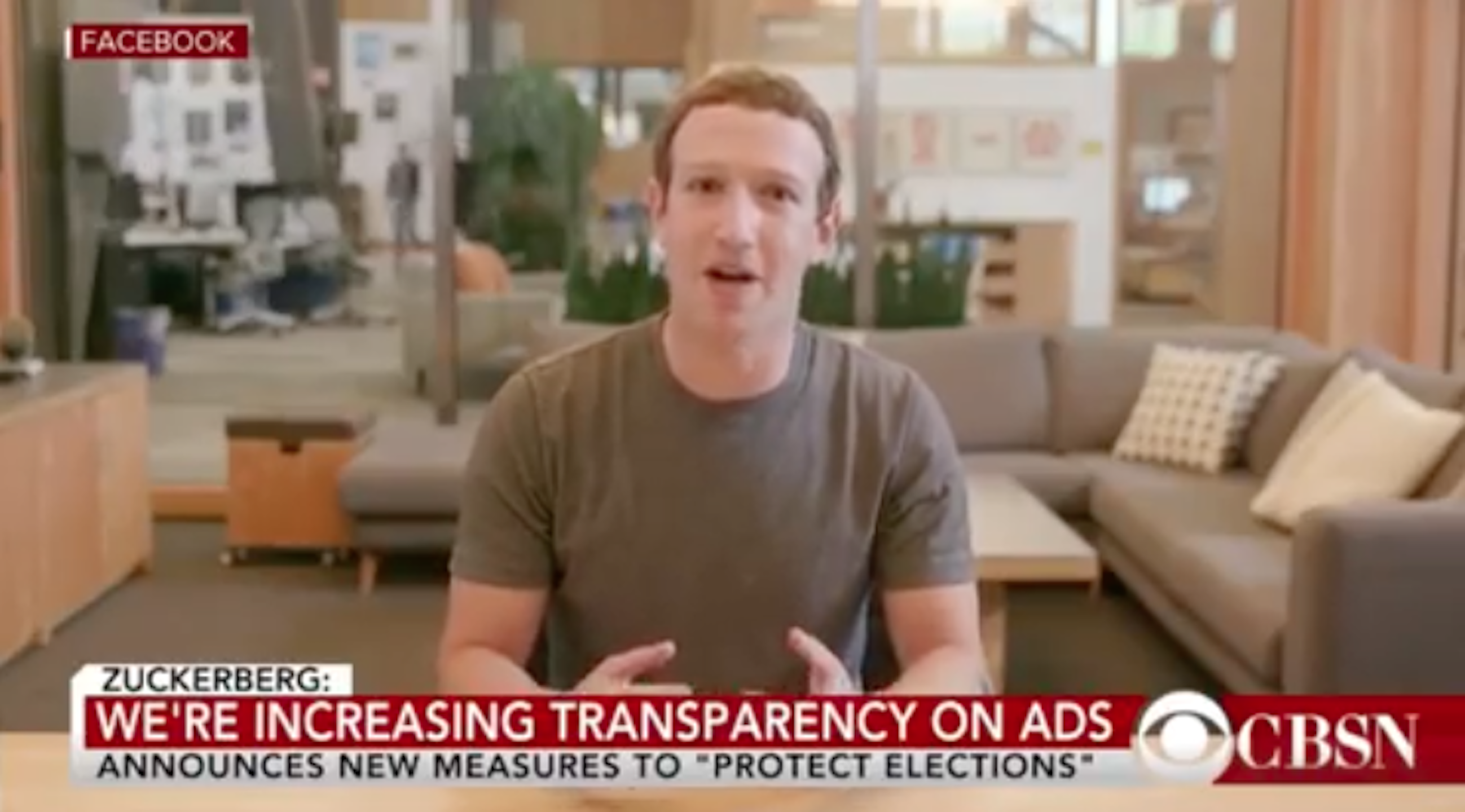
Two artists and an advertising company created a deepfake of Facebook founder Mark Zuckerberg saying things he never said, and uploaded it to Instagram.
The video, created by artists Bill Posters and Daniel Howe in partnership with advertising company Canny, shows Mark Zuckerberg sitting at a desk, seemingly giving a sinister speech about Facebook's power. The video is framed with broadcast chyrons that say "We're increasing transparency on ads," to make it look like it's part of a news segment.
In an instagram post with almost 3,000 views (more we suspect any minute), a fake video of Zuckerberg created using "deepfake" technology proclaims the following chilling statement:
"Imagine this for a second..."
"One man with total control of billions of people's stolen data. All their secrets, their lives, their futures. I owe it all to Spectre."
"Spectre showed me that whoever controls the data, controls the future."
The video was first spotted by Vice, was posted by an Instagram account known as @bill_posters_uk. The original, real video is from a September 2017 address Zuckerberg gave about Russian election interference on Facebook.
“We have seen this rapid rise in deep learning technology and the question is: Is that going to keep going, or is it plateauing? What’s going to happen next?”
Artificial intelligence is fueling the next phase of misinformation. The new type of synthetic media known as deepfakes poses major challenges for newsrooms when it comes to verification.
We at The Wall Street Journal are taking this threat seriously and have launched an internal deepfakes task force led by the Ethics & Standards and the Research & Development teams. This group, the WSJ Media Forensics Committee, is comprised of video, photo, visuals, research, platform, and news editors who have been trained in deepfake detection. Beyond this core effort, we’re hosting training seminars with reporters, developing newsroom guides, and collaborating with academic institutions such as Cornell Tech to identify ways technology can be used to combat this problem.
“Raising awareness in the newsroom about the latest technology is critical,” said Christine Glancey, a deputy editor on the Ethics & Standards team who spearheaded the forensics committee. “We don’t know where future deepfakes might surface so we want all eyes watching out for disinformation.”
Here’s an overview for journalists of the insights we’ve gained and the practices we’re using around deepfakes.
How are most deepfakes created?
The production of most deepfakes is based on a machine learning technique called “generative adversarial networks,” or GANs. This approach can be used by forgers to swap the faces of two people — for example, those of a politician and an actor. The algorithm looks for instances where both individuals showcase similar expressions and facial positioning. In the background, artificial intelligence algorithms are looking for the best match to juxtapose both faces.
Because research about GANs and other approaches to machine learning is publicly available, the ability to generate deepfakes is spreading. Open source software already enables anyone with some technical knowledge and a powerful-enough graphics card to create a deepfake.
Some academic institutions such as New York University are taking unique approaches to media literacy. One class at the Interactive Telecommunications Program (ITP) at NYU Tisch — “Faking the News” — exposes students to the dangers of deepfakes by teaching them how to forge content using AI techniques. “Studying this technology helps us not only understand the potential implications but also the limitations,” said Chloe Marten, a product manager at Dow Jones and master’s candidate who enrolled in the NYU class.
I took a crack at making one back when the first tools were uploaded to mega.nz and posted at reddit, but I quickly decided it was not worth my effort. Training a data set and everything was just way too much work, and I assumed that the methods would become much easier as time went on.
Around that same time I managed to get another machine learning project up and running, namely DeepDream. The reason that I wanted to be able to generate the images myself was that all of the versions online were using the same dataset, and I wanted to get it working with the MIT Places set for more impressive architectural effects. Still, a lot of work for something that would eventually be as simple as tapping on an app.
Indeed, but I have to ask, why are all these people so interested in convincing us that nothing we see is real? These are presumably the same people who subscribe to a 'simulation' cosmology.
And while we spoke of many things, fools and kings
This he said to me
"The greatest thing
You'll ever learn
Is just to love
And be loved
In return"
“The purpose of studying economics is not to acquire a set of ready-made answers to economic questions, but to learn how to avoid being deceived by economists.” ― Joan Robinson
The company behind ‘Fortnite’ just made it shockingly easy to create lifelike people
...
Epic is sharing its latest breakthrough on its engine with a feature called MetaHumans. MetaHumans are highly convincing, completely digital people. The twist? While high-end digital characters can require a month or more to create, an artist using MetaHumans can construct them in mere minutes.
n the video above, you can see just how convincing the MetaHumans look. Their skin ranges from porcelain to freckled to wrinkled, sun-weathered leather. When they speak, their lips don’t appear to pop out from the model (as so many artificially generated faces do) but are clearly connected to the skin and muscles through the entire face. And each individual figure simply looks splendid regardless of where it falls on the spectrum of gender or race—an equal amount of attention has been paid to any type of protagonist you’re looking to create. In fact, a spokesperson tells us that Epic is able to generate such a diversity of faces because it’s actually scanned people’s faces from around the world, integrating the data (blended and anonymously) into this tool.
An Epic spokesperson tells me that they expect MetaHumans will be quite popular for games, but also for creating virtual influencers on platforms such as Instagram, and for augmented reality experiments (the system is comparable with Apple’s ARKit). But they don’t claim MetaHumans are good enough for live-action films yet.
Larger picture, it’s clear that easily created, convincing people are only getting easier to produce with less technical skill. Whether it’s the face-swapping video editing technology of deepfakes or the portrait generating website This Person Does Not Exist, or now MetaHumans, these tools are only becoming more commonplace every day. We truly live amid a war on what’s real.
Video games, fighting the war against what's real since nineteen-seventy something.
Both his words and manner of speech seemed at first totally unfamiliar to me, and yet somehow they stirred memories - as an actor might be stirred by the forgotten lines of some role he had played far away and long ago.
“The purpose of studying economics is not to acquire a set of ready-made answers to economic questions, but to learn how to avoid being deceived by economists.” ― Joan Robinson
As we observed, particularly over the last ~2yrs, reality is increasingly subjective, to be edited and revised on your screen to suit your (conditioned) leanings and preferences.
Reface, a viral face-swap app from Ukraine, adds anti-war push notifications
Reface, an a16z-backed synthetic media app that’s developed out of Ukraine, has added push notifications informing its ~200 million-strong global user-base about Russia’s invasion of the country — urging people to #StandWithUkraine, including by watermarking face-swapped videos created with the app.
All videos created in the app are now being watermarked with the Ukrainian flag and the #StandWithUkraine hashtag.
On first opening the app after this update, it also displays an image of civilians sheltering in Kyiv, with a caption that describes the picture as “evidence” of Russia attacking Ukraine.
CLIP guided diffusion models are nearing fake news quality. These images were generated from the prompt "#BREAKING: Massive explosion reported over Kharkiv, Ukraine."
CLIP however doesn't know the specifics of military hardware, nor is able to put the pieces together coherently. These were generated from "abandoned Russian 9K33 OSA surface-to-air missile by the road in Ukraine in winter." Incoherent things like explosions are much easier.
AI-synthesized faces are indistinguishable from real faces and more trustworthy
Abstract
Artificial intelligence (AI)–synthesized text, audio, image, and video are being weaponized for the purposes of nonconsensual intimate imagery, financial fraud, and disinformation campaigns. Our evaluation of the photorealism of AI-synthesized faces indicates that synthesis engines have passed through the uncanny valley and are capable of creating faces that are indistinguishable—and more trustworthy—than real faces.